Those are my principles, and if you don’t like them … well, I have others.
—Groucho Marx
True Work is that which occupies the mind and the heart, as well as the hands. It has a beginning and an ending. It is the overcoming of difficulties one thinks important for the sake of results one thinks valuable.
Jacques Barzun
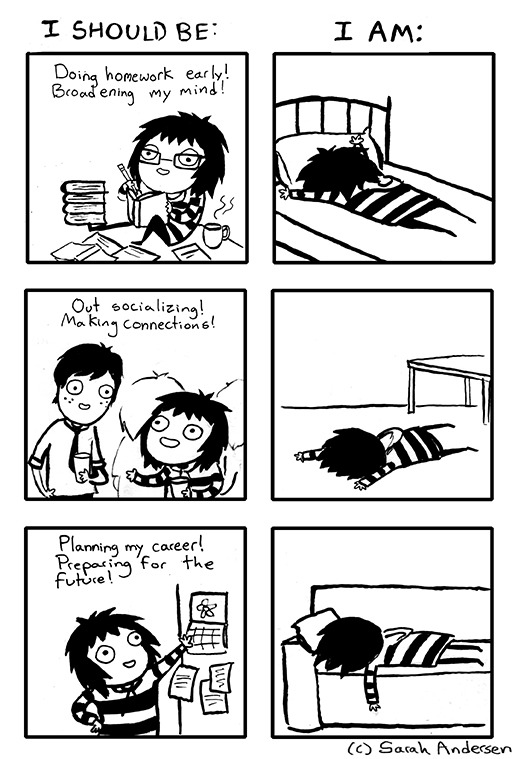
I Should Be / I Am
#
I also find it sad that because his book is filled with a whole bunch of nonsense, that’s why it’s a bestseller; that’s why we’re talking. Because that’s how you get on the bestseller list. You promise the moon and stars, you say everything you heard before was wrong, and you blame everything on one thing. You get a scapegoat; it’s classic. Atkins made a fortune with that formula. We’ve got Rob Lustig saying it’s all fructose; we’ve got T. Colin Campbell [author of The China Study, a formerly bestselling book] saying it’s all animal food; we now have Perlmutter saying it’s all grain. There’s either a scapegoat or a silver bullet in almost every bestselling diet book.
Unforeseen things will occur and you will inevitably deviate from your plan, this is organic, and it is a good thing. It is what keeps the game interesting.
I once heard a writer say that the only punctuation mark that we ever need is a period.
When to give up on a book you're reading
#From Nancy Pearl’s Book Lust, the Rule of 50 will change your life:
Nobody is going to get any points in heaven by slogging their way through a book they aren’t enjoying but think they ought to read. I live by what I call ‘the rule of fifty,’ which acknowledges that time is short and the world of books is immense. If you’re fifty years old or younger, give every book about fifty pages before you decide to commit yourself to reading it, or give it up. If you’re over fifty, which is when time gets even shorter, subtract your age from 100. The result is the number of pages you should read before deciding.
When to give up on a book you're reading
Do not mistake coincidence for fate. Also, never ignore a coincidence. Unless you’re busy, in which case, always ignore a coincidence.
“Our whole life is an attempt to discover when our spontaneity is whimsical, sentimental irresponsibility and when it is a valid expression of our deepest desires and values.” Helen Merell Lynd
If I step back from it, then of course it’s complete nonsense. But I always think that it’s important that when you watch Doctor Who, you are completely invested in it. You’re emotional: wiping away a tear, frightened, laughing your socks off. All that stuff.
There’s a saying about fridge logic - that when you go to the fridge afterwards, you’re thinking ‘ah, that didn’t really work’. My response always to fridge logic is: who fucking cares? If you’re still thinking about it by the time you’ve got to the fridge, the show has already won.