So what does work? Here are some techniques Professor Wiseman has found in his study that are effective at helping people reach their goals:
1) Breaking goals down into small steps, then rewarding themselves when each stage has passed.
2) Telling friends about what they were trying to achieve.
3) Reminding themselves of the benefits of obtaining their goal.
4) Charting their progress.
Not that quasi-friends are entirely bad. Sociologists have shown that “weak ties” are as crucial to the flourishing of social networks as strong ones; more quasi-friends probably also means more job opportunities, and more chance of making real friends, or meeting the love of your life. Perhaps all we need is some kind of technological fix, to display a message under every chipper status update, and as a permanent subtitle on numerous television shows: “Don’t forget: this person is barely holding things together.”
That’s the most beautiful thing that I like about boxing: you can take a punch. The biggest thing about taking a punch is your ego reacts and there’s no better spiritual lesson than trying to not pay attention to your ego’s reaction. That’s what takes people out of the fight half the time. They get hit and half the reaction is your ego is saying, I cannot believe that person just lit me up, how humiliating. And what a fighter has to do and what Micky does and what these guys do, whether it’s a prison thing or a crime or a drug episode, is they kind of just go. [He mimes ducking and getting up.]
Writing lessons learned (yet again)
#I'm currently writing a final paper for my Chekhov class (which has been WONDERFUL). My teacher and I agreed that it would be a good exercise for me to dig really deep into a single story rather than try to survey a batch of stories to prove some conjecture or other. As a writer of fiction myself, I was more interested in reverse-engineering a story to see how Chekhov constructed it.
I chose a story we had not read called "On Official Business" (Garnett translation). On the surface, it's a story in which nothing happens except that people wind up as depressed and miserable as when they started. But on really picking the story apart to see how Chekhov wrote it -- the narrative techniques he uses, his deployment of imagery, sound, and repeated phrases -- well, it became a rather rich stew.
I thought, aha!, I will now be able to get this paper off my plate early and not have to worry about it late in the semester. Ha-ha! Not so! My first priority was to distribute a questionnaire to my neighborhood as part of my master's project, and the logistics of that proved surprisingly overwhelming. (As with almost all master's work, it isn't hard, it just takes lots of time.)
I started making notes per my favorite writing book, Thinking on Paper, and quickly had 8 pages. [1] Then I floundered around looking for some sort of structure that I could slot my ideas into, looking for headings that were "mutually exclusive, collectively exhaustive," but found that approach just generated more text.
At this point (last night, in fact) I decided it was time to stem the flow and remind myself of some writing truths I picked up from here and there:
- If everything's important, nothing's important. This is a staple of technical writing. I was trying to put everything I knew into this paper, all of my notes -- with the effect that the really big points were getting lost.
- Kill your darlings. Faulkner's famous piece of writing advice. In my working life, whenever I've had trouble writing an article or column that I felt strongly about, deleting the text I loved best allowed the piece to fit neatly into its allotted word count and allowed the other ideas to fall naturally into place. I'm too in love with some of the points I'm making or the language I'm using.
- Create a title, just to get started. A title creates a focus for ideas; fiction writers or poets may pick a toneword or image or piece of music that expresses the effect they're after and that helps them choose the words and images that will cluster around it. I re-read the Chekhov story again, started making more notes, and hit on the title" "Dreams and Reality in Chekhov's 'On Official Business'". It's helping me decide what to leave out, which is as important as what I put in.
- Write more than you need. As the authors of Thinking on Paper say, use the words you have to attract the words you want. You're not under any obligation to use them.
- The sooner I get the first draft done, the more fun I have. Rewriting is re-thinking, revising and editing is more fun than squeezing out that first draft. When I re-read what I wrote, new phrases, new ideas, better choices come unbidden to my head.
- It's only supposed to be a 12-page paper, for crying out loud. But, I'd decided to let the paper be as long as it wants to be. I'm enjoying spending time on this project and discovering all the clues Chekhov put into the story. However, time and energy constraints -- and the patience of my professor -- should also be respected!
The blog Stupid Motivational Tricks has really smart, tough advice on the business of academic writing. One post very cogently said that you don't write a paper, you write for an hour. Just focus on this piece or this point for an hour or so, get that done, and then move to the next.
For this morning's writing session, I want to focus on the character Lzyhin and draw together some of the criticism related to his epiphany. In other writing sessions, I want to tackle the secondary characters, Chekhov's use of imagery and sound to create a netting that holds the story together, and the circularity of the story's beginning and ending. That's all way too much to write about in a short paper, even given 8 uninterrupted hours. But I can get each piece done and, as Jonathan Mayhew points out, even a mediocre week of writing ends in getting some writing done, and that's the bottom line.
[1] I created a PDF summarizing the book -- and other bits of writing advice -- in my first class at SILS in 2006. That historical provenance out of the way, here's a link to the PDF.
Examining the unlived life
#Alex has a wonderful essay up this week on the unexamined life vs the unlived life. I recognized so much of myself in his description of his early college self. And i would say it's only been fairly recently that I've decided to bias myself towards action -- even fidgety action -- over excessive rumination. (Just look up what "brown study" means.)
I think had Alex pushed farther, he would have probably detected fear prompting the defensive thinking posture he (we) adopted. Fear of rejection, fear of not being good enough, fear of not being perfect, fear of not being loved. There are damn few Socrates in the world whose motivations are not based on fear; for the rest of us, I think we adopt that intellectual camouflage and hope for the best.
And I loved this description of one of the risks we run by overindulging our penchant for thinking over a livelier balance between thought and action:
Believing advice is the greatest help we can provide others who are suffering. It’s not. The greatest gift we can provide others who are suffering is encouragement—encouragement that draws its power from our having experienced similar sufferings that we’ve overcome ourselves.
Anyway, his post reminded me for some reason of this wonderful Alexander Theroux quote from his novel Laura Warholic:
I decided at one point in my life that I never wanted to be anything that would not allow me to be anything else I wanted to be ... I ended up being nothing that I can currently identify, which I suppose means I got my wish.
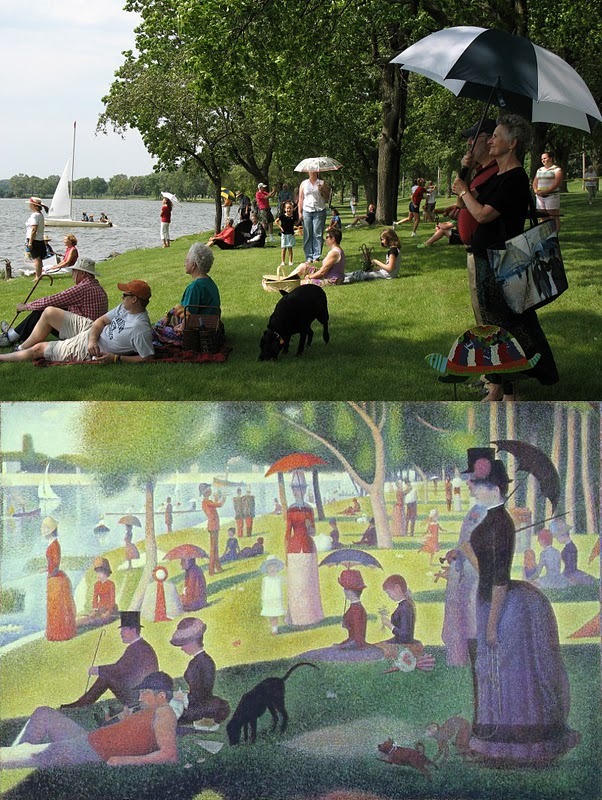
The Best Article Every day - Sunday Afternoon on the Island of La Grande Jatte
The real trick isn’t to solve the problem, it’s to find out what problem you’re already (unconsciously) trying to solve… so you can STOP.
“We see evidence for mind-wandering causing unhappiness, but no evidence for unhappiness causing mind-wandering,” Mr. Killingsworth says.
Whatever people were doing, whether it was having sex or reading or shopping, they tended to be happier if they focused on the activity instead of thinking about something else. In fact, whether and where their minds wandered was a better predictor of happiness than what they were doing.
"The enemy"
#Here’s a quote from Stephen Fry’s novel Making History, one of the few passages that struck me as admirable in that lamentably bad book.
If there is a word to describe our age, it must be Security, or to put it another way, Insecurity. From the neurotic insecurity of Freud, by the way of the insecurities of the Kaiser, the Fuhrer, Eisenhower, and Stalin, right up to the terrors of the citizens of the modern world –
THEY ARE OUT THERE
The enemy. They will break into your car, burgle your house, molest your children, consign you to hellfire, murder you for drug money, force you to face Mecca, infect your blood, outlaw your sexual preferences, erode your pension, pollute your beaches, censor your thoughts, steal your ideas, poison your air, threaten your values, use foul language on your television, destroy your security. Keep them away! Lock them out! Hide them from sight! Bury them!
(originally posted 2010-11-22, updated for micro.blog)