After I renewed my Crashplan subscription last August, they announced, bless their hearts, they were leaving the consumer space to focus on business-only plans.
The Crashplan folks have generally been derided and criticized for that, but let’s count our blessings.
They did not just pull the plug on my account so the data is unavailable. That’s happened to me with other vendors.
They are honoring my subscription, so that Crashplan is still backing up my files through August 2018.
This gives me enough time to find another online backup provider and get in a full backup before my account shuts down.
Given Crashplan’s exit from this space, many vendors are offering discounts or plans to transition Crashplan users to their new platform.
Crashplan had a functional, unlovely interface; still, it also sported a few features that other vendors did not have and it was rock-sl. So, moving to a new vendor will involve trade-offs.
My use cases for online backup are few: back up all my key documents (mainly my Documents and Photos folders), always be on in the background to upload new or changed files, and easy download or restoration of files.
Crashplan has worked in the background for the past 5 or so years. Once I set it up, I left it alone and never touched it again. I only really ever needed to recover files using Crashplan one time. But that one time was the Black Swan, the big event no one is expecting that has outsized consequences.
That event was the 2015 burglary of our house where the bad guys stole my MacBook and my wife’s laptop, among other small items.
Yes, I had a Time Machine backup … but we now had no Mac devices of any kind in the house.
I bought a Chromebook and was able to log in through Crashplan’s web interface to download and find information we needed. We were also able to download a zip file of specific files from my wife’s account to her Windows work laptop so she had her most-needed files at her fingertips.
When I bought an iMac as the new home computer, I installed Crashplan immediately and it is running to this day. I’ve never had to open it for any reason.
Based on my use pattern, this is a service I will interact with very little once I have set it up. If I need something right away, then I’ll have Time Machine (if I ever get the blamed Time Capsule working again) or a bootable backup. But I feel more comfortable knowing that, in the case of another Black Swan, I have a safety net.
Liz and I have an informal tradition of going to a local bakery/deli place for breakfast when there’s a federal holiday. It featured coffee urns in the center of the dining area where patrons could refill their cups.
As the bakery is across the street from Duke's East Campus, I'm sure people camped out at a table all day with free wi-fi for the price of a single bottomless cup of coffee.
The place just reopened after a few weeks of renovation. On ordering, we discovered that the “bottomless” cup of coffee was gone. Coffees are now refilled by the counter staff -- and refills are $1.
The coffee instantly tasted less good.
I can't say I blame the establishment for the policy change. Were I in their business, I'd probably do the same thing.
Nevertheless, we’re now looking for a new breakfast joint.
The key tool for me will be a weight-tracking chart made with pen and graph paper.
The chart format is described in the 1975 book Total Fitness in 30 Minutes a Week by Laurence E. Morehouse and Leonard Gross (long out of print). I first heard of this book through Mark Forster’s article.
The goal of the chart is to help you track losing a pound a week. This is a sustainable and non-superhuman rate of loss that should, we hope, prevent feelings of deprivation and will-power stuggles.
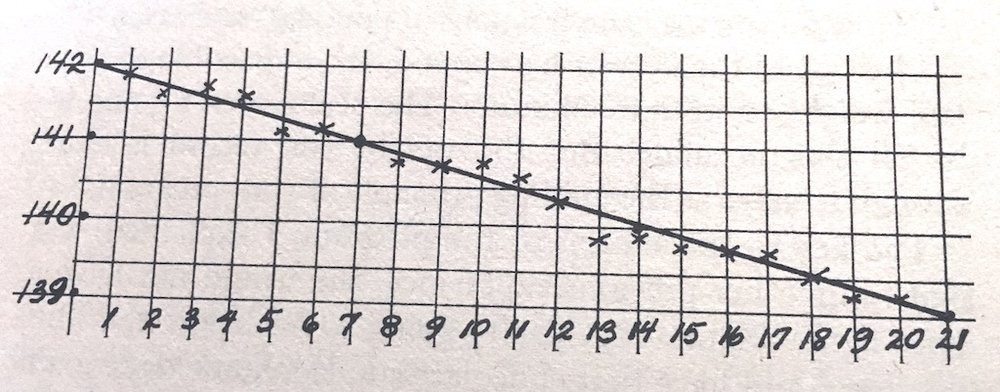
Here’s how Morehouse presents the graph in his book:
Dates run along the horizontal axis.
Weight is on the vertical axis. Each block on the graph represents a half-pound, so weight amounts are placed on every second line.
Starting from the upper left, count down two blocks and over seven. Make a dot. Continue counting down two and over seven, making a dot at each intersection, till you get to the lower right. In the image, those dots are on days 7, 14, and 21.
Use a ruler to draw a line from upper left to lower right connecting those dots.
That line determines your weight control program. My graph runs from 1/13 to 2/20, about 5 weeks. Every day I weigh myself, my weight will be above, below, or on the control line. For fractions of a pound, round up or down to the nearest half-pound.
Morehouse describes the protocol:
The objective is to always be on the control line.
If you’re below the line, eat what you want so you’re on the line tomorrow.
If you’re above the line, then reduce the food and increase physical activity so you’re on the line tomorrow. Morehouse recommends eating 200 fewer calories and burning 300 extra calories by physical activity.
By the end of the first week, you should know what foods or activity are needed to stay on or below the control line.
Morehouse makes the point that your daily weight will of course fluctuate for any number of reasons; some we can control, some we cannot. But for the purposes of this exercise, treat the weight as true and adjust accordingly. As Morehouse says,
We pay attention to the scale, particularly since it’s such a good source of motivation, but we don’t take it too seriously.
If you’re above the line for several days in a row, then it ain’t the weather; do what you need to do to bring your weight below the line. But if you're below the line, hooray! Take advantage of the fluctuation.
Keep tracking your weight in this way till you reach your target weight. In my case I’d like to be 195 lbs. So, if all goes well, I’ll get there sometime in mid-May.
There are spreadsheets out there (the Hacker’s Diet being one) that track one’s weight daily and smoothe out the fluctuations. And any app store is lousy with weight trackers.
So why use pen and paper? For one thing, I like looking at the chart and seeing how long this will take. It reminds me that sustainable weight loss is a slow process – slower than I’d like, frankly. But whenever I’ve tried to lose faster than this, I would rebound to some degree.
Making the chart involves me in the process and updating it every morning is also more active than simply typing my weight into an app. When I record the weight and note its position relative to the control line, I immediately begin planning my day’s eating and activities.
What do I do when I’m over the line? When I figure it out myself, I will post it here!
James Cary, writer of numerous UK radio and TV sitcoms and of the excellent Sitcom Geek blog and of the Kindle ebook Writing That Sitcom, is also a co-host with writer Dave Cohen of the Sitcom Geeks podcast. The man is about sitcoms.
Their podcast has just posted a two-part interview with the brilliant Graham Linehan, of Father Ted and IT Crowd fame. It’s now queued in Overcast on my iPhone and I can’t wait to listen.
I have paid for Herbalife, Diet Center (where I had to weigh in weekly and eat at least one large salad and one large apple a day), protein shakes, meal-replacement shakes, olive oil to do the Shangri-La Diet, lots of chicken breasts and veg for the South Beach Diet, lots of chicken, beans, and eggs for the Slow-Carb Diet, lots of potatoes for the Potato Hack, and a nutrition consultant, who is the only one who did me any real good – I lost 17 lbs. under her tutelage.
I have always been a fat kid and a plump adult. At one point in my 20s, I joined a gym and weighed in at about 250 lbs. I’m 6’3", so some people were kind enough to say I carried it well, but still…I knew I could look and feel better.
At my lowest, I weighed 195 lbs., but I was so stressed out by the seeming chaos of my life at the time that I could not enjoy it.
I have purchased and read over my adult life maybe 25–40 books and ebooks on diet and eating.
There is always a new twist on old thinking, new takes on old food, and new perspectives on the bizarre problem of a fat society in a starving world. I am convinced now, based on the current science and thinking, that exercise is good for the body and the metabolism, but eating is what controls your weight.
There is a great little formula I picked up from somewhere on the ’Net:
When it comes to exercise: more is better than less, faster (or more intense) is better than slower, anything is better than nothing.
When it comes to food: less is better than more, eating slower is better than eating faster, nothing is better than anything.
For the last several years, I’ve settled on a few basics:
Real food, not packaged food.
More protein, more veg and fruit, fewer simple carbs.
If I snack, snack on protein.
No calories counting or food weighing.
Skipping a meal or fasting for 20–24 hours is easier than anything else I can do.
Know thyself and thy environment. As the week wears on, I am more susceptible to binging or eating foolishly. Plan for this. If I’m at a buffet or party, plan how I will eat so I don’t overindulge.
But sometimes, I’m going to binge. Forgive myself and get back on the horse.
Less is better than more, nothing is better than anything.
I sustained a weight of 203 lbs for most of 2017, till we travelled for two weeks through Nova Scotia, Cape Breton, PEI, and Grand Pre. We ate out for most of our meals, like you do.
I weighed 207 lbs when we returned in July and I could never get below that. With the gorgings of the holiday season just past – plus all the foodstuffs given to us and to each other as gifts – my weight has not gone below 210 lbs.
I went to the Y and aerobics classes in the ’80s, used the weight machines with my gym memberships in the ’90s, bought a NordicTrack, went to yoga classes, bought my own set of dumbbells, bought a dozen exercise tapes and DVDs, and I don’t know what all.
Since about 2007 or so, I settled on using kettlebells as my primary resistance and cardio fitness tool. After sustaining a shoulder injury using them in a group class setting, I now meet with a trainer every couple of months so she can correct my form and write out custom routines. While I like classes for some things, I prefer one-on-one coaching with the kettlebells – it’s too easy to hurt myself otherwise.
I had a pretty good kbell routine last fall, but a cold and then a cough that wouldn’t go away stopped me. One of my rules is to not work out when my body is fighting illness.
My method for starting or restarting a new routine is to take it slow. The goal for my current routine is to do 5 sets of exercises with a 35 lb. kettlebell. So tonight I did 2 sets with a 25 lb. bell. Next time I’ll do 3, and so on. When I’ve done a week or two of 5 full sets with 25 lbs. using excellent form, then I’ll start the 35 lb. bell with 1 or 2 sets and work my way up again.
After a six-week layoff, re-establishing the habit and routine of exercise is more important to me than hitting a weight or rep target. Planning which evenings I’ll exercise (I prefer exercising at home after work), setting up the space, doing my warm-ups – getting back into the rhythm of all of that is crucial.
Along with this vigorous exercise, I need to go back to walking more regularly (my FitBit daily goal is 10,000 steps, which I hardly ever hit in winter) and adding some sprints once or twice a week.
I also want to get back to a regular yoga routine. I sit so much during my days while the kettlebell work shortens the muscles. So stretching those muscles and realigning my posture 2–3 times a week is important as I enter my late 50s.
On my iMac, I’ve used the Chrome browser for many many years. This was an artifact of my using a Chromebook immediately after the 2015 break-in; it served as my primary computer for quite a while. Even after I got this here iMac, Chrome remained my preferred browser since I used it on both platforms.
Over that time, I’ve tricked out Chrome with just the extensions I want and I’ve gotten used to how it works.
With the arrival of the iPad Pro, I decided to give Safari on macOS another try. I believe in shaking up my routines now and then, and I wanted to see if using Safari made a difference.
I liked the Handoff of bookmarks between the macOS and iOS, and using Safari on the iPad is a great experience for me. I may try the Chrome iOS browser but feel no great need to do so.
However, Safari and I did not hit it off on the iMac. I was able to roughly reproduce my Speedial setup using Safari bookmark folders, but it felt clumsy to me. I did not notice that Safari was any faster than Chrome.
But what I really missed were the extensions and customizations. I am very used to the bookmarklets lining my Chrome toolbar to email a link to myself, run a site search, add a bookmark to Pinboard, and many other things. I could not reproduce this easily in Safari.
But the killer extension for me on Chrome is Video Speed Controller. Since videos now rule the web, and I tend now to do my at-home tech training via video rather than reading, I like the control of speeding up, slowing down, and skipping through a video with simple keystrokes. Not just on YouTube, either, most any HTML5 video.
I could not reproduce this functionality in Safari. And I did not see the sense in running Safari for everything except video when video is ubiquitous.
So I’ve gone back to Chrome on the iMac and feel much more comfortable. Thus endeth the experiment.
The course was titled “Make A 5-Minute Documentary in 7 Weeks” but it was almost seven months before I uploaded my Teacher documentary to YouTube.
Here are some notes on the experience.
The People’s Channel
The class was held at The People’s Channel in Chapel Hill, where we learned the basics of using a Panasonic AC90 camera, recording video and sound, using an extra microphone, unpacking and packing the tripod, and so on. The class fee included an Individual Membership to TPC for a year, allowing us to check out the camera and use TPC’s iMacs for video editing.
All TPC asked in return was 1) don’t break anything and 2) the privilege of showing the documentary you made using their equipment. They include many of these short films about people and the community in their program rotations alongside their longer-form programming.
Shooting the Video
I shot all the footage in a single weekend. J. Michael Pope, the subject of the documentary, happened to be performing at a church that Sunday with one of his students. He also arranged lessons in his studio with four of his students that I filmed almost in their entirety. Plus, we did a 30-minute interview.
By the end of that weekend, I had about 8 hours of video. This is where it’s easy to intimidate yourself. How was I going to create a 5-minute video out of all that footage? Where do I even start?
Sage Advice
Local video artist and potter Jason Abide taught the class and passed along some good tips.
Just sit and watch all the footage one time through without making any notes.
The next time through, watch with a notebook. I gave each clip a name, and noted timings of when songs started or when Michael said or did something I thought illustrative of his teaching style. I also made notes on some themes I saw emerging from the footage.
Don’t overthink this. Editing is mainly about cutting things away. Plonk the bits you like best in a row, and start cutting away the stuff you don’t like.
Use jump cuts for transitions. Viewers are used to them from newscasts and television generally. You can always change the transitions later.
Final Cut Pro X
Shooting footage is easy; editing it into a product is hard. For the 7-week class, fully 5 weeks were spent coming to grips with Final Cut Pro, a struggle that lasted for months.
Despite Jason’s advice to keep it simple and just cut, “simple” and “Final Cut Pro” do not go together.
The trouble here was that, in addition to figuring out what we wanted to say with our movies, we also struggled with learning the basics of how to make Final Cut Pro X do anything. We could see in our minds’ eye what we wanted the finished product to look like, but FCPX did not make it easy for us to realize them.
Aside from the overwhelmingly busy interface, there’s also the FCPX nomenclature. I still do not know the difference between libraries, events, and projects and those are basic concepts in FCPX.
My Sad Sad Story, Boo-Hoo
I could possibly have bought FCPX for my iMac, but I did not want to pay $300 for an application I did not expect to use again.
This meant using the iMacs at TPC.
Trouble #1: they were only open till 7pm a few nights of the week, and I work first-shift. I could have rearranged my schedule but the work upheavals that drove me to take the class also compelled me to stay close to the office.
Trouble #2: the only other time TPC was open was Saturday from 10am–2pm. So I had a four-hour window once a week during which I would have to relearn how to use FCPX, reacquaint myself with my footage, and try to make some sort of visible progress.
Trouble #3: Sometimes TPC would be closed on Saturday! After the second time this happened, I sent myself an automated reminder every Friday to call TPC and check their Saturday schedule. This saved me wasted trips a couple of times.
So my hands-on time with the footage was limited and there would be some occasions, such as when we went on vacation, where I’d be gone for weeks at a time. Whatever momentum I’d built up would be long gone. Hence the months needed for editing.
Lessons Learned
As Jason advised, don’t try to learn everything about FCPX. Search Google for “FCPX 10.3” (include the version number you’re using) to find specific help as you need it. Then write it down in a notebook so you find it faster next time!
That said, search on “FCPX cheatsheet” or “FCPX keyboard shortcuts” and bookmark or print the more helpful items. Jason encouraged us to learn and use basic keyboard shortcuts we’d use 98 percent of the time: start, stop, reverse, forward, zoom in to the timeline, etc.
I found a few excellent Lynda.com FCP tutorial videos that I returned to often. On Saturdays, I’d start my work session by looking at the tutorials to review and remind myself of the technique or method I would use that day.[1]
Dedicate a notebook to the project and use it to collect your notes on timings, themes, learnings, etc. I noted FCP key shortcuts in the back of my pocket Moleskine.
I spent weeks simply reviewing the footage, and marking and organizing sections of clips for both the interview and the b-roll (or secondary) footage. This made compiling the first half of the video go more swiftly than I expected.
As the video took shape, I’d start each work session by watching it through twice, noting any nips and tucks that were needed, deciding on the next steps, etc.
I treated Michael’s interview as if it were recorded for radio. I edited, trimmed, and clipped silences, hesitations, etc. so it sounded tight. I knew I could cover the awkward jump cuts with my b-roll footage illustrating whatever he was talking about.
As Faulkner said, “Kill your darlings.” When I got rid of the bits that I really loved, the story fell into place.
I saw the movie in layers. Get the interview foundation solid, then add b-roll on top of that to add visual interest and variety, then play with the audio so the music or interview would fade in and out, then add the titles and credits. And then, sit and watch it over and over to tweak as needed till it looked smooth, to my eye.
Near the end, I thought I needed three full 8-hour days to finish the thing. But by working on it a little at a time, I discovered to my surprise that I was done after only two Saturday sessions. I was stunned at how quietly it came together.
I learned yet again that I can start from a place of zero knowledge and create something. I just have to keep showing up and doing the work.
Some creative decisions are ones of necessity, but they can still be really good decisions.
Some ideas come to you when you’re looking in the other direction. While I was making the bed one day, it occurred to me to end the movie with Pope saying “Excellent!” at the end of Ron’s solo. You hear him say it throughout the movie, so it’s natural and unforced.
When I hit on ending the video with Pope exclaiming “Excellent!”, I thought of it as simply a nice button so we wouldn’t go out on a blank screen. He says this often during a lesson and it’s so expressive of his personality as a teacher. I didn’t realize till later that it could be interpreted on other levels: that he was proclaiming the movie as “Excellent!”, and that he was also saying it to the viewer who just sat through a mini-lesson with him.
Be ready for that moment when a big project that has occupied your mindspace for months is now done. Because it will leave a vast echoing space behind and the question, “What next?” Have something waiting.
Unfortunately, Lynda.com removed the best documentary-based FCP course, one that followed a producer making a news piece on enticing CEOs to consider U.S. veterans for jobs. I wish I had noted the producer’s name, because she had lots of great tips and advice that saved me loads of time. Alas, gone without trace. ↩
I did not start drinking coffee till my mid to late 20s at my first job. My bad nightowl habits, along with the early days of David Letterman’s late night show, meant I was usually sleepy the next day.
My doctor recommended drinking one cup of coffee in the morning and one after lunch to wake me up. “Treat it like a drug,” he said. “Not as a beverage or a dessert.”
That advice lasted for a little while, bless him. It was not long before coffee became my go-to drink of choice.
Herbal teas I never quite got the hang of; too fruity, most of them. And Earl Grey and the other black teas were not that tasty to me, either.
But coffee, that usually hit the spot. Except at night. I could drink decaf in the evening, sure, but even so – I was always a little suspicious that it had a little caffeine in it.
Several years ago, I read some blogger trying to wean himself off caffeine. He touted a product called Teeccino, an "herbal coffee" beverage he was using a coffee-substitute.
The local Whole Foods carried it and I tried it. It has since become one of my favorite hot evening beverages, along with peppermint or ginger teas (my tastes have expanded, thank you).
Teeccino is made from a blend of chicory, dates, figs, etc. and is totally herbal without caffeine. What I like about Teeccino is that it’s thicker and more flavorful than the usual herbal teas; you brew it, rather like you brew a cup of coffee. I rotate among my preferred favors of Hazelnut, Mocha, and Java. With a splash of half-and-half and a bit of sugar, a cup of Teeccino strikes a very comforting note for me, especially in these dark winter months.
The only trouble with Teeccino is that it’s finely ground, and our tea ball’s mesh did not keep the grounds out of the drink. I’d tried using a gold filter cone, which worked OK but only OK; the water took a while to seep through and the cone was a mess to clean out.
What has taken my Teeccino experience to the next level is a wonderful Christmas gift from Liz: a Finum brewing basket.
The basket sits in the cup, the cover keeps the beverage hot as it steeps, hardly any grounds or sludge seep out into the cup, and cleanup is a breeze.
Teeccino and the Finum brewing basket: Highly Recommended.
Sorry for the horrible "diarizing" in the title, but the word fits for now.
In addition to this blog, on which I'm aiming to make a daily post of some kind, I'm also recording the days in the fifth year of a 5-year diary (many, many gaps of white space in previous years), and am playing with the 1-Second Everyday video app on my iPhone.
Each medium contains a different message, as it were. The blog is the stuff I clean up and show to people, the diary holds some minutiae of the day (weather, errands done, people met, movies seen), and the video app records a blink of visual time. Two days ago, I shot a second of our still fully lit and decorated Christmas tree from my chair in the living room. Today, I shot a second of the bare tree lying on our snowy curb.
Each medium forces me to think a bit differently about what is worth remembering. They are all, in some way, about paying attention. I wonder what I will see.