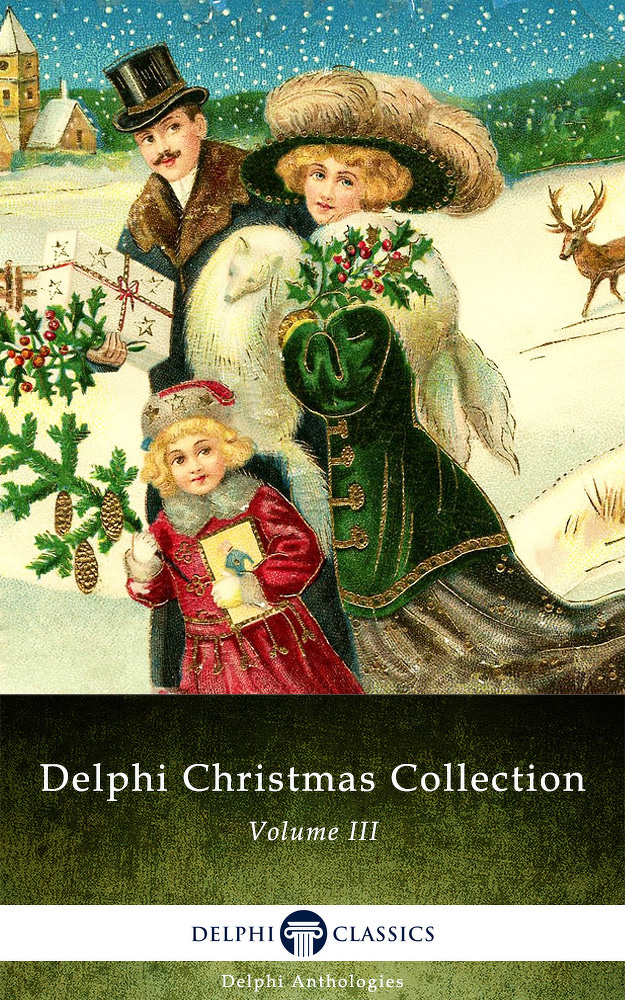
Delphi Christmas Collection, Volume III 📚
#I have all three of the collections, but Volume III 📚 is the first I (mostly) read most of. I read this ebook mainly because my backlit Kindle provided the only readable light in our Airbnb. I also felt a grim duty to sample these literary Christmas offerings of the ages and see what if any Christmas spirit they would move in me.
As with all Delphi’s ebooks, these are public domain texts, mostly clean of scanning errors but with a few stories indifferently proofed from the scans. The ebook contains 18 pieces on Christmas themes or that have Christmas as a setting, arranged roughly chronologically and covering a wide range of authors – from the Victorians to a pair of anodyne holiday quatrains by H.P. Lovecraft (!). Alas, the quality range is narrower and, even within that tighter band, wildly variable.
The ebook’s main novelty for me was its collection of curiosities: an overwritten paean to the Pilgrims by Harriet Beecher Stowe (“The First Christmas of New England”) and a group effort (“Message from the Sea”) from 1860 by Charles Dickens and five other writers; the latter is near-interminable in its coincidences, melodramatic situations, over the top stagey characters, and annoyingly verbose omniscient voice. As this group effort is the first story in the collection, one learns from it the valuable art of skimming that will get one through the rest of the book. (Does a novella have five parts? Start at part four.)
Among the standout stories for me: Beatrix Potter’s famous “The Tailor of Gloucester.” Anthony Trollope’s “Christmas Day at Kirkby Cottage” is a smoothly written Christmas trifle of young lovers and misunderstandings, and M.E. Braddon’s “The Christmas Hirelings” is pure sentimental Victorian treacle and all the better for it. Edgar Wallace contributes two smartly done pulp stories, while M.R. James takes the book’s quality prize with two of his unsettling ghost stories, “Lost Hearts” and “The Story of a Disappearance and an Appearance.”
The oddest, most provocative story was Bret Harte’s “The Haunted Man,” subtitled
A CHRISTMAS STORY.
BY CH — R — S D — CK — NS.
In it, a “Haunted Man” is plagued by a Ghost of Christmas Past and is mightily unimpressed by the spirit’s theatrics. The story’s voice and dialog viciously satirize Dickens’ style and his well-known tale:
Again the Goblin flew away with the unfortunate man, and from a strange roaring below them he judged they were above the ocean. A ship hove in sight, and the Goblin stayed its flight. “Look,” he said, squeezing his companion’s arm.
The Haunted Man yawned. “Don’t you think, Charles, you’re rather running this thing into the ground? Of course it’s very moral and instructive, and all that. But ain’t there a little too much pantomime about it? Come now!”
Harte’s “The Haunted Man” and Ambrose Bierce’s cynical “Christmas and the New Year” splash ice water into the face of readers wanting Christmas cheer and comfort. They were bracing antidotes to the other stocking stuffers.