Review: Two books on Bar Harbor, ME
#Finished reading: Lost Bar Harbor by G. W. Helfrich and Gladys O’Neil, The Great Fire of 1947 and the End of Bar Harbor’s Golden Era by Mac Smith. 📚 Purchased at Sherman’s Book & Stationery.
During our stay at the wonderful Sand Bar Cottage B&B, our host recommended these books if I wanted to learn more of Bar Harbor history.
Of the two, Lost Bar Harbor is the most evocative. An oversized paperback with large archival black and white photos of the hotels and “cottages” (mansions, really) that filled Bar Harbor when it was society’s summer resort from the Gilded Age through the 1920s. High society fell in love with Bar Harbor and Bar Harbor with its rich and famous summer residents.
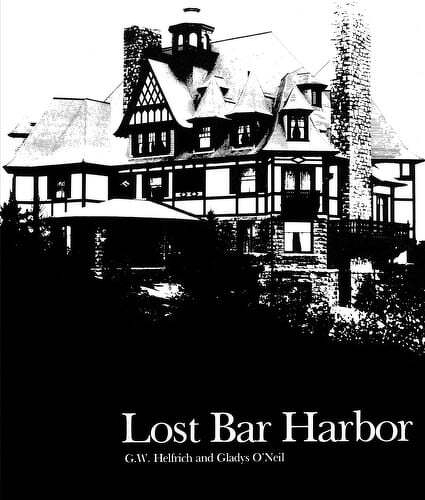
Helfrich and O’Neil’s introduction paints a picture of American financial royalty and its culture in the remote New England coastal village their money remade: “There were dances at the hotels every night during August, receptions and dinners at the cottages, parties on board the yachts, picnics, sailing parties, garden parties, and concerts, and always good conversation – the best, according to Barrett Wendell of Harvard, to be found anywhere in America.” The town was almost giddy with the arrival of their rich summer residents. A cottage social directory was published each summer noting all the upper-class comings and goings.
The book’s archival photos are antique and reproduce a bit muddy, but the size and scope of the buildings they document are nevertheless impressive. Brief squibs accompanying the photos provide a biography of the place, its owners, and its architects. Only one entry includes pictures of a cottage’s interior, and I found those pictures to be the most evocative for expressing the town’s own Belle Époque.
But many of the entries end with the same, rather poignant final words: “torn down,” “demolished,” “razed,” “destroyed,” and – most commonly – “burned in the 1947 fire.”
The Great Fire of 1947 swept Mount Desert island and nearly engulfed Bar Harbor. The fire struck during a year of severe drought, a summer of intense heat, and violent winds that made fighting the fire both dangerous and nearly impossible to outwit. The fire ravaged the island, destroyed all the grand hotels, and many of the cottages.
But both books are clear that, even long before the fire, the area’s days as a resort getaway were over. Helfrich and O’Neil: “It is popularly believed that the Great Fire of 1947 finished off Bar Harbor as a resort. But the fire was for many a blessing in disguise. Although a third of the 222 cottages burned, many were already empty or for sale. Bar Harbor had tottered through the depression and World War II, and the 1947 Cottage Directory reveals that only 135 cottages were occupied that summer. By this time, Bar Harbor was already ’lost,’ although a few relicts of happier days were to linger on …”
You can still see traces of the old hotels and cottages here and there in Bar Harbor: concrete steps leading to nowhere, stone pillars flanking a disappeared driveway. Our host pointed out that, before the fire, the hotels and cottages lined the main road leading to the Bar Harbor turnoff, leaving the little town itself to be a village of small houses near the water with a commercial block of stores and buildings. But after the fire, commerce moved down that small road to the harbor. Today, that little village is bustling, bungalow prices are sky-high, and one business owner told us he lives 45 minutes away because he can’t afford to live in Bar Harbor.
Smith’s book on the 1947 fire has no pictures or – more relevantly – maps to help orient the reader, but his account is the authority on the conditions that led to the fire, speculations on how and where the fire started, and an almost daily account of how firefighters, military, volunteers, and communities came together to save as many lives and properties as they could.
The Great Fire of 1947 is helped along by Smith’s use of previous oral histories of the fire, interviews, and other documents that provide color and personality to the telling. The result, while informative, is a tough reading experience. When I say this book is “authoritative,” I mean that any forward movement of the story is stopped by large lumps of data that no casual reader could possibly be interested in but that future students of the fire may well find useful. If you want to know the names of all the committee members who served on the reconstruction finance committee following the fire, this is your book.