Snowscapes -- day and night
#Durham NC got about 8-11 inches of snow today. Here’s a shot from our backyard (taken by Liz) this afternoon and from our front porch this evening.
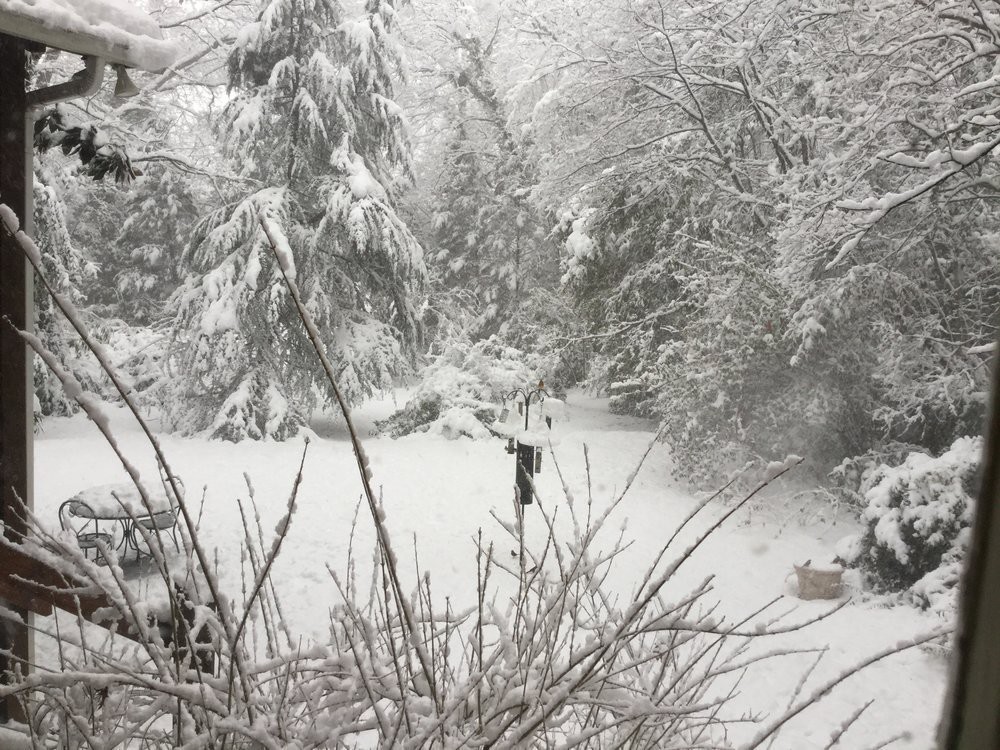

Durham NC got about 8-11 inches of snow today. Here’s a shot from our backyard (taken by Liz) this afternoon and from our front porch this evening.
The key tool for me will be a weight-tracking chart made with pen and graph paper.
The chart format is described in the 1975 book Total Fitness in 30 Minutes a Week by Laurence E. Morehouse and Leonard Gross (long out of print). I first heard of this book through Mark Forster’s article.
The goal of the chart is to help you track losing a pound a week. This is a sustainable and non-superhuman rate of loss that should, we hope, prevent feelings of deprivation and will-power stuggles.
Here’s how Morehouse presents the graph in his book:
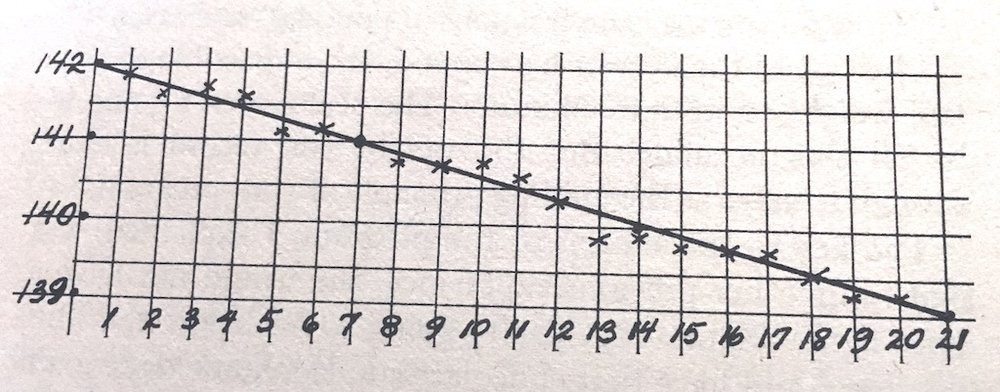
That line determines your weight control program. My graph runs from 1/13 to 2/20, about 5 weeks. Every day I weigh myself, my weight will be above, below, or on the control line. For fractions of a pound, round up or down to the nearest half-pound.
Morehouse describes the protocol:
Morehouse makes the point that your daily weight will of course fluctuate for any number of reasons; some we can control, some we cannot. But for the purposes of this exercise, treat the weight as true and adjust accordingly. As Morehouse says,
We pay attention to the scale, particularly since it’s such a good source of motivation, but we don’t take it too seriously.
If you’re above the line for several days in a row, then it ain’t the weather; do what you need to do to bring your weight below the line. But if you're below the line, hooray! Take advantage of the fluctuation.
Keep tracking your weight in this way till you reach your target weight. In my case I’d like to be 195 lbs. So, if all goes well, I’ll get there sometime in mid-May.
There are spreadsheets out there (the Hacker’s Diet being one) that track one’s weight daily and smoothe out the fluctuations. And any app store is lousy with weight trackers.
So why use pen and paper? For one thing, I like looking at the chart and seeing how long this will take. It reminds me that sustainable weight loss is a slow process – slower than I’d like, frankly. But whenever I’ve tried to lose faster than this, I would rebound to some degree.
Making the chart involves me in the process and updating it every morning is also more active than simply typing my weight into an app. When I record the weight and note its position relative to the control line, I immediately begin planning my day’s eating and activities.
What do I do when I’m over the line? When I figure it out myself, I will post it here!
In all the year-end roundups on the various blogs, I enjoyed David Cain's 16 things I know are true but haven’t quite learned yet. I already knew and practice #2 but several, like #s 1, 3, and 6 -- I still struggle with those. (But substitute MacBook for smartphone.) It made me think of a few things I know that I am still learning are true for me.
I work for a government contractor, and we were sent home at 11:30am on Tuesday, Oct. 1. The company (rather generously, believe it or not) covered everyone’s hours that week. This week, we’re taking mandatory vacation. No indication yet what next week’s plan is.
I’ve not been that disturbed. Oh, I’ll pay for this time off, no question. I will wind up owing the company hours or days, or I won’t have any vacation pay over Christmas. But for now, I am quite simply enjoying my time. I also know that this is a temporary problem, unlike being unemployed (which I have endured). I have the feeling I’ll be back at work soon enough.
(On a related note: I avoid much of the news surrounding the shutdown. I can’t do anything about the situation, apart from write to my representatives, which I did. So I’m letting them handle it while I get on with my life.)
Last week, I focused on creating a set of emails for the neighborhood association’s upcoming community meeting. I devised a set of twice-weekly emails, wrote them all, sequenced them, and then set up email reminders for myself. My system will remind me when it’s time to post an email to the neighborhood listserv and then I’ll take care of it. It took way longer to do that than I thought it would, mainly because I was procrastinating on writing 8-10 emails. But once I got started, I was able to push through and get them done.
Which then left the problem of what to do with acres of unscheduled time. Is that a problem? It doesn’t have to be. But I’ve discovered over the years that if I don’t have a project or some structure to my day, I do go to pot pretty quickly.
This would be a golden time to update my LinkedIn profile. I could also call that entrepreneurial non-profit and set up an appointment to talk to them about starting their program. Right now, all my eggs are in one employer’s basket; it might be better for me to start my own endeavor that puts me more in control. I’ve written the email to the non-profit, but I’ve not sent it yet. I don’t know why.
I have a creative project I had set aside so I could focus on the neighborhood project; I’m trying to not chase two rabbits anymore. I’ve been ramping up the research and writing on that project. I find the mornings are the best time for me to write and edit, or sometimes later in the evening. Afternoons are for housekeeping, laundry, desk cleaning, reading, and, if possible, a 20-minute nap at 2 or 3 pm.
I also charged through a few motivational books by the coach Steve Chandler on my Kindle. I’ll probably write them up here sometime. I’m reading a third book of his to see if the same themes recur.
I’ve also taken the opportunity to meet friends and acquaintances for coffee, without feeling the need to hustle back to the office. Running errands has also been less stressful. I do like to leave the house at least once a day, even if it’s just to put gas in the car, otherwise I get cabin fever.
The weather lately has been cool, due to Tropical Storm Karen, so I set up my office on our screened-in back porch. It was lovely. Whenever my eyes or shoulders got tired, I could set the MacBook or Kindle aside and look out at the trees and the bird-feeders and just relax. It’s so odd to have so much less thinking going on in my mind. The job takes the best hours of one’s day, and the days are filled with a thousand decisions related to problem-solving, writing emails, deciding where to go for lunch, returning phone calls, etc. With less on my plate, with fewer problems to solve, there’s subsequently less on my mind and my god is it peaceful.
Tomorrow is my banjo lesson in the morning. I will shop at the grocery after to get the food I’ll make for supper tomorrow night. And I’ll have time to write, read, have a nap. It’s not like floating down the Mississippi on a raft, but for me, it’s pretty good.
Updated on 2026-01-10
Up early and walked down to Patti's house, where we carpooled to the Creative Entrepreneur Expo 2013, sponsored by the Durham Arts Council. When I first saw the email advertising this half-day workshop, I thought, "No. I'm not a 'creative,' and I am not selling any services to creatives. So there." But then Patti forwarded it to the neighborhood listserv. And then Liz reforwarded it to me. At this point, the knocking on my door is getting so loud I can't ignore it any more. So I arranged with Patti that we would buddy-up and attend together. My intention was to have no goals or objectives about the day; I just wanted to expose myself to what was going on and see if anything resonated with me.
I have a coffee while we examine our materials and a young woman, Heather, walks up, introduces herself, and asks what our businesses are. Patti explains her business and I say, rather smugly, "I'm just exploring today. Just want to see what's out there and what's going on." She nods. Heather tells us about her business, which helps artists grow and manage their businesses.
Several memories and ideas bubble to the top of my brain and collide: this is an opportunity to try out ideas in a non-judgmental space, what can it hurt to put myself out there a little, follow the energy, one of Mike Uhl's early urgings to me to become a time management coach, since he'd benefited from our frequent conversations about his workflows and habits at the office, if the next thing I say isn't interesting then I can tweak it for the next person, oh come on what could it hurt.
So I tell Heather that, well, if I were to sell a service, it would probably be something like this (dredging up the old marketing template of "I help X do Y so that they can Z"): "I help artists and creative entrepreneurs solve their time management problems so they can get more of their creative work done." Her eyes widened, she smiled, she leaned forward -- I'm on to something! I mention it again later to an artist who we talk to; she's immediately enthusiastic and suggests a few venues where I could hold small roundtable discussions on the topic with artists.
Met a few of the vendors and talked to one fellow who's part of a non-profit that helps veterans get their own businesses started. I rattle off my spiel to him. He nods his head, leans forward, says I could register as a government contractor to teach stuff like that.
We go in to the keynote and receive some fabulous information on Durham's "Creative Vitality Index": in short, compared to the rest of the state, similar cities of our size in the Southeast, and the US, Durham is incredibly energetic and vibrant as more artists settle here and more revenue is generated from arts and culture activities. I don't know how they gather their data. I note that technical writers count as a creative jobs category and the numbers of technical writers in this area have decreased markedly since 2006, which confirms my observations.
I heard one of the vendors say that way more people showed up than they expected, and the second-floor theater was indeed packed. The keynote speakers were entrepreneurial gurus who have started their own organizations and teach at Duke. Their aim appeared to be to introduce common business concepts and jargon to the artists, with their core message being that with the decline of traditional industries and revenue in this geographic area, the arts and culture are taking up the slack by bringing in increasing levels of revenue; therefore, more opportunities may arise for profit/non-profit collaborations.
It wasn't the first time that day that we would hear about how artists need to manage their work as a business. Fred Hathaway of Entredot gave a presentation on the basics of business, with the (to me) comforting idea that there is a method here and no one needs to create a business plan from the start. He echoed the keynote speakers' advice to stage lots of small experiments, fail quickly, and iterate often. Plan while doing and do while planning.
For me, the star presenter was Tivi Jones of Tivi Jones Media, who gave a great talk on creating a marketing plan. She called on people at random and asked me, "Sir, what is your business?" I cheerily waved my hands and said, "I don't have a business. I'm just observing." She moved on to someone else and I was instantly besieged by thoughts: Why did you do that? This is the perfect place to try out the pitch. The energy in the room is great. You're never going to get a better opportunity than now. Just do it.
So after she posed the next question on her worksheet -- What problem does your product or service solve? -- I raised my hand and said I'd changed my mind. I said something like, "I help artists and creative entrepreneurs figure out custom time management solutions so they can end their days feeling more productive rather than tired." (In talking with Mike about elevator speeches, we'd noticed that the most memorable ones included a built-in duality or contrast.)
Even before I finished my pitch, Tivi sort of yelped and said, "I need this!" The woman sitting beside me asked for my contact information. A man asked me later for a card (I didn't have one! I was only going to explore!).
And oh, my brain is buzzing.
I'd already decided to take the rest of the day off from work. I check out a book from the library. I go by Parks & Rec to pick up free tabloids and giveaways for our Sunday neighborhood association meeting.
It's now 2pm and I've not had lunch. I grab a hotdog and eat it in the parking lot with my windows down. A woman in scrubs asks me to help her get a traffic safety cone unwedged from under her car. Why the hell did she run over the cone in the first place? Nonetheless, I crawl around on the pavement and somehow wrestle it out.
I go home, prune some tree limbs, and cut the grass, since light rain is being forecast every day for the next week and I hate cutting wet grass. I shower and nap.
Liz comes home and we go to a new restaurant for us, Dain's Place, which has awesome hamburgers. I debrief Liz about my day and show her the stack of papers, business cards, leaflets, etc. that I collected.
As we walk out, we see Peggy Payne walking down Ninth Street in a cobalt blue sequin party dress and cape, handing out cards advertising her new novel, Cobalt Blue, and inviting us to a reading she's giving with her friend Carrie Jane Knowles, whose novel Lillian's Garden has also been released. (Peggy and I were both in a creative writing class taught by Lee Smith in the mid-80's.) Liz and I agree: when you're invited to the party, say "Yes."
To pass the time before the reading, we go to a near-empty Francesca's and get ice cream. Thence to the Regulator Bookshop for the reading, which is very well attended and entertaining. I also see David Halperin there; I'd last seen Peggy at the book launch for David's novel.
What a rich, bizarre day for me. I met more people today than I normally meet in a week. I made a list of at least three new people I want to take out for coffee and a door has opened for me to ... do what? I don't know. But someone was knocking, and I opened it. I did some hard physical work that also made the house look good. We went to a new restaurant on a Thursday night (!) -- very out of character for us -- and diverted ourselves to an impromptu book reading.
Thence home, where I checked my email for the second time that day and saw that there really was not a lot worth spending my time on at all.
Thence here, where I wanted to write up the events of this day before their freshness faded.
Oliver Burkeman writes about a woman who actually visits all of her Facebook friends to see if they’re really friends. She’s writing a book about the experience, of course. It’s one of those stunt ideas that will become a book whose message we will skim, we will blog and tweet about it for a week, we will stroke our chins thoughtfully, and then we will toss the book into the pile going to the library’s book sale.
Burkeman uses her story as a lens to explore the popular research on social ties, friendships offline and on-, and the idea of “decluttering” your life by letting go of the “friends” we accumulate as easily as we accumulate books, shoes, knick-knacks, and other physical clutter. How many friends can you really manage? How can you measure the quality of a friendship, either online or offline?
Burkeman writes:
“Friend clutter”, likewise, accumulates because it’s effortless to accumulate it: before the internet, the only bonds you’d retain were the ones you actively cultivated, by travel or letter-writing or phone calls, or those with the handful of people you saw every day. Friend clutter exerts a similar psychological pull. The difference … comes with the decluttering part: exercise bikes and PlayStations don’t get offended when you get rid of them. People do. So we let the clutter accumulate.
I’ve written before about the idea that electronic connections keep relationships going that, under ordinary circumstances, we would probably slough off. (Keeping in mind, of course, that sometimes I am the person who someone sloughs off.)
That said, I do have certain rules when I “friend” someone:
Were I to start a business on the side, I’d re-examine my relationship with these services. But for now, this is a picture of how I manage my online relationships.
I don’t unfriend or unfollow many people because I believe that I’m careful about who I let in to my life. I try to keep a certain number of people who I can stay in touch with fairly regularly and whose company I would enjoy. I try to have lunch or a meal or a coffee with local friends fairly regularly; it’s important to me that I see my local friends face to face. I don’t put such things on a calendar or anything; the prompt for these get-togethers is usually, “Hm, haven’t heard from X in a while. Wonder how they’re doing?”
I send distant friends birthday cards and letters a couple of times a year, sometimes longish emails, rarely longish phone calls. I and most of my friends are at stages in our lives where we’re superbusy with families, careers, etc. and so staying in touch takes conscious effort. We all know this, so once-in-a-while updates are OK with me.
I can’t remember where I got this quote, but I remember saying it at my 50th birthday party: “Whoever dies with the most friends, wins.” I said it to a roomful of friends on a warm September night who chose to spend their Saturday evening celebrating with me and it was one of the happiest moments of my adult life.
At a recent mastermind meeting, my fellow blogger Mike Uhl asked what I felt about having crossed the halfway point of writing 50 M-F blog posts. Did I feel great about accomplishing that milestone? Was I having fun doing this thing? I’ve always had a tough time with “fun.”
I was once asked years ago what I did for fun, and I really had no answer. I don’t think I’m a drudge or mechanical person, but this was a question I never thought to ask myself. There are many things I enjoy – reading, comics, museums, eating out, sitting on the back porch during a thunderstorm – but “fun” is a different type of word that suggests abandonment of self, losing oneself in an exciting activity. I’ve always thought or believed that people were referring to roller coasters or white-water rafting or some other intensely physical activity when they referred to fun. It was just something I never really noticed in myself.
(Perhaps my life has been lived minimizing pain rather than maximizing pleasure? Discuss.)
So, let’s overthink about this.
I like the idea of breaking “fun” into “fun-fun” and “serious fun.” This paper defines serious fun as “play with a purpose.”
Serious fun goes beyond the apathy of strict order and the over-excitement of chaos to generate an ordered chaos that permits freedom within structure and fun within limits.
Fun-fun has no purpose beyond itself. Which is great. We need this. For me, that can be laughing till I hurt at a Flying Karamazov Brothers show or, from my distant past, performing in a play. The most fun I ever have, I think, is talking to friends, losing myself in conversation and connection with other people. My 50th birthday party last year was one of the peaks of 2011 and I enjoyed every minute of it – the anticipation, the singing, and the remembering it later.
And while I enjoy watching a movie or TV show or most performances, I don’t call that fun-fun. My years as a theater and movie reviewer, and as someone who enjoys thinking about writing fiction, have enforced a habit of judging, balancing, guessing where the narrative or performance is going, and then evaluating its execution. It keeps direct experience at an arm’s length.
When I think about how I spend my time, I lean more toward “serious fun.” I enjoy losing myself in an activity, but I want that activity to have a result. I can happily lose myself in emptying my bookshelves and then putting all the books back in some new ordering scheme. I can rename a folder full of PDFs so they sort just as I want, and time flies. I can also easily lose myself in writing, whether it’s fiction or a blog post, and enjoy seeing what I produced.
I can’t say that I have fun-fun writing these blog posts; there’s no sense of physical abandon to the writing (more like stiffness and eyestrain).
But I have serious fun. I enjoy finding something out and sharing it on my blog. I enjoy taking an inchoate idea and surprising myself by shaping it into something like a mini-essay. I enjoy documenting the Byzantine curlicues of my baroque thought processes, though I am often dismayed at how complicated I make my life. I like documenting my little habits and routines; each post becomes a message in a bottle that I will look at years from now and go, “Huh. I forgot all about that.”
Merlin Mann had this great P.S. to a 43Folders.com blog post:
Has anyone ever figured out that 90% of the posts on this site are actually (notes|pep talks|reminders) to myself? I sometimes think not. The site definitely makes more sense once you get this.
I enjoy losing myself in the activity of writing, in creating this object. The fun at the start of the writing, which is playing with the idea and being surprised at the words it collects around itself, eventually gives way to the more serious business of making this machine work. From the first paragraph, the reader enters a contraption from which the only escape should be the last paragraph.
The crafting of that machine, the polishing and fixing – it takes focus and time. Even for short posts, I think about placement, context, wording, sentence rhythms, etc. What I hope is that, after I hit Publish, I can feel good about the time and energy I spent. The result of my efforts can be several hundred words of adamantine prose and unblockable metaphors, plus a feeling – a satisfied feeling – that my time was well-spent.
When I look at the calendar to the left of the post and see another day in bold italics – signifying a new post – I am pleased with myself for sticking to the plan.
When I peruse the finished object later in my feed reader, I hope to lose myself again in what I created – this time, as a reader.
When I scan my ideas and drafts for the next post, I start feeling that little tingle of excitement – what will I write next? What do I want to share? How long do I want it to be? What’s interesting to me today? What idea has been ripening for a while and is ready to fall?
That moment just before I decide – like the moment the curtain goes up just before the show begins – is probably the most fun moment of all.
For many years, I’ve taken shameful (or shameless) advantage of Top Shelf’s annual $3 web sale of comics and graphic novels from their catalog. Not everything is $3, of course – but a large number of selected items from their catalog are remarkably discounted, with some inventory they’ve never been able to shift cut down to $1.
I scanned the list yesterday and started filling out my mental list of stuff I wanted: Eddie Campbell’s omnibus volume of the Alec stories and a Jeffrey Brown collection, and a few others.
But I caught myself. I didn’t feel that little thrizzle I used to feel when anticipating the comics I wanted to buy. Sad to say, I felt a little hollow in there. I also felt a little sad knowing I didn’t really need any of them.
Beyond the financial calculation, I’d also computed the space, time, and interest calculations.
I think the time for profligate reading is behind me. At least for now. I feel more drive and interest in solidifying my career (as a contractor, I always work on shaky ground), spending more time with family and friends, and generally being more active. In some ways, I’m reading as much as ever, but the time I can devote to reading is shrinking and I am finding it easier to shrug off some items that I previously considered necessities.
Getting out of one’s comfort zone by trying some new behavior or activity is the modern panacea for self-improvement. I’ve certainly adopted it in the last few years by taking on leadership roles, trying new activities, and taking on bigger responsibilities – all while feeling anxious and ill-prepared. Moving out of my comfort zone by doing these new things stretched me and expanded my sense of what I could do. I’m glad I did them.
A slightly different aspect of expanding the comfort zone is not doing things that previously brought pleasure. Addicts of all stripes know that abstaining is an active struggle; it’s the struggle that moves you out of the comfort zone.
My struggle this year in deciding what comics to buy at the Top Shelf sale turned into a non-struggle. I found it sad, necessary, and surprisingly easy to set aside my desire for a yearly jolt of color and novelty. I wondered what I would replace that activity with. Which is when I started writing this post.
In the late ’90s, I decided I wanted to take piano lessons. By chance, a flyer at the Regulator Bookshop let me know about Mara Gibson, a Duke PhD student in composing, who taught piano on the side. I worked with her, I think, for about 2 years before she left Durham to finish her PhD. A few memories I have from that period:
Mara held an annual recital for her students at the back of Boyce Piano Emporium on 15-501. Her students all sat up at the front of the room, with the invited audience sitting behind us.
I didn’t realize up till then that she mostly taught kids from elementary age up through high school, with only seven or eight adult students. Mara had sequenced us so that I sat next to a junior high kid, I think, who was playing before me. He said, “That seat is for Mara’s students” and I said, yes, I know, I’m one of her students.
The younger students started by playing their recital pieces. After the last little person played their song, Mara called my name and I could hear the titters and amused murmurs from the audience as I lumbered up to the piano to announce my recital piece. You could hear them thinking, who the hell is this?
“Hi,” I said, “my name is Mike Brown and I started taking lessons with Mara about eight months ago. I’ll be playing three short pieces by Dmitry Kabalevsky. And,” I paused, looking around the room at the kids and parents, “I believe I’m the first person playing today who is over 6 feet tall.” That got a nice laugh and Liz said later it definitely broke the tension.
I think it was on the first or second piece, I burbled something and got a bit lost. So I stopped, smiled, excused myself, took a breath, and started in on it again. The pieces took less than 2 or 3 minutes to play, and it all went fine.
Many parents came up afterward to congratulate me and expressed their wonder and admiration at my performing a recital piece in front of a room full of people. I thanked them and then waved my hand at the kids – who had just done the same thing that I did. The parents seemed to think that performing was something children naturally did, whereas an adult putting himself in a position where one could fail (or succeed!) publicly was something they couldn’t conceive of doing.
Mara eventually left Duke to finish her PhD. Since 2004, she has been on the faculty of the Conservatory of Music and Dance, University of Missouri-Kansas City, and is now at Louisiana State University. She leads the life of a busy artist, academic, and mother, and I’m so happy to see her making so many big contributions to her art and her community.
Mara has also started selling some of her compositions digitally on Bandcamp. You can listen to the full pieces and then purchase and download them to your computer. It is so cool to have a Mara Gibson playlist on my iPhone.
Updated on 2026-02-25
In July 2010, I’d made the big decision to leave the PhD program. I was back working part-time at my old job, turning over the strange things I’d experienced. And feeling a bit adrift. The PhD promised a roadmap of sorts, after all, and I’d just balled up that map and thrown it out the window.
As i wondered what my next step would be, Christine Kane offered her Uplevel Your Life seminar. I can’t remember how I ran across her web site, but I had added her to my short list of RSS feeds and then signed up for her newsletter. I liked her story – she’d made herself into a singer/songwriter, then entrepreneur, then coach – and her blog posts struck me as sensible and sane bits of self-management advice.
I signed up for the course, enjoyed it, and still use some of her materials today. Christine is now launching an updated version of that seminar and as one of her alums, I’m happy to write about what I got out of her program.
Here are some of the things I remember about Christine’s course:
I enjoyed Christine’s program and I do recommend it for anyone who has questions about themselves and their lives and doesn’t know what to do first, wants to sort things out in a self-study format, at their own speed, and wants a sensible plan with an excellent guide. You’ll definitely finish the program with certain ideas and phrases floating in your mind that I guarantee you’ll access when you least expect them and most need them.
I have continued to follow Christine’s rise and rise, and here a few things I’ve noticed. I don’t think these observations should stop anyone from signing up for her workshop. This is me reading between the lines:
I think only a few rare people can improve themselves all on their own. I, for one, am someone who benefits from the coaching model: someone who will give me assignments, hold me accountable, and kick my ass when it needs kicking. Even in this self-directed, self-paced format, I think Christine Kane proves herself to be an excellent coach, and I find myself coming back to her materials often.
Updated on 2026-04-13: Christine’s blog is now offline, replaced by a standalone page since her stepping back from running large coaching programs.
I remember reading somewhere online that she has a couple of Airbnb’s in Asheville. It looks to me that, particularly after the pandemic, she probably felt burned out running her business and ready to stop feeding the machine she’d created. More power to her. It takes courage to start a business and put yourself out there in the marketplace, and it takes courage to walk away from it when you’ve had enough.