
“Our whole life is an attempt to discover when our spontaneity is whimsical, sentimental irresponsibility and when it is a valid expression of our deepest desires and values.”
Helen Merell Lynd
Terry Teachout on the Mystery of Music and Great Art
It won’t surprise me if neuroscientists eventually succeed in unlocking the mystery of music. I don’t fear that prospect, but I do have a sneaking suspicion that part of the charm of music lies in the fact that we don’t know what it means, any more than we can explain the equally mysterious charm of a plotless ballet by George Balanchine or an abstract painting by Piet Mondrian. “We dare to go into the world where there are no names for anything,” Balanchine once said to Jerome Robbins. Most of us, on the other hand, live in a prosy, commonsense world where everything has a name and most things have an explanation. That’s why it is so refreshing to enter into the presence of great art, and why the greatest works of art always contain an element of ambiguity. A masterpiece doesn’t push you around. It lets you make up your own mind about what it means —- and change it as often as you like.
Today in History
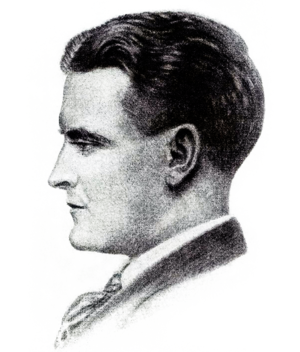
- Image via Wikipedia

Wikipedia about today. Here's what the BBC and NY Times have to say. A certain key event from 1961 is missing from all three. (But you could go read some F. Scott Fitzgerald short stories anyway or watch Jim Henson's early version of the Muppets selling Wilkins Coffee.)
It's also National! Punctuation! Day!
There are certain character traits of people (including maybe people you might know) who might have been born on the 24th.
Another numerology trick is to add up all the numbers of your birthdate till they reduce to a single number, which expresses your "qualities." So, say someone was born on this day in 1961 (as a hypothetical example), 9 + 24 + 1961 = 1994. Then add 1+9+9+4=23. Then 2+3=5. This is the Life Path number.
Here's what another page says about 5s:
You abhor routine and boring work, and you are not very good at staying with everyday tasks that must be finished on time...If you are living on the negative side of the Life Path 5, you are apt to be multitalented, but suffering from some lack of direction, and there is confusion surrounding your ambition. Restless, discontent, and impulsive, you may bounce from one job to the next without accomplishing much at all.
Watch out, 5!
In the Tarot tradition, the Major Arcana card for 5 is The Hierophant, whose keywords are education, belief systems, conforming, and group identification.
This day falls under the sign of Libra.
I wonder what else could be said about this day?
The bones beneath the skin
A few months ago, I was struck by this tweet from HiroBoga. For whatever reason, a circuit snapped in my head and I Got It. All my little productivity obsessions and systems were all about creating my own infrastructure: my calendar, my to-do list, my inbox, my habits, all of it. If I were to look at myself and my life as if it were a business, then these are the tools I need to make sure the business runs efficiently and doesn't fall behind. We all do it with our reminders for paying the bills, balancing the checkbook, getting the car's oil changed, keeping receipts in a shoebox for income taxes, etc.
But these systems are not the thing itself that I want to accomplish; rather, they're the mundane roads and bridges that help me get where I need to go.
Transitioning now to the grad-student life, I see that I'll be an entrepreneur of a sort: I have to define my domain of interest, find interested backers and supporters (faculty to be on my committee), find funding (grants, fellowships), create a product line (articles, studies), create a network of professional contacts, etc. And this "business" needs to be supported by an infrastructure that helps me get the work done.
Reading that tweet helped me realize that what I've been doing this year and especially the past few months was preparing infrastructure to support me in my new life. I couldn't have said what I was doing or why, but now I can.
So this is what I did:
- Back in March, Liz and I sat down with a spreadsheet and looked at our finances and began thinking about how to make this transition work, could we afford it, what about health insurance, professional dues, subscriptions, mortgage, car insurance, groceries, etc. I told a friend of mine at school we were doing this and she said, "That's so grown up!"
- I bought a 23" Dell widescreen monitor, with an external speaker, so that I had a big, bright screen where I could tile windows and not have to squint. The speaker lets me listen to my iTunes music while I work. As has been well-documented, the biggest productivity gains come from having large or multiple monitors, and I have to say it's been the best purchase I've made in a long time.
- An Apple external keyboard, with the number pad, lots of function keys, etc. to trick out my 13" BlackBook. Great key action and easier to type on than the laptop's keyboard. (I bought this and the monitor over the no-sales-tax weekend.)
- The above purchases also meant a total re-think of my desk and office layout at home, and that arrangement is still ongoing. But still, part of the process.
- Bought a new pair of walking shoes since I'm walking a lot more now on campus and to and from the bus. (Also bought with no sales tax.)
- Speaking of the bus: I got a TTA transit card (free rides for a year, courtesy UNC's CAP program) and a gatecard that lets me park at the American Tobacco parking deck near the Durham bus terminals. The Beauteous Liz and I made a test run of the TTA route beforehand to get a feel for how long it takes. I decided I could live with the longer ride-time since it means I now don't have to drive through traffic, and it lets me get some last-minute reading in before class.
- I've been reading tons of blog posts from Cal Newport's Study Hacks site, which I think is an essential read for students of whatever stripe. It's geared mainly to undergraduates, but graduate students will find plenty here to help them. Cal recently turned in his dissertation -- Congratulations! -- and I'm adopting several of his techniques for reading, notetaking, filing, etc. as part of my systems infrastructure.
- I bought several hundredweight of Mac programs too -- DevonThink and Bookends spring immediately to mind -- to help me manage the various information streams flowing into my tiny head.
- I also bought a cheap telephone to keep in my office, since I'm lucky enough to have a phone jack already installed. Randy Pausch recommended in his time management lecture to make sure there's a speakerphone option, so you can work while listening to the soothing on-hold music.
Even my silly posts on writing lit reviews and research papers document my experiments with creating repeatable processes to reduce the chaos and mechanical effort of getting through school. There will always be thinking and writing, and they will always take time and will be hard work. but I want the tools, habits, and systems to help with some of the heavy lifting so I don't have to spend thought and energy engineering a new process every time. I'll be using this blog as a place to document some of those terribly nerdy student things.
And I hope these tools can be adapted and re-fitted to other jobs and assignments I take on as I move through the academy's alimentary canal.
Downstream, Upstream
One of the ways to make sure a change in your life sticks is to make what you want to do so easy to do, you can't avoid it. Another way is to adjust your environment so that going back to the old way is more difficult. Not given to easy solutions, I suppose, I opted for the latter.
I've now started my first semester as a doctoral student at UNC-Chapel Hill's School of Information and Library Science (SILS). I was 12 hours from finishing my master's, but it was clear to me that the master's wasn't going to help me; I was going to stay where I was, career-wise. Unlike my friend Mike, who'd gotten his MBA in the same time period and thus had both the sheepskin and the experience, I would have only had the diploma with no relevant work experience or internship to back up the education.
But I saw that I loved the campus environment and was good at this type of work. I also found very encouraging support from fellow students and key faculty. And some opportunities came my way that I did not want to ignore. So, for many many reasons too numerous and tedious to list here (though "100 reasons I'm in PhD School" would be a good topic for a post), I opted to make some severe changes in my life.
The most critical one was to leave my full-time job and drop down to about 10 hours a week--enough to cover my weekly car payment and provide some spending money. I also helped to interview and train my successor. The finality of my decision really didn't hit home with me till we started interviewing candidates: someone else will have this job and, if the school thing doesn't work out, there's no going back. That's when this whole adventure started getting Real for me.
(This may be because I'm from a generation and upbringing where Having a Job is the primary sign of worth and usefulness to yourself, your family, and your self-esteem. Not having a Real Job is just strange and odd to me, like looking at a picture of myself printed backwards.)
The image I use to describe this to people is that of a ratchet: turn the ratchet, it clicks past the notch--and can't turn backward. The ratchet only turns one way. Likewise, I've made changes to my environment such that I can only move forward; I can't go back. And while it's a little terrifying, this commitment is a good thing for me. I've left jobs before without a second thought, because I was fortunate enough to have some safety nets in place--my parents, The Beauteous Liz--and I was confident I could find another job in the local tech-writing field if I needed one. My skills were portable and I had the freedom to go where I thought the jobs were the most interesting (though after 4 years at a place, I was always ready to leave and try something new).
In this case, I am my safety net. Liz is still there, of course, as is our house, our friends, etc. But there are hardly any tech-writing jobs out there nowadays, and the good times are past when the table was so full you could live off the crumbs. This, among many many other reasons, was why I made this choice to take the fellowship and invest in myself now, rather than wait. The wave was cresting, and I wanted to ride that current as it moved downstream rather than continue to paddle and waste my energy trying to make it back upstream. And the commitment that this racheting effect enforces is important to me right now. There's no easy escape hatch back to my old life -- it's up to me to make this work. It's a challenge I feel ready for.
Links harvest
- Why bother learning stuff?
- Social Media Venn diagram
- As he turns in his dissertation, Cal Newport (of Study Hacks blog fame) reflects on his grad-school experience
- A thought on the university as "an ethically superior institution"
- James Fallows is back in the US after several years reporting in China, and has this priceless quote in his blog post about the healthcare "debate":
Pretty soon I will lay off the "As a Rip van Winkle returnee to your country, what I notice is...." approach. But I have to say that it is striking to come back -- from the world of controlled media and not-always-accurate "official truth" in China -- and see the world's most mature democracy, informed by the world's dominant media system, at a time of perceived economic crisis and under brand new political leadership, getting tied up by manufactured misinformation. No matter what party you belong to, you can't think this is a sign of health for the Republic.
This wonderful but cruel game never stops testing or teaching you. “The only comment I can make,” Watson told me after, “is one that the immortal Bobby Jones related: ‘One learns from defeat, not from victory.’ I may never have the chance again to beat the kids, but I took one thing from the last hole: hitting both the tee shot and the approach shots exactly the way I meant to wasn’t good enough. … I had to finish.”
Dahl on travel and civilization
In this excerpt from Roald Dahl's Boy, his mother asks if he wants to go to Oxford or Cambridge.
"No, thank you," I said. "I want to go straight from school to work for a company that will send me to wonderful faraway places like Africa or China."You must remember that there was virtually no air travel in the early 1930s. Africa was two weeks away from England by boat and it took you about five weeks to get to China. These were distant and magic lands and nobody went to them just for a holiday. You went there to work. Nowadays you can go anywhere in the world in a few hours and nothing is fabulous anymore. But it was a very different matter in 1933.
I love the use of that word fabulous. It saves the passage from sounding like a cranky-old-man reminiscence.
Dahl gets his wish and is posted to Africa, where he will work for three years straight, with no opportunity to visit home or see his family. I admire the detail and compression in this paragraph as he summarizes three years of his life into a paragraph.
...I got my African adventure all right. I got the roasting heat and the crocodiles and the snakes and the long safaris up-country, selling Shell oil to the men who ran the diamond mines and the sisal plantations. I learned about an extraordinary machine called a decorticator (a name I have always loved) which shredded the big leathery sisal leaves into fibre. I learned to speak Swahili and to shake the scorpions out of my mosquito boots in the mornings. I learned what it was like to get malaria and to run a temperature of 105 degrees F for three days, and when the rainy seasons came and the water poured down in solid sheets and flooded the little dirt roads, I learned how to spend nights in the back of a stifling station-wagon with all the windows closed against marauders from the jungle. Above all, I learned how to look after myself in a way that no young person can ever do by staying in civilisation.
![Reblog this post [with Zemanta]](http://img.zemanta.com/reblog_e.png?x-id=f46742bc-7137-4657-bc9d-d33e6bdf0fbe)
Dahl on the life of businessmen and writers
In the following excerpt from Roald Dahl's Boy, he's left public school at 18 to take a job with Shell Oil company. He is taking their internal training courses and is learning the business.
...[E]very morning, six days a week, Saturdays included, I would dress neatly in a sombre grey suit, have breakfast at seven forty-five and then, with a brown trilby on my head and a furled umbrella in my hand, I would board the eight-fifteen train to London together with a swarm of other equally sombre-suited businessmen. I found it easy to fall into their pattern. We were all very serious and dignified gents taking the train to our offices in the City of London where each of us, so we thought, was engaged in high finance and other enormously important matters. Most of my companions wore hard bowler hats, and a few like me wore soft trilbys, but not one of us on that train in the year of 1934 went bareheaded. It wasn't done. And none of us, even on the sunniest of days, went without his furled umbrella. The umbrella was our badge of office. We felt naked without it. Also it was a sign of respectability. Road-menders and plumbers never went to work with umbrellas. Businessmen did.I enjoyed it. I really did. I began to realise how simple life could be if one had a regular routine to follow with fixed hours and a fixed salary and very little original thinking to do. The life of a writer is absolute hell compared with the life of a businessman. The writer has to force himself to work. He has to make his own hours and if he doesn't go to his desk at all there is nobody to scold him. If he is a writer of fiction he lives in a world of fear. Each new day demands new ideas and he can never be sure whether he is going to come up with them or not. Two hours of writing fiction leaves this particular writer absolutely drained. For those two hours he has been miles away, he has been somewhere else, in a different place with totally different people, and the effort of swimming back into normal surroundings is very great. It is almost a shock. The writer walks out of his workroom in a daze. He wants a drink. He needs it. It happens to be a fact that nearly every writer of fiction in the world drinks more whiskey than is good for him. He does it to give himself faith, hope, and courage. A person is a fool to become a writer. His only compensation is absolute freedom. He has no master except his own soul, and that, I am sure, is why he does it.
![Reblog this post [with Zemanta]](http://img.zemanta.com/reblog_e.png?x-id=f96c48b6-7a8b-497b-bdba-8def6320f473)
Roald Dahl's "Boy"
A very nice habit we picked up from Liz's parents was her dad reading to her mom. We've adapted that to me reading to Liz before she turns out the light for bed (I'm an owl, we stay up later). After much experimentation, we've decided that memoirs are the best before-bedtime subject matter. Even then, there's an awful lot of variation in memoirs that makes them entertaining enough to read aloud and keep our interest for the weeks it takes to read 10-20 pages a night. Roald Dahl's memoir Boy, published in 1984, is a fine example of the kind of memoir we enjoy. It's well-written, with vivid scenes, conversations, and observations; it doesn't sag, get overly poetic in description, or droningly philosophic in its digressions. It satisfies also what I recall Roger Ebert quoted George C. Scott as saying he wanted to see in movies: show me people I've never seen before, in a place I've never been before, saying things I've never heard before.
Boy covers Dahl's first 18 years, growing up in England, attending public schools, and then his transition to manhood, just before he joined the RAF in WWII. It's a time when boys were brutally caned by headmasters and housemasters for utterly capricious and arbitrary reasons, motor cars attained high speeds of 30 miles an hour, and anesthetic was never used when visiting the dentist or lancing a boil (he describes watching, fascinated, as a clever doctor performs the latter operation on a sick boy). Liz almost screamed several times: "Why aren't they using anesthetic, for God's sake?!?"
But Dahl is describing the past, a foreign country and, as LP Hartley said, "they do things differently there." On the occasions where a serious operation is needed--his sister needs an appendectomy, his nose is sheared off in a motorcar crash and needs to be sewn back on--the doctor comes to their house, lays a clean cloth on the gardening table, soaks cotton in ether to knock the patient out, and gets down to it. Otherwise, Dahl reports, anesthetic was simply not often used in the 1920s and '30s, and one was simply expected to take it.
Liz also had me skip over the numerous passages devoted to boys being whipped, caned, and treated like dirt by the adults and others with power over them; the cruelty Dahl describes is simply too harsh to take. In one episode, he describes the boys perusing someone's caned bottom and admiring the housemaster's technique with the cool attitude and commentary of connoisseurs. Dahl at one point apologizes for telling so many of these stories, but the book is a skimming of the memories that made such a deep impression on him that they were the moments that stood out. Being whipped by a master who later became the Archbishop of Canterbury was enough to convince him that this God business was obviously wrong; and he said that, as an adult, sitting on a hardwood chair for too long awakened the feelings he had as a child sitting down after being caned, and he would have to stand up.
It's an unsentimental look back at his life, funny, gentle, and at times horrific, very well told.
![Reblog this post [with Zemanta]](http://img.zemanta.com/reblog_e.png?x-id=91d16d64-86e7-457c-b226-6a1f92d31903)