Sorry to disappoint my skeptically inquiring readers, but I love reading my weekly Freewill Astrology post.
Rob Brezsny's Libra posts for the last three weeks have swirled around the idea of a cycle ending, taking stock, and looking ahead. Here's how his Aug 12, 2010, reading put it:
If you and I were sitting face to face and I asked you, "What are the most important lessons you've learned these last 11 months?", what would you tell me? I think you need this type of experience: an intense and leisurely conversation with a good listener you trust -- someone who will encourage you to articulate the major developments in your life since your last birthday. Here are some other queries I'd pose: 1. How have you changed? 2. What long-term process needs to come to a climax? 3. What "school" are you ready to graduate from? (And by "school" I mean any situation that has been a hotbed of learning for you.)
Well, of course, the use of the word "school" got my attention. And I think he's right about looking at the sweep of the last year for the big lessons, rather than picking away at the details of this or that assignment., or becoming obsessed with today's details while not acknowledging what has happened to me. I think I had a bit of that conversation on my last call with Cairene, and my just recently ended coaching relationship with Christine also raised some good thoughts about the experience.
So, what are the most important lessons I've learned since August 2009? No doubt I'll come back to this post as more stuff floats to mind. No doubt I'm missing more than a few.
Good friends are invaluable. Safe places are always needed. Even though I really couldn't afford the time to do it, I spent one day a week at my old job, where they had kept me on part-time. The extra money was valuable, of course, but simply walking into a place where I felt competent, where people were happy to see me and asked me about what was going on, where I could help out on a project in a pinch -- it did so much for my sense of wholeness. It was a cooling balm. My self-image didn't have to rely only on what was feeding back to me from school, which I often interpreted, rightly or (mostly) wrongly, as negative.
But you need to leave the safe places, too. There's Grace Hopper's famous quote about ships being safe in a harbor, but that's not what ships are for. As welcome as my Friday visits to the office were, one of the reasons I went for the degree was that I had reached the limits of my safe job.
The universal answer: "It Depends." This is the punchline to most any question posed in classroom discussions. There are too many variables to most situations and so there can be no definitive answers; but there can be better answers for some situations.
Be clear about why you're doing anything. There's a famous theatrical anecdote (about George S. Kaufman?) where he was brought in by the producers of a show that was in trouble. "We think there's problems with the second act," they told him. After watching the show, he said, "The problem with the second act is the first act." In my case, I was never really clear about why I wanted the PhD -- what was it going to do for me? How would it serve as a bridge from where I was to where I wanted to be? The PhD is the means, not the end. By starting out not being clear about my goal, I set myself up for the problems I faced later.
If your Why is strong enough, you can put up with any What. I think I first saw that phrase in one of Christine's blog posts. One of the main problems of PhD school is simply persisting in the face of many obstacles. If you know why you're doing this thing, you'll put up with whatever you must put up with to get it. It's simply the price you've agreed to pay.
Indecision causes suffering. My first coach was PJ Eby, and this is one of his oft-related pieces of advice that I've found useful at work, school, and even when diagnosing character motivations in short stories. I never wholeheartedly said yes to the PhD, which divided my energies and made me susceptible to the pressures. I read one economics gradschool writer who said it's actually a good idea to burn all your bridges and not have a safety net if gradschool doesn't work out -- that way, the only direction to go is forward. You are forced to commit all of your resources to the schoolwork and your research. In this case, it may be that my lifeline back to my old job did me no favors. And even through the spring, I was talking to professors and PhDs about their experiences, trying to find some inspiration or reason to keep going.
Know thyself. One of the things I noticed with the other students ahead of me, and other PhDs I talked to, was they all said "You'll enjoy it more when you're done with classes and can get to your own research." But but but...I like classes! That's what I like best about school! I also discovered that I was mostly curious about the PhD experience and I wanted that curiosity satisfied. Consider that desire satisfied.
Deadlines and accountability work wonders for your productivity. The Accomplished Dr. Cassidy taught me that lesson: you have to put pressure on yourself. Send in the poster proposal before your data is in so it forces you to do the work. Otherwise, you'll wait and spend time to make it perfect instead of getting it done. As I look back over the time I've been in school (since the summer of 2006), I'm kind of amazed at how much work I've produced, its variety, and the various experiences I've undergone because of it. Left on my own, I'd probably have spent the last years watching Green Hornet videos on YouTube and puttering in my office. And making myself more miserable about my lack of productivity in the process. One of my personal challenges now is finding the right blend of activity and rest and accountability that will keep me producing things, but without the crippling stress.
Time will always be wasted. No matter how busy I was, no matter how much I tried to use my commute time to good effect, I still wasted what felt like to me vast amounts of time. I never got the feeling I was working smartly or efficiently; instead, I was working effortfully. Perhaps because I was working on the wrong things? Or that I felt so busy and deadlines felt so short, I had no brainspace left to work out how to do it better?
I'm not as smart as I thought I was. Or maybe I'm smart at other things. I took statistics in the Sociology department (reputed to be the toughest stats course on campus) and was astonished at how smart I was not. I quickly reached the limits of my capacity and felt increasingly humiliated when I confronted homework problems that I could barely understand, let alone calculate. This was a different experience for me, as I'd been sailing through most of my other classes up to this point. This, I think, is what most adults who go back to school fear that their experience will be like. Looking back, I could have probably done better if I'd had one fewer course and an extra 20 hours in the week to read the book more closely, do the work, and find supplemental explanations for the concepts. The goal of both stats courses was simply to nudge people a little further along, no matter their starting point, and I certainly do know more now than I did then.
Have a support team. During my darker days of the spring, I worked weekly with an in-person counselor and carried on email conversations with an academic coach. And of course, there are the always supportive friends and family and fellow students, who are more than happy to commiserate.
Self-care. I learned better how to take care of myself during stressful times. One of the keys being to somehow change panic mode to problem-solving mode. I took one of Havi's ideas for the Book of Me and compiled lists of methods, quotes, ideas, questions, etc. that I could use when I needed a pick-me-up. It also helped me to see a catalog of stuff I "knew" but couldn't always bring to mind when I needed it. Some days, I looked through it often. Lately, now that I'm out of the day-to-day hard stuff, I've not picked it up. But I keep it close by. Another bountiful source of methods to use when in a personal crisis can be found in David Burns' books, Feeling Good and When Panic Attacks, both of which offer mounds of techniques and tools for reducing the anxiety caused by over-thinking and over-imagining.
"The end is not fixed." The quote that Ben Casnocha produces in this post summed up some of the best and simplest advice. Liz loved that idea, that the end is not yet written.
The experience will fulfill you. Another mantra I held on to, that came from one of my counselors and that I duly wrote in my Book of Me. One of the thoughts here being that the fulfillment may not come soon, may not come for years, but that it will come and then I'll understand the lesson the experience was teaching me. Looking back over the last decades of my adulthood, particularly the bad stuff that caused me pain at the time, I can see the truth of that statement. If nothing else, this experience forced me to deal with a lot of dirt that came up. These were issues that would not have come up otherwise, and that I would not have had to deal with. The PhD hastened my self-education, which I believe is a good thing.
I can’t remember how I ran across Markson’s novel This Is Not A Novel, but I found it so fascinating an experiment that I scooped up and read his other novels that followed the same disconnected yet mosaic-like form.
Colin Marshall has written an appreciation of Markson, who recently died, that takes in all of his novels, and the comments led me to this post on the author’s death, written in the late-Markson style.
It’s a potent style that’s quite seductive to adopt. And of course I adopted it in 2009 when writing about Markson’s last books for UNC-CH’s School of Information and Library Science’s in-house zine, The Galley, and which I’ve included below. (I had a stringent word-count to meet, hence its painful brevity.)
Suggested headline: This Is Not A Book Review
Commuting from the Park & Ride lot, I read these books, one by one. You can read 10 pages in a very short time.
Unusual they are, with sometimes awkward syntax. With about 14 one- or two-sentence blurbs to a page. Sometimes only fragments.
Every page filled by remembered passages of verse or prose, quotations, anecdotes, the detritus and gossip of artists’ sad lives. The “residue of a lifetime’s reading,” says the back-cover blurb.
A melancholy book. With one or two jokes thrown in.
You’re left to intuit what’s really happening at its center. Rather like contemplating the negative space in a painting. It’s weirdly fascinating and absorbing.
Markson claims that not one fact is repeated among all the books.
Reader’s Block and This Is Not A Novel are the first two books, and are the best. Markson has found a new, challenging, avant-garde form, and plays with this odd new toy.
But the third book, The Last Novel, feels too deliberate and planned.
Give them a try. They’re at Davis Library. I bet you’ll read more than 10 pages at a time.
For academic writers, the Rule of 200. Writing 200 words/day is rather like writing for 15 minutes/day -- it sets an objective, emotionally neutral goal. Getting that first draft squeezed out is most important; quality can be layered in later. Also, this raises the task from a "special project" (I only write when I'm inspired or when I think I have time) to a routine that one doesn't have to think about doing -- you just sit down to do it. I would like to find a similar metric for editing a document, but maybe minutes per day is the best metric there.
Over the July 4 weekend, I faced the fact that I was not enjoying the PhD experience. I discovered the limits of my capacity for the amount and velocity of work that poured into my life. I survived and that was as much of an accomplishment as I can claim.
Based on what others had told me about their experiences, I was not the only one going through changes and wondering if this was really an experience I wanted. I kept waiting it out, expecting it to get better or for me to get more motivated or to discover the spark that would light a passion for what I had intended to do. I never caught the spark and I never found a way to make it enjoyable. I got perhaps a grim satisfaction out of pulling rabbits out of hats, and decided that I did not want to live under that kind of pressure all of the time.
I never really adapted to the pace and wound up not performing to my and others' expectations in several areas.
As one of my coaches said, at this point in my life, it's OK to not want to make the sacrifices that are necessary to get the degree.
During my single year in PhD-land, my primary focus of research was myself. I learned a lot about my beliefs, the unchallenged rules that governed my life, and other inner mysteries. I learned how to take care of myself in a crisis (real or perceived). I discovered new ways to manage myself and my emotions.
Had I known what I would go through, I would probably still decide to do it, because I'd think, "Ha! I can figure out a way around that." And I would have fallen into the same traps again.
Next steps? Finish my master's degree. Underschedule my fall and spring semesters so I can finish my master's project. Have the student experience that I wanted to have. Graduate in the spring and invite my parents to come take pictures (I started work on my master's in 2006, after all -- I deserve to dress up!). And, think about the big question I've avoided answering for 25+ years: what do I want?
So, as this blog's title says, "Learning as I Go." Still going, still learning.
Interesting confluence of views from today's feeds:
Let's face it, science is boring - science-in-society - 21 December 2009 - New Scientist
"Science is not a whirlwind dance of excitement, illuminated by the brilliant strobe light of insight. It is a long, plodding journey through a dim maze of dead ends. It is painstaking data collection followed by repetitious calculation. It is revision, confusion, frustration, bureaucracy and bad coffee. In a word, science can be boring."
Taking a leaf from Havi’s Friday Chicken, this post will review the semester just past, but with a few additional headings.
The Hard
I never got around to writing all the blog posts documenting my semester, its ups and downs—which is one of the reasons I started the blog, so that it could serve as my diary/journal for this trip. It became one of many obligations I had to ignore as the semester limped along.
About 3 or 4 weeks into the semester, I said to people that I wasn’t coping with school—I was trying to get to a point where I could start coping.
The work, oy, the work. Mounds of it. Only some it was horrendously difficult, but it was all mostly time-consuming and came pelting on my windshield in clumpy wet blotchy gusts. And because few of the work products resembled each other, there was no way to build up any momentum so that you could leverage a day’s work on 2 projects, for example. Each task was too unique. This meant thin-slicing my attention to where nothing got my full attention (I hated this condition) or waiting till a deadline or question from a stakeholder forced me to pay attention to the thing. I was never able to work ahead to my satisfaction.
Statistics. The homework that soaked up hours, the 56-question midterm that I could not complete in 75 minutes, the feeling that I was 4-6 weeks behind in understanding the Niagara of information washing over me, the frequent panics and dark moments when it hit me forcefully that I wasn’t getting it. Realizing I wasn’t as smart as I thought I was. Definitely the worst experiences of my college career.
Dialing down my expectations. Part of what made the semester hard was the writing on the inside of my skull that said everything had to be perfect, every page of every assignment had to be read, every commitment had to be honored. Re-negotiating my expectations for what I could realistically (as opposed to idealistically) accomplish was a major hit to the ego.
Letting things go—and these were assignments and commitments I was on the hook for producing. It hurt to have to drop or ignore them because I didn’t have time for them.
Not letting things go—the snack-information pellets I continued to read, the idea that I needed to give myself frequent breaks—the trying to hold on to the old parts of my life and personality that are holding me back from embracing what I think has to be a new part of my personality.
Felt like I was still using too much nervous energy, not enough smarts, to get things done. I felt that I was counting too much on the Thanksgiving break and random days off to work on or finish assignments that could have been completed in a more reasonable, less nerve-wracking fashion.
Always predicting disaster and failure erodes my nerve-endings and makes me no fun to hang out with.
Found myself leading two groups and feeling very inadequate in the role of leader and project manager. Always the feeling that that I’m not measuring up and that I’m letting people down. This is a feeling that is not going away anytime soon.
Guilt, guilt, and more guilt for not reading enough, doing enough, staying up late enough, accomplishing enough, being enough.
The hours spent commuting. Some time can be filled with reading on the way to school, but I was too tired at the end of the day to get any good reading done. Still haven’t found a good way to use that down time except to relax and mull, which is probably what I need to do anyway.
Felt like a whiner for most of the semester.
Seeing my mentor graduate with her dissertation and leave the school; hers is the face I will always see first when I think of this school. Will miss her advice and availability.
Flipping between two and three different time management systems through the semester, never quite finding The One.
Forecasting mountains of hard work that makes it easy to want to give up. I have the following coming up in the spring: helping with a 3-day event in early January, helping with a student event in mid-January, conducting actual research for my advisors and writing up a draft, writing quarterly reports for our grant, helping plan and run a major week-long event in May—and did I mention I’m taking three courses (including the second statistics course)? And there will be extra impromptu projects that arise—they always do.
Comparing myself to others who seem to be doing this gig more effortlessly than me.
Trying to find 10 hours/week for my part-time job. Sometimes I couldn’t.
Working against my natural rhythms—I really shouldn’t try to do hard-focus work from 2-5pm.
Is there a good, easy, simple way to manage multiple projects that doesn’t require spending hours feeding tasks and end dates into an application? This is another case where I’m using too much brute force and brain cells instead of trusted routines and systems. I’m convinced I can manage most of these things with pen and paper or a text file and a calendar, but I haven’t found it yet.
Giving up the comfortable, familiar handrails of a job, of a place where I felt competent and accomplished.
Struggling still with the idea of whether this academic enterprise is something I really want, or whether it wants me. The idea of a life spent working is not at all attractive to me—unless it’s work I enjoy (and that’s a new thought for me). At this point in the game, I’m still taking orders from people and struggling to meet the expectations of others, so enjoyment is not part of the agenda.
Fighting my distractions: YouTube, web smurfing. There’s more joy in my distractions than in the work.
Wanting to hide when someone suggested a new project or new task when I didn’t know how I was going to handle my current tasks. Feeling very protective of my time.
Discovering I’m not as smart as I thought as I was. But then, one of my goals was to get smarter, to learn to think more critically. As one of my advisors said early on, you’ll stretch and it’ll hurt.
The Good
I know a little better now how I want next semester to go, insofar as planning my schedule, managing commitments, dealing with technical courses, etc.
It’s probably just as well that I didn’t document on this blog everything that happened to me, as it would have been extremely tedious reading throughout the semester. Also, writing about it probably would have made me feel worse; I’d be spending the time practicing my angst rather than working on my projects.
I passed Statistics, but not in the way I would have liked. My homework partner carried the burden of the hours-long homework sets, and my contributions were minimal. But I passed. (“P’s make degrees.”)
Help is all around—fellow students, professors, friends, my wife. I just need to let them know what’s going on and ask for help or for some time to vent. I found that when I vented my fears in public, others also confessed their misgivings. So I’m not alone in this.
Things usually—well, pretty much always—turned out better than I expected. How about that.
Commuting via TTA worked out really well. I filled up my car maybe every other week, and rode the bus when possible.
Mondays at home all day. Terribly essential when I needed big gobs of time to read or write or research.
Discovering that one of our professors is interested in an esoteric subject that I’ve been interested in for years. I followed up on this with my advisor, who said this could perhaps be worked into a dissertation, but would require some massaging. The sooner I can find and define a dissertation topic, the better life will get.
I got through the semester.
I can look back and see how much work I produced at school while also mentoring a friend who took over my old job through the busiest time of the company’s fiscal year. One of the reasons for this career change was to improve my productivity, and I’m certainly doing that.
Having a part-time job to make up the income deficit, and being able to mostly squeeze it into the tiny gaps of my day.
My professor’s knack for assigning intermediate deadlines for term projects that forced me to create smaller products and thus engage with the material on a smaller scale over a longer period of time. When it came time to write the final paper, the ground had been well-broken and was familiar to me. This is a technique I need to remember and employ for myself.
Trusting my writing instincts and creative intelligence—I know I don’t have to have it all figured out before I write things down. The very act of writing and sifting the material, and thinking about it as I walk or commute, creates the connections. I don’t have to force anything. It was good to be reminded of this.
Settling at last on Google Calendar and a page-per-day planner book with my Autofocus lists in the back.
The Pomodoro technique for breaking work into units. I would often start a work session thinking, “I need to get 3 pages written” or “I need to find 10 pieces of literature for the review”; instead, by allotting 25 minutes of focused time to the task—and then using as many of those 25-minute slots as needed or as I had time for—I still felt as if I was progressing. These were often useful at the start of a project, when I really didn’t know which way was up or how to get into the material.
Discovering I could produce a lot in a little amount of time. Parkinson’s Law should be remembered; impossible deadlines tend to elicit focused work from me in an annoyingly productive way. Don’t tell me you want it next month, tell me you need it by Friday. But can I do this for myself? To myself?
Deciding that going to bed by midnight was non-negotiable. For a while there, 1 a.m. was my limit, until I wised up. I hope to work this down to 11 pm in 2010, and then to simply going to bed when I’m tired. Never skimp on your sleep. Were I to fall ill, my empire would topple.
During my last week of paper-writing, I stuck a big post-it to my monitor that said “80%”. A reminder that perfection isn’t needed for some jobs, just a good effort, and sometimes good enough is good enough; even if the paper isn’t as perfect as you’d like, let it go and move to the next one. Don’t go crazy.
The Questions
Too much introspection and hand-wringing? Not enough action?
What if I went forward in all my pursuits with the expectation that I will succeed and everything will come out all right? How would that feel?
Can I schedule my distractions so that I can focus for longer periods of time? Knowing that I’ll have time to read or play, will that keep my attention from wandering?
Can I set myself impossible deadlines so I can get routine work done faster?
Can I make Cal Newport’s 9-to5 schedule work for me? Maybe on some days, not so much on class days. But in order to stem the flood of work and build in some down-time, the only way to do that, it seems to me, is to establish pretty rigid time boundaries and say, “I’ll commit to doing the work at this time for this duration, and then I stop.” Even so, I’m still at the early point in my career when I’m not as in control of my schedule as I will be in 2 years. Also, I’m way too overcommitted—but no way to get out of them for a while, so must grit my teeth…
Lessons Learned
Front-load the semester—do as much work as possible as early in the semester as possible. This is particularly the case for long-term projects. As the semester wears on, there is less and less time to devote to big projects. One of the old project management sayings I remember is, “There’s always more time at the beginning of a project than there is at the end.” Don’t wait; I’m kinder to myself tomorrow when I get something done today.
Leverage asynchronous communications. I don’t have to respond to most emails immediately, and I shouldn’t expect other people to do so. I can usually tell when a phone call will work better.
I experimented with one composition book per class, but that fell by the wayside for the seminar classes. I now use a single Moleskine large-format cahier to take all class and meeting notes. I date each page. As I process each page into meeting minutes or, in the case of my Statistics class, into a separate notebook where my scribbles are cleaned up, I draw a slash through the page to indicate that it’s “done.” This becomes my everything book and user-capture device. (I don’t always carry my MacBook with me, but I always have this book with me.) I also kept a separate notebook for statistics homework, but I may incorporate it into the flow of my class notes next semester. I think keeping too many things in separate buckets fragments my attention.
Learn as I go. This is especially true with statistics, where I trusted that I would have time and intelligence enough to figure it out later. That did not work. Next semester, take frequent office-hours meetings with the professor or TA (if the TA is helpful) starting the first week, start the homework early early early, ask the questions early, and make as much use of YouTube and web stats tutorials as I can. I believe that stats, for me, is a case of both hard-focus and lots of time. Don’t expect I can cram 14 weeks of conceptual material into a weekend. Also—I can understand things if they’re explained clearly enough and if I practice them often enough.
Skimming is OK to do and I can still contribute in class.
Feeling scared and intimidated is OK and is almost encouraged. These are feelings that have to be negotiated with no matter where you are in life.
The Ineradicable Cassidy’s dissertation defense illuminated what had been often said: it’s up to the student. The student drives the process because the advisor is too busy to look after him/her. The student has to dog the advisor, the student has to harangue the committee, the student has to seek help if help is needed. Also, the student has to learn to put the pressure on themselves via deadlines—send in a poster proposal before the results are in, set a date with your advisor for the draft even if you haven’t started it. Without that pressure, none of us would get anything done. And this is in part how an academic must progress in their career. (Whether you want to continually be tricking yourself this way for the next 20-30 years, well, that’s a different discussion and part of my lingering discontent with this academic project. But that might also be a part of my old self resisting the changes to my new life.)
When I had to push something out quickly—a lit review, research for a presentation—I was able to clear my calendar and do it. And, weirdly, the sooner I did this work, the more in control I felt of what was happening to me. The feeling of being on top of things is so powerful. There’s no reason to wait to start working on a project; some progress can always be made.
“Our whole life is an attempt to discover when our spontaneity is whimsical, sentimental irresponsibility and when it is a valid expression of our deepest desires and values.”
Helen Merell Lynd
It won’t surprise me if neuroscientists eventually succeed in unlocking the mystery of music. I don’t fear that prospect, but I do have a sneaking suspicion that part of the charm of music lies in the fact that we don’t know what it means, any more than we can explain the equally mysterious charm of a plotless ballet by George Balanchine or an abstract painting by Piet Mondrian. “We dare to go into the world where there are no names for anything,” Balanchine once said to Jerome Robbins. Most of us, on the other hand, live in a prosy, commonsense world where everything has a name and most things have an explanation. That’s why it is so refreshing to enter into the presence of great art, and why the greatest works of art always contain an element of ambiguity. A masterpiece doesn’t push you around. It lets you make up your own mind about what it means —- and change it as often as you like.
#
_A study of F. Scott Fitzgerald by Gordon Bryan_
Wikipedia about today. Here’s what the BBC and NY Times have to say. A certain key event from 1961 is missing from all three. (But you could go read some F. Scott Fitzgerald short stories anyway or watch Jim Henson’s early version of the Muppets selling Wilkins Coffee.)
There are certain character traits of people (including maybe people you might know) who might have been born on the 24th.
Another numerology trick is to add up all the numbers of your birthdate till they reduce to a single number, which expresses your “qualities.” So, say someone was born on this day in 1961 (as a hypothetical example), 9 + 24 + 1961 = 1994. Then add 1+9+9+4=23. Then 2+3=5. This is the Life Path number.
You abhor routine and boring work, and you are not very good at staying with everyday tasks that must be finished on time…If you are living on the negative side of the Life Path 5, you are apt to be multitalented, but suffering from some lack of direction, and there is confusion surrounding your ambition. Restless, discontent, and impulsive, you may bounce from one job to the next without accomplishing much at all.
Watch out, 5!
In the Tarot tradition, the Major Arcana card for 5 is The Hierophant, whose keywords are education, belief systems, conforming, and group identification.
A few months ago, I was struck by this tweet from HiroBoga. For whatever reason, a circuit snapped in my head and I Got It.
All my little productivity obsessions and systems were all about creating my own infrastructure: my calendar, my to-do list, my inbox, my habits, all of it. If I were to look at myself and my life as if it were a business, then these are the tools I need to make sure the business runs efficiently and doesn't fall behind. We all do it with our reminders for paying the bills, balancing the checkbook, getting the car's oil changed, keeping receipts in a shoebox for income taxes, etc.
But these systems are not the thing itself that I want to accomplish; rather, they're the mundane roads and bridges that help me get where I need to go.
Transitioning now to the grad-student life, I see that I'll be an entrepreneur of a sort: I have to define my domain of interest, find interested backers and supporters (faculty to be on my committee), find funding (grants, fellowships), create a product line (articles, studies), create a network of professional contacts, etc. And this "business" needs to be supported by an infrastructure that helps me get the work done.
Reading that tweet helped me realize that what I've been doing this year and especially the past few months was preparing infrastructure to support me in my new life. I couldn't have said what I was doing or why, but now I can.
So this is what I did:
Back in March, Liz and I sat down with a spreadsheet and looked at our finances and began thinking about how to make this transition work, could we afford it, what about health insurance, professional dues, subscriptions, mortgage, car insurance, groceries, etc. I told a friend of mine at school we were doing this and she said, "That's so grown up!"
I bought a 23" Dell widescreen monitor, with an external speaker, so that I had a big, bright screen where I could tile windows and not have to squint. The speaker lets me listen to my iTunes music while I work. As has been well-documented, the biggest productivity gains come from having large or multiple monitors, and I have to say it's been the best purchase I've made in a long time.
An Apple external keyboard, with the number pad, lots of function keys, etc. to trick out my 13" BlackBook. Great key action and easier to type on than the laptop's keyboard. (I bought this and the monitor over the no-sales-tax weekend.)
The above purchases also meant a total re-think of my desk and office layout at home, and that arrangement is still ongoing. But still, part of the process.
Bought a new pair of walking shoes since I'm walking a lot more now on campus and to and from the bus. (Also bought with no sales tax.)
Speaking of the bus: I got a TTA transit card (free rides for a year, courtesy UNC's CAP program) and a gatecard that lets me park at the American Tobacco parking deck near the Durham bus terminals. The Beauteous Liz and I made a test run of the TTA route beforehand to get a feel for how long it takes. I decided I could live with the longer ride-time since it means I now don't have to drive through traffic, and it lets me get some last-minute reading in before class.
I've been reading tons of blog posts from Cal Newport's Study Hacks site, which I think is an essential read for students of whatever stripe. It's geared mainly to undergraduates, but graduate students will find plenty here to help them. Cal recently turned in his dissertation -- Congratulations! -- and I'm adopting several of his techniques for reading, notetaking, filing, etc. as part of my systems infrastructure.
I bought several hundredweight of Mac programs too -- DevonThink and Bookends spring immediately to mind -- to help me manage the various information streams flowing into my tiny head.
I also bought a cheap telephone to keep in my office, since I'm lucky enough to have a phone jack already installed. Randy Pausch recommended in his time management lecture to make sure there's a speakerphone option, so you can work while listening to the soothing on-hold music.
Even my silly posts on writing lit reviews and research papers document my experiments with creating repeatable processes to reduce the chaos and mechanical effort of getting through school. There will always be thinking and writing, and they will always take time and will be hard work. but I want the tools, habits, and systems to help with some of the heavy lifting so I don't have to spend thought and energy engineering a new process every time. I'll be using this blog as a place to document some of those terribly nerdy student things.
And I hope these tools can be adapted and re-fitted to other jobs and assignments I take on as I move through the academy's alimentary canal.
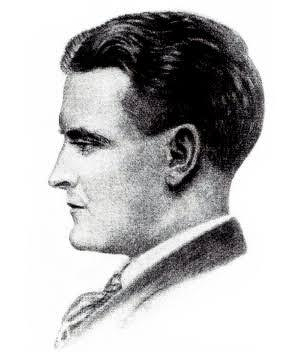 _A study of F. Scott Fitzgerald by Gordon Bryan_