📚 Purchased from a gift/souvenir shop in Chester, N.S. Sadly, I cannot recall the name and cannot find it in Apple Maps.
Of all the books I got in Nova Scotia, this was the most powerful. The Expulsion of the Acadians – also called the Great Deportation – which occurred from 1755-64, is one of the great scars of history on this beautiful place, perpetrated by the brutal British colonial government on a peaceful agrarian population whose crime was that they spoke French. The Expulsion echoes still in this region and its local culture.
There are a great number and variety of books on the topic of the Great Deportation; the Grand Pré Visitors Center had books covering all aspects of the event, ranging from academic histories to fictional retellings. Longfellow’s poem “Evangeline” exists in many different formats.
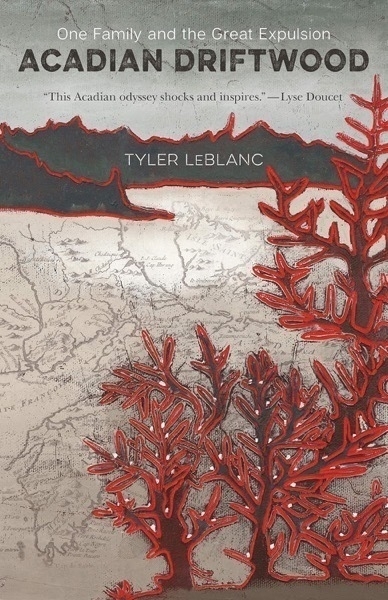
But this book felt different. Acadian Driftwood, despite its slim profile, is packed with thorough research and scholarship, imaginative storytelling using the known facts, and a deeply personal exploration by its author, Tyler Leblanc.
Leblanc did not even know his ancestors were Acadian until he traced his genealogy back to Joseph LeBlanc (his great-great-great-great-great-great-grandfather). The book tells the separate histories of Joseph and his 10 siblings who were expelled from their homes and lands and quite literally scattered to the four winds. Each chapter follows the trail of an individual sibling, where they ended up, and how they possibly fared. Some of them died at sea, others who made their way to France, England, Philadelphia, and yes, Louisiana, and even some who hid out and escaped the clutches of the British soldiers. The book describes the type of life and living conditions Leblanc’s ancestors would have found in these unsafe and openly hostile environments, so different from the green and peaceful Acadia they had known.
A short, powerful book that tells you what you need to know factually about the Great Deportation and what you should know emotionally, personally, about how that event played out in these individual lives. And then ponder how the world treats refugees today and ask yourself: is it any better? Is it any different?
📚 Purchased from the Grand-Pré National Historic Site Visitors Center. The Center has lots of CDs of Acadian and traditional music, and many books on Acadian history and culture, with a focus on the British government’s deportation from 1755-62 of the Acadians from Grand-Pré. The Center also has lots and lots of versions and retellings of Longfellow’s “Evangeline,” which I really must get to one day.
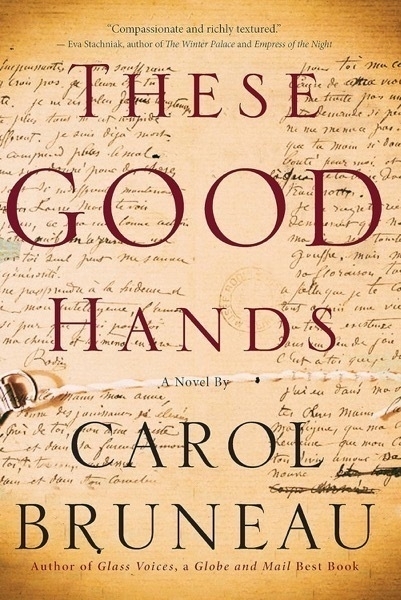
From the bookflap: “Set in the early autumn of 1943, These Good Hands interweaves the biography of French sculptor Camille Claudel and the story of the nurse who cares for her during the final days of her thirty-year incarceration in France’s Montdevergues Asylum.”
Still on my to-read shelf. I bought this early in our trip thinking I’d get back into reading a real book (by which I mean, a good novel). Even though the novel does not have anything to do with Nova Scotian or Acadian culture, I loved the description of the book from its flap and that’s why I bought it.
Also not a book with Acadian themes, but it sweeps from one end of Nova Scotia to another, and is a fine first novel. The author’s bio on the last page says this:
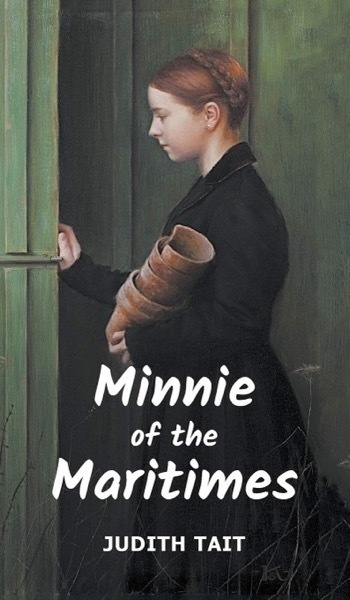
Investigating her ancestors led to the fictional life of a real person, Minnie Healy, born in 1864 outside the village of Port Williams in Kings Co., Nova Scotia. No other details of her life were recorded.
Set in the late 19th and early 20th century, the book follows young Minnie as she is cast out from her family’s home. Her pregnancy has cast shame on her family in the community and so she is sent to Montreal, where she delivers the child in a Catholic-run facility for unwed mothers – who are not allowed to keep their children. From there, she lives on Prince Edward Island with her aunt’s family, marries and moves to Halifax, and then ends her days in Wolfville.
It packs a lot of incident for a short book, and there are tinges of melodrama here and there. But the descriptions of those times – along with vintage photographs of the era that help inform the book’s atmosphere – are bracingly physical with great details. Minnie’s train ride to Montreal, the cold stoniness of the Catholic facility, the summers and winters of PEI as she grows to young womanhood – there are so many lovely episodes that the book is a joy to read.
But it’s not just nostalgia for a lost time. I’d heard about the Halifax Explosion but Tait’s description of its aftermath, as Minnie wanders through a neighborhood scorched and scraped bare, was unsettling. The book may appear to be a cozy, but its report has claws.
A small book, maybe a minor book, but a perfect little gift of a book for anyone who loves Nova Scotia and wants to know what life 100+ years ago felt like.
The bedtime book I read to Liz before lights out. We knew nothing of Emily Carr; this was a used book I picked up in Annapolis Royal and it proved to be wonderful. Carr’s descriptions of her early life and her times in San Francisco and London as an art student are brisk and readable. She exhibited such strong character, and withstood such vicious and determined opposition from her family and neighbors, that her occasional lapses of collapsing self-doubt are really heart-breaking. That she powered through so much opposition to make her work and suffered several bouts of what she calls nervous exhaustion (but were likely heart attacks) make it easy to understand why she stopped believing in herself. Until the pictures she’d made brought the world to her door. A remarkable life and this – her last memoir, finished just before her death – covers the sweep of it with unsparing anecdotes.
Finished reading: The Cursed Hermit by Kris Bertin (Writer), Alexander Forbes (Artist) 📚
A sequel to the duo’s previous The Case of the Missing Men though that isn’t strictly needed to appreciate this adventure. The story is not as bonkers as Missing Men but is still deranged and unhinged, with a deeper look at Pauline’s character. She showed hints in the previous book of second-sight, and she goes on a deep personal journey in Hermit.
Found myself going back to the beginning, going back to specific pages and sequences (that paint smudge over Pauline’s eye in the early pages! the kaleidoscope patterns!).
The art by Alexander Forbes is jaw-droppingly detailed and brilliant. I spent several minutes just studying the cross-hatching, shading, brushwork on the trees and cliff faces and rocky outcroppings. His landscapes and nature drawings have a solidly real look, while the fantasy images use that realism to unsettling effect. His character-acting is also great, especially during Pauline’s visions; the inhabitants of Hobtown all look dulled, dumpy, uncaring – and Bertin’s story explains why that is.
I don’t know how many hours and years it took them to create this book, but I will happily wait however long it takes for them to create another. This one really hit my sweet spot for comics, spookiness, character development (Pauline and Dana’s relationship felt real and caring).
I did a three-card reading using the World Spirit Tarot deck (1st edition). Instead of the usual “Past Present Future” layout, as I shuffled the cards I asked them to tell me something I needed to know about this year and to tell it as a story.
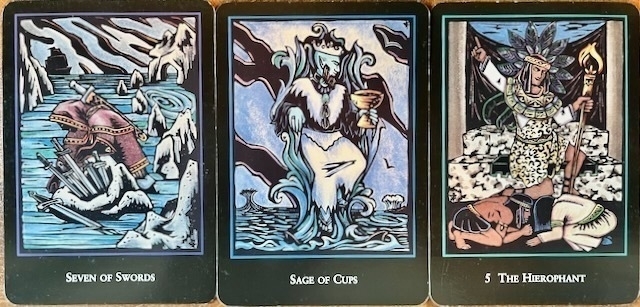
Here are the cards I drew.
The World Spirit Tarot site, maintained by Madame Onca, the deck’s artist, has these handy capsule descriptions of each card:
SEVEN of SWORDS – “Strategy, stealth and wit are required to meet your goals. From tactful communication to outright manipulation, utilize the spectrum of strategy to obtain your objectives. Be honest about your motives and methods, as dishonesty can beget its own problems. Can you accomplish your ends without compromising your integrity? (Craftiness)”
SAGE of CUPS – “Emotional maturity and a progressive nature allow the Sage to adapt to the changing times. Capable of great finesse and calculated communication, they lead well, and gaslight brutally. This empathetic personality struggles to maintain a most challenging balance between the rigors of worldly responsibility and a deeply emotional, artistic nature.”
V THE HIEROPHANT – “Are you ready to expand your knowledge? Bringing together the worlds of inner spirit and outer learning, this card represents the laws and culture of religious and academic tradition. Study the collected wisdom of the ancestors with all its gifts and shortcomings, then find the truly Sacred in your own way.”
The Hierophant, by the way, is my Spirit Card, the Major Arcana card that aligns to certain numerological data associated to my name and birth date. Seeing that card turned over at the end made my eyes pop.
The swords are an air sign, symbolizing intellect, communications, and boundaries. The cups are a water sign, signifying emotions, intuition, love, dreams. The Hierophant, as a Major Arcana symbol, dominates the reading. If these cards tell a story – starting from the intellectual and moving to the emotional – then the Hierophant is a hell of a note to end on.
One of the things I note about the card’s figures: the Swords figure is facing left and down, bending over, picking up the swords in a freezing cold sea, while a ship is heading toward her in the distance. She has to work fast. She is also facing to the left while the Sage is facing right in contemplation. Opposites-ville. But both figures are in cold, blue settings with clouds stabbing diagonally across the sky. They’re telling different sides of the story but they’re swimming in the same sea.
The Swords card pretty accurately summarizes my head at the moment. I want to clear up various health issues this year, and I have a life-changing project simmering in the background that will come to fruition, I hope, later this year. I want to set lots of plates spinning on the tips of many swords, and am wondering how to coordinate it all.
Once those plates are spinning, though, time to be the Sage and contemplate where I am, how I’m feeling, and how I will negotiate the life-change transition that is headed my way. The Swords card is, I think, about planning the physical aspects of my life. The Sage reminds me not to forget the emotional side, which needs equal care and attention. The honest Sword turns away from the calculating, gaslighting, manipulative Sage. But that last sentence of the card description shows the Sage trying his best to bridge the needs of the world with the needs of the soul.
And how will the story end? The Hierophant. The Rules-Maker and Rules-Follower, the Lawgiver, who joins in one role the emotional (religious, yearning, soulful) and the academic (intellect, boundaries, order from chaos). The dark side of the Hierophant is a slavish devotion to the rules rather than balanced and knowing wisdom. The rather haughty pose in the card, and the supplicants, show for me a disposition to avoid, a haughtiness I do not want to emulate. But I do want to honor the Sacred in the card, the light of the torch, and – the mysteries. What lies behind that black curtain? The Hierophant represents a codified religious system, but that system’s purpose is to guide one to the mysteries that lie within.
I took this to be a very hopeful and beneficial reading. I will be working hard at the start of the year (Swords), by mid-year I’ll be assessing where I am and how I’m feeling about where I’m going (Cups), and – I hope – by the end of the year, I’ll be the writer of my own story, the master of my moment, enjoying the pleasures of the emotions and the intellect. And since the Hierophant is my Soul Card, perhaps the reading indicates that I will come into my own, be fully myself.
Spent all day turning the apartment and yesterday’s clothes inside out looking for my airpods case. I was just now reading my Gmail, put my hand in my front left jeans pocket, and there it was. I have zero memory of putting it there.
I had a productivity insight recently. Namely, that if my natural state is peace, and I’m the one whose thinking messes with that peace, then my natural state is focus and the only way I lose focus is when my thoughts distract me from it.
So I don’t need 12 steps to a distraction-free environment or the key understanding to controlling my attention. Instead, I just notice when my thoughts start to insist that I need a break. The insistence feels uncomfortable and that’s the cue to stand, stretch, breathe, make a cup of tea. Clear my head, in other words, rather than continue cluttering it with web-surfing or YouTube.
I’ve noticed my Self over the last few weeks unsubscribing from newsletters and podcasts, being more intentional about how I spend my attention energy, and deliberately opening up spaces in the evening where I don’t do anything, just sit, without consuming this intellectual snack food.
With the turnover of a new year, I did not want to carry the burden of imaginary work into 2024.
I looked at my Readwise Reader collection of saved web pages/PDFs/videos to process (~1,000 items). My YouTube Watch Later list totaled over 2,200 items. My default Amazon wishlist for Books has not been emptied in years.
I have always used my read-later, watch-later, and buy-later lists as “cooling off” platforms. When I returned to them later, I could assess whether an item captured in the heat of the moment retained its warmth. Most of the time, I’d think, “Why did I save this??” and thus saved myself the time and trouble of processing it.
It’s always interesting to me to scroll through the lists and see what captured my attention at specific periods of the year: plantar fasciitis remedies and exercises, note-taking, retirement planning, authors I was following, reviews of a specific book or movie I’d just read, breakfast prep videos, etc. Yes, if I had unlimited time and energy, I’d love to have read and viewed all these things.
But I don’t. No one has.
So, I decided to declare bankruptcy on all these lists and clear them out. If something really wants my attention, it’ll come back and then I’ll take action on it in the moment by reading it, viewing it, or buying it. Or capturing it in one of my cooling-off lists, which I’ll likely again have to clear out at the end of 2024.
How To - Readwise
Cleaning out the Readwise list was pretty easy; find the Bulk Actions command and Delete All.
I’ll still indiscriminately add web pages to Readwise for later reading in 2024. It’s a dumping ground for my current in-the-moment interests. If I want to keep something, Archive it.
How To - Amazon
Display the Books list, select More, then Manage List, scroll to the bottom, then Delete List. Repeat for all other specialty lists that are no longer needed.
In 2024, I’ll create specialty lists as I need them, and I’ll continue to use my new Books list as a cooling-off chamber for in-the-moment captures.
How To - Youtube
YouTube was the toughie. It’s not in Google’s best interests for users to delete all those yummy videos they’ve saved up. Fortunately, there are scripts you can enter into the browser Console to do the work for you. The scripts usually work in Chrome, Firefox, and Edge.
Searching YouTube for “how to delete YouTube watch later list” yields how-to videos going back years; find ones that are recent, within the last few months ideally. YouTube changes its interface frequently, which breaks these scripts.
The easiest way to clear the Watch Later list is to use the Chrome extension YT Watch Later Assist. If you have thousands of items in the list, start the deletion process and ensure the screen doesn’t go asleep.
If you have other YouTube playlists you want to clear out, check out the scripts that run in the Console. They usually enable you to change the list name from “Watch later” to the another list name.
If you have over the years subscribed to too many YouTube channels (I had over 150 in my list), use the Console to run a mass unsubscribe script. While I had trouble getting the Watch Later scripts to run, this unsubscribe script ran perfectly. It ran so quickly though that it skipped some items. Running it 3 or 4 times did the trick and I am now unsubscribed from all YouTube channels.