

(via Suman’s ad #1 (featuring the actual Suman Bhatia) - Painting By David Terry Art)
The Conet Project
#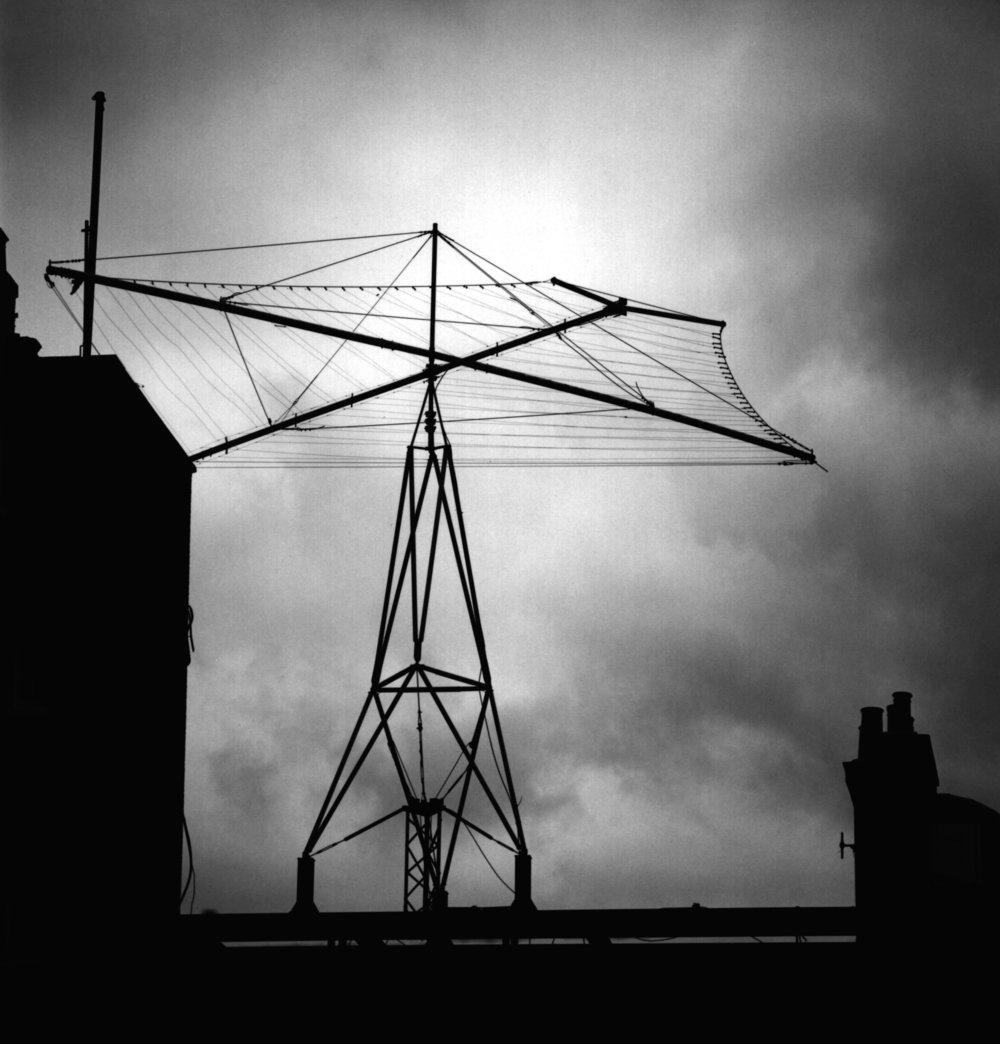 I must have heard about the shortwave numbers stations years ago on this Lost and Found Sound recording for NPR's All Things Considered (original page, YouTube version).
The story was strange, the recorded sounds spooky, and the low-fidelity of the shortwave signal making them sound even spookier, as if other sounds and voices are edging their way into the transmissions. (I guess in this context, "spooky" has more than one meaning.)
It seemed -- and still seems -- so weird that in this day and age, when so much of the world is gridded and mapped and monitored that there are still spy organizations (for lack of a more correct term) out there doing this: playing a tune or song to alert whoever is receiving the transmission and then reciting a series of numbers, letters, or words. We don't know who is sending the transmission, who is receiving it, or what the numbers mean.
And this is happening everywhere, it seems, not just the old Cold War countries. When I listen to the recordings of these stations, I feel an eerie tingle creeping up the back of my neck. There is still mystery in the world, still things that do not want to be known. I read somewhere that the best way to listen to these recordings is late at night, with the lights off. That sounds right.
The Conect Project has 5 CDs worth of these recordings collected from all over the world and over a long period of time. The first four CDs worth of recordings -- collected over 20 years through 1997 -- can be heard and downloaded for free via archive.org. Also free is the 80-page CD booklet in PDF, describing the project, the shortwave stations, and every track. You can also download the free sound files and PDF or order the CDs from Conet's official site (which offers links to other sites on the numbers mystery).
The first four CDs are available as a digital file from Audible.com (for the exceedingly odd price of $2.09) or from Audible's parent company Amazon for only 95 cents! Inexplicable.
Other resources: Wikipedia links to The Conet Project and Numbers stations, and the results of a Google search on "the shortwave numbers mystery."

Domestic Comedy
#Exchange between me and Liz as we drove past Ravenscroft school. ME. That's where Matthew did his play.
LIZ. Yeah, that musical about Noah's ark. He was Ham.
ME. (Pause. ) (Seriously.) He was doing his best.
LIZ. (Pause.) No! His character! His character's name was Ham! He was the son of Noah!
Soothing Sounds for Baby
#
Software: Audiobook Builder
# Back in the days of iron men and wooden computers, I listened to audiobooks on cassette.
In 2001, I joined Audible.com and listened to digitized audiobooks using my trusty yet problematic Digisette Duo-Aria; for years, my secondhand cars only had cassette players so the Digisette served me well. I preferred listening to audiobooks over music whilst commuting, traveling, or just motoring about. The other great thing about digital audiobooks was that I could listen to them anywhere, while raking the leaves or working out. Carrying my books everywhere was as important to me as carrying music everywhere was to other people. I also subscribed to Audible’s various monthly or weekly audio programs, like NPR’s Science Friday, in those dark days before podcasts.
After my second Digisette bit the dust and I entered a fraught period of unemployment, I stopped subscribing to Audible. My cars now had CD drives so I recorded BBC radio programs, burned them to CD, and listened to them in the car.
In 2009 or so, I bought an orange iPod nano as a birthday present for myself. I then began delving into the bizarre world of iTunes, how it manages music files, how it loads and plays podcasts on my iPod, etc. Audible-encoded files play very well in iTunes and with iPods of all kinds, so with my podcasts and Audible books now playable anywhere, and with a more dependable gadget, I was even happier.
Now, when I download an Audible file, it comes usually as one or up to three large files. But when I bought a few of the Doctor Who Big Finish productions via digital download, each track arrived as a separate file. Since they were originally published on CDs, and some of the productions are 2-CD sets, there could be upwards of 40-odd separate audio files to be managed. I can categorize the files as Media Kind “Audiobook” and they’ll show up with my other audiobooks. They would transfer to the iPod just fine, but the order-out-of-chaos maniac in me hated that they existed as individual files — I really wanted them to be in one or two big files, as the Audible books are.
Over the years, I had also collected many other MP3 files: stray podcasts or interviews not available from iTunes, audio programs I had bought, or coaching programs where the instruction arrived as lots of MP3 files. I had also recorded things off the web, such as this BBC2 radio documentary on the history of British comedy — four hour-long programs. It offended my sense of order to have all these files scattered in separate directories and not snugly nestled in iTunes where I could control them a little better. The iTunes interface really doesn’t handle these kinds of rogue files very well, in my experience, and I thought the whole operation could be made much easier.
To consolidate these separate files into a few merged files, I had been using the Join Together script from the amazing Doug’s AppleScripts for iTunes site. It combined individual files into audiobook files and worked fine, but I wanted more of a standalone app.
After poking around, I tried out and bought Audiobook Builder from the App Store (link). It’s a great little app that takes all those separate audio files, merges them into iTunes audiobook files (.aab files), and deposits them into iTunes’ Books area, where they belong — NOT with the music! This makes the files much easier to manage.
One of the things I like about the app is that I can throw a ginormous amount of files at it — such as a directory of 36 MP3 files totaling 1.1 GB — and it will not crash or fall over. In this example, it will process all those files to produce three large audiobook files, each suffixed with “Part 1, Part 2,” and so on. The largest files will run about 11 hours each. Now, the process is slow on my 2007-era MacBook, I’ll grant you. It can take up to 45 minutes for it to chew through a gigabyte of audio files. That’s OK for me if I get the files I want.
I can then delete or archive or offload those original files to other media so they don’t take up room on my hard drive. Order! Contained chaos!
If you have have audiobook CDs, it’s simplicity itself to have Audiobook Builder compile them into proper iTunes audiobook files. The help file is good and, after experimenting with some small jobs — particularly when it comes to creating and naming chapters (if you want to do that) — its mysteries are soon revealed.
One tip: I like having an image of the book or speaker or interview subject as part of the file. The simplest way to get that image applied to your new audiobook is to do this:
- Go to Google Images and enter the name of the book or person.
- Select and copy the image from your browser.
- In Audiobook Builder, after you’ve created the project file, left-click in the box that says “Drag Cover Artwork Here.”
- Press Command-V to paste the image from the clipboard.
You can also use this method to copy images from your existing audiobooks to new ones you create. Easy-peasy.
Update: I should have added another important reason why I prefer the audiobook format over separate files: you can stop anywhere in the file and pick up later where you left off. With audiobooks, I can interrupt the recording, listen to other stuff while I work, go back to the audiobook when it's time to commute home, select "Resume", and I carry on listening from the previous stopping point. To do that with individual tracks categorized as Music, you have to manually select the files and activate the bookmarking capability.

Current reading
#The Relationship Handbook -- George Pransky. The focus is primarily spousal relationships, though there are a few chapters dealing with parents and children. The core message is that our insecure thinking lowers our moods, which causes us to act defensively against our partner and they against us. The chief remedies include simply calming down until our thoughts look less real and choosing to talk about sensitive issues only when both partners are in their best state, when each partner's statements are understood and not simply reacted to. More important than "solving problems" is enjoying your partner's company and basking in a warm relationship. Simple language, readable, and applicable to fostering a better relationship with oneself as well. Pransky is of the first generation of Three Principles practitioners who worked with Sydney Banks. As with other popularizations of the Principles, it focuses more on revved-up thinking than with the other principles.
In These Times the Home is a Tired Place -- Jessica Hollander. Before I started my grad school adventure in 2006, I was in a writing group that counted as its members two people who would go on to publish their fiction. One was David Halperin, who published Journal of a UFO Investigator in 2011. The other is Jessica, who went on to an MFA at the University of Alabama and last year published this book of short stories, which won the Katherine Anne Porter Prize in Short Fiction (publisher description). They're odd, off-kilter, ethereal stories (or maybe prose poems) that take place in the characters' mundane world of cheap duplexes, loud neighbors, families under pressure, and someone who keeps moving the Welcome mat to other apartments in the building. You know the saying that every line of a poem creates a universe? Every sentence in a Jessica Hollander story does the same thing. The stories all have a voice that is uniquely Jessica's -- a quality her stories had even back in the day. I would kill to write dialogue that oblique and funny, with such a light touch.
How to Live: Or A Life of Montaigne in One Question and Twenty Attempts at an Answer -- Sarah Bakewell. Bakewell attacks the life of Montaigne and the life of his Essays by taking the writer's chief question -- How should one live? -- and then drawing from the essays 20 different, sometimes contradictory, answers. Along the way, she paints pictures of the historical, intellectual, and cultural currents of his time (I did not know the horrific conditions in France caused by the Catholic-Protestant conflicts) and how Montaigne's message of Stoicism, skepticism, and delighted self-discovery has been viewed by other thinkers, writers, and readers through the centuries.
True Work is that which occupies the mind and the heart, as well as the hands. It has a beginning and an ending. It is the overcoming of difficulties one thinks important for the sake of results one thinks valuable.
Jacques Barzun
Serious reading, after all, should be active, focused, engaged—and Cooper suggested some ways to make it so.
First, read aloud—at least some of the time. “Every line of Shakespeare, every line of Milton, is meant to be pronounced, cannot be duly appreciated until it is pronounced.”
Second, read slowly. “Take ample time. Pause where the punctuation bids one pause; note each and every comma; wait a moment between a period and the next capital letter. And pause when common sense bids you pause, that is, when you have not understood.”
This led to the third dictum: “Read suspiciously. Reread. What a busy man has time to read at all, he has time to read more than once.”
Elsewhere, he added another piece of advice: Learn by heart at least a few poems and passages of prose.