Richard Sala: Colleen's Dream
#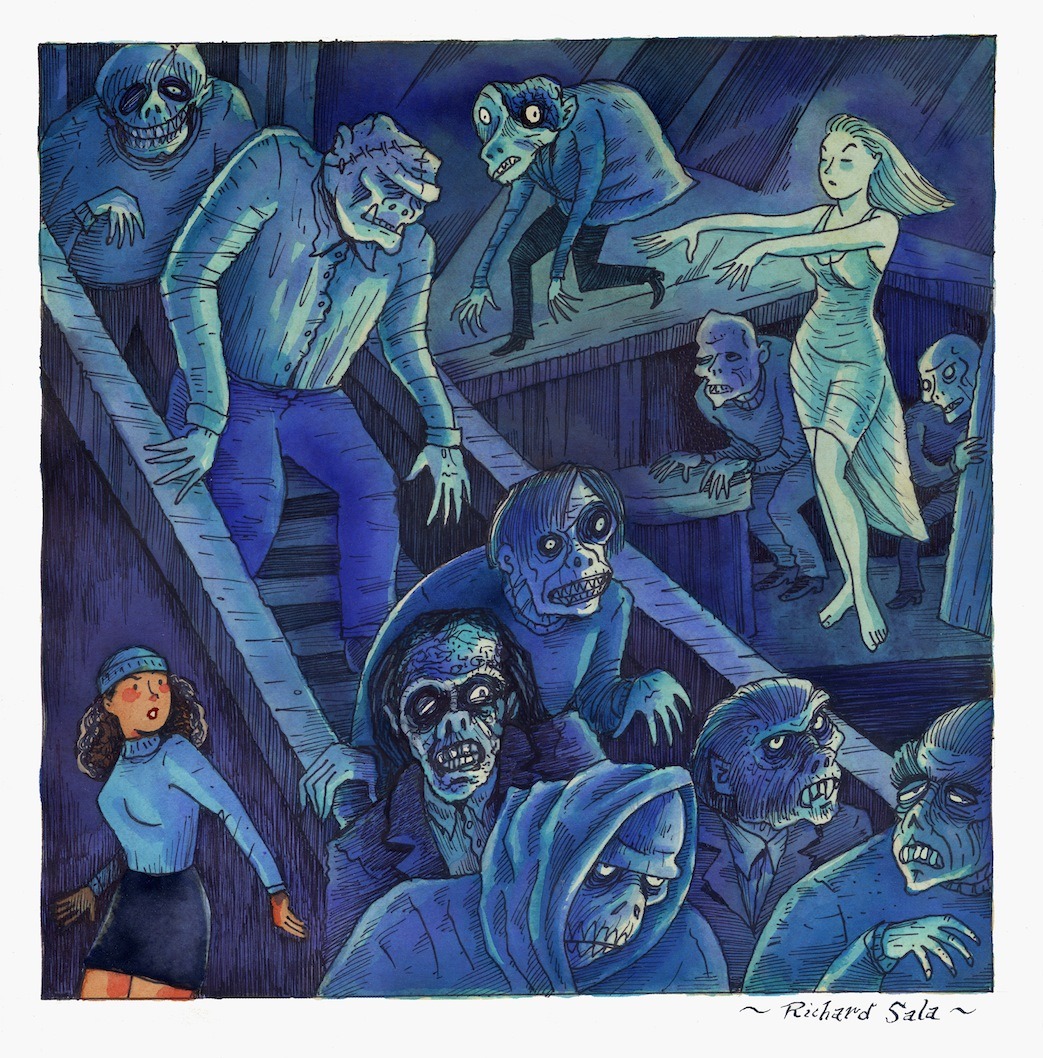
“Colleen’s Dream” (An outtake from my book THE HIDDEN). To read the story behind it, see Here Lies RICHARD SALA: An Outtake from The Hidden ~ Colleen’s Dream
“Colleen’s Dream” (An outtake from my book THE HIDDEN). To read the story behind it, see Here Lies RICHARD SALA: An Outtake from The Hidden ~ Colleen’s Dream
Give a person a fish and you feed them for a day. Teach a person to use the Internet and they won’t bother you for weeks, months, maybe years.
Today’s dose of wisdom « Getting Things Done in Academia
(See also: Teach a man to light a match, he warms himself for a day. Set him on fire, and he’s warm for the rest of his life.)
Trollope said, “On the last day of each month recorded, every person in a work of fiction should be a month older than on the first.” We go with our characters wherever they lead us, and as time makes its mark on us, so it must on them.
HALLIE BURNETT
If you acknowledge all this resistance and act on your plan anyway, you will make one of the most liberating discoveries possible for a human being—that you can take constructive action in any moment no matter what you feel, and no matter what excuses occur to you.
In short, you are free. Thoughts come and go. Feelings arise and fade. But none of them need to stop you from living a meaningful life based on your values.
Here’s a quote from Stephen Fry’s novel Making History, one of the few passages that struck me as admirable in that lamentably bad book.
If there is a word to describe our age, it must be Security, or to put it another way, Insecurity. From the neurotic insecurity of Freud, by the way of the insecurities of the Kaiser, the Fuhrer, Eisenhower, and Stalin, right up to the terrors of the citizens of the modern world –
THEY ARE OUT THERE
The enemy. They will break into your car, burgle your house, molest your children, consign you to hellfire, murder you for drug money, force you to face Mecca, infect your blood, outlaw your sexual preferences, erode your pension, pollute your beaches, censor your thoughts, steal your ideas, poison your air, threaten your values, use foul language on your television, destroy your security. Keep them away! Lock them out! Hide them from sight! Bury them!
(originally posted 2010-11-22, updated for micro.blog)
Interesting confluence of views from today's feeds: Let's face it, science is boring - science-in-society - 21 December 2009 - New Scientist "Science is not a whirlwind dance of excitement, illuminated by the brilliant strobe light of insight. It is a long, plodding journey through a dim maze of dead ends. It is painstaking data collection followed by repetitious calculation. It is revision, confusion, frustration, bureaucracy and bad coffee. In a word, science can be boring."
Medical Hypotheses: Why are modern scientists so dull? "How science selects for perseverance and sociability at the expense of intelligence and creativity"
It won’t surprise me if neuroscientists eventually succeed in unlocking the mystery of music. I don’t fear that prospect, but I do have a sneaking suspicion that part of the charm of music lies in the fact that we don’t know what it means, any more than we can explain the equally mysterious charm of a plotless ballet by George Balanchine or an abstract painting by Piet Mondrian. “We dare to go into the world where there are no names for anything,” Balanchine once said to Jerome Robbins. Most of us, on the other hand, live in a prosy, commonsense world where everything has a name and most things have an explanation. That’s why it is so refreshing to enter into the presence of great art, and why the greatest works of art always contain an element of ambiguity. A masterpiece doesn’t push you around. It lets you make up your own mind about what it means —- and change it as often as you like.
Harlan Ellison:
There are times when I am terribly presumptuous, to visit my personal feelings on other people’s way of living a life. In truth, I’m very egalitarian in that way. I’m an elitist because I think there are too many stupid people in the world. But one must not pity them; one must take an AK-47 and kill them. You just need to kill as many stupid people as you can find. Go out in the streets and ask them if they have ever heard of Guy de Maupassant. No? Bam, you’re dead. Have you ever heard of Bessie Smith? No? Bam, you’re dead.
Work inspires inspiration. Keep working. If you succeed, keep working. If you fail, keep working. If you are interested, keep working. If you are bored, keep working. —Michael Crichton
stevereads: The Queen Victoria Series!
Jean Plaidy wasn’t the only pen-name she used, far from it: most famously she was also Victoria Holt and Philippa Carr, but if memory serves, there were many, many others. For decades, her novels (a great heaping mass of them historical novels) fell from her creative teats and hit the floor like baby rats – fully-formed, stripped bare for function, and avid for survival.