From James Webb Young, The Diary of an Ad Man: The War Years, June 1, 1942-December 31, 1943 (Chicago: Advertising Publications, 1944)—
“Talked with domestic science editor of one of the women’s magazines. She told me that she had tested literally thousands of recipes, covering almost every kind of food. Asked her what, after all this, she considered the best eating. She thought it was pretty hard to beat a good sirloin steak, washed down with straight whiskey. Western gal.” (via The Poetry of Sight: Sirloin Steak and Whiskey)
“How do you and your wife split songwriting chores?“
It’s an adventure. You’ve got a flashlight, I’ve got the map. You hold the nail, I’ll swing the hammer. You wash, I’ll dry. If two people know the same thing, one of you is unnecessary. My wife has dreams and is telepathic and clairvoyant and female. I write from the news or what I see in my field of vision. I’m boots and hats and pocketknives. She’s filled with musical and lyrical surprises. She’s a joy to work with.”
From Tom Wait’s Library
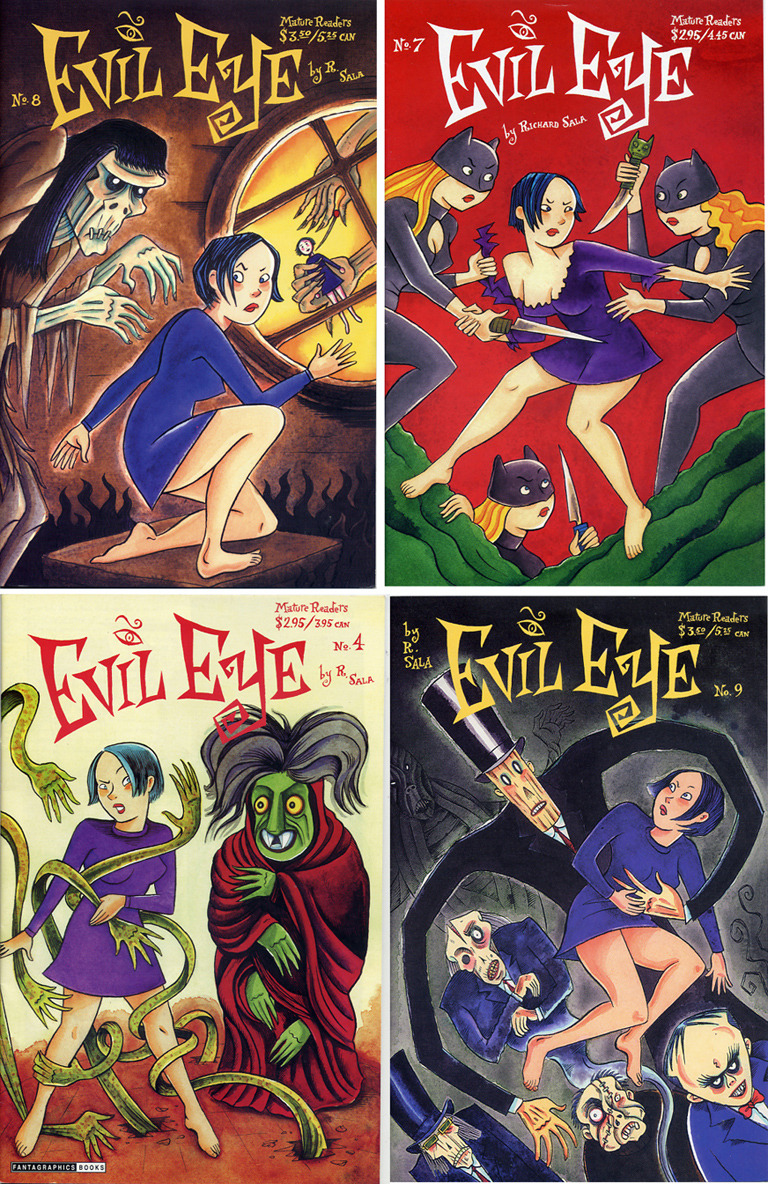
richardsala:
Some more EVIL EYE covers
A great way to give thanks…
for the privileges we’ve got is to do important work.
Your job, your internet access, your education, your role in a civilized society… all of them are a platform, a chance to do art, a way for you to give back and to honor those that enabled you to get to this point.
For every person reading this there are a thousand people (literally a thousand) in underprivileged nations and situations that would love to have your slot. Don’t waste it.
“What you newspaper and magazine writers, who work in rabbit time, don’t understand is that the practice of architecture has to be measured in elephant time.”
Eero Saarinen/Eero Saarinen on His Work/elephant time
A good magazine article doesn’t need an introduction, so don’t begin with the background of your subject, how you happened to get interested in it, why the reader should read it, or how you obtained the information for it. Begin your article with conflict that produces tension, often revealed by including a brief example or anecdote and problem that will be resolved at the end. It’s a good rule to start as near the end as possible and then plunge your reader into the central tension. When you’ve involved your reader in this way, weave in background facts or information as you think the reader needs it to understand the purpose and point of your piece.
DONALD M. MURRAY
Before the crisis years of the AIDS epidemic I had that sense that one does of a long, expansive living ahead of me. When my friends and my partner began to sicken and die around me, that shifted everything in a sense that you just don’t know what prospect is ahead of you. For me, that exacerbates desire. On the other hand you have to negotiate because desire enflamed can become a blinder. It’s a balancing act I have never felt especially good at.
Secretly, I believe balance is boring. I used to take yoga classes and there’s these exercises where you’re supposed to be standing on one leg in this position as a stork, and I was terrible at them! I would get annoyed because they would always turn it into metaphor: “If you don’t have physical balance it means you need to seek balance”; No I don’t!
1. Dialogue should be brief.
2. It should add to the reader’s present knowledge.
3. It should eliminate the routine exchanges of ordinary conversation.
4. It should convey a sense of spontaneity but eliminate the repetitiveness of real talk.
5. It should keep the story moving forward.
6. It should be revelatory of the speaker’s character, both directly and indirectly.
7. It should show the relationships among people.
ELIZABETH BOWEN
7 Rules for Dialogue