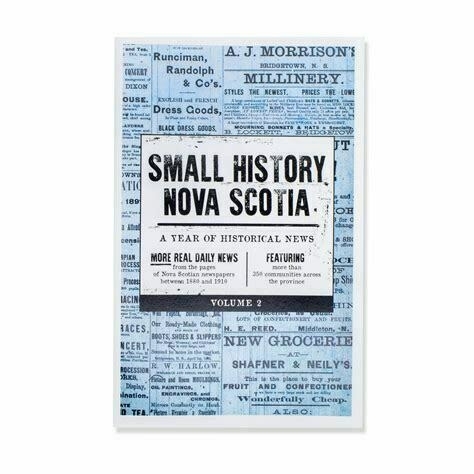
The second in a series of three pamphlets compiled by Sara Spike, with Volume 2 published in 2020. As she says in her introduction, the series “shares real daily news from [over four dozen] historical newspapers across the province between the years 1880 and 1910.” It also includes illustrations of old advertisements and notices, which break up the grey and add a lot of nostalgic charm to the package. You can view a sample page from volume 2 on the Small History Nova Scotia site.
Spike started tweeting these news items from rural and small-town newspapers in 2014. Twitter turned out to be a perfect medium, as she explains:
Local news columns were frequently long lists of short bits of news. The tweets, like the daily entries here, are entire news items just as they appeared in the original newspapers.
Here are a few examples:
The coast was enveloped in fog nearly all day. Yarmouth Jul 3 1893
The picnic on Moose Island consisted of baked beans, canned salmon, cake of all kinds, pie of every description, hot tea and coffee. Five Islands Jul 8 1895
Mr. Jon Vaughan has a cat that is rearing two young minks and a black kitten. Anyone passing may see the lithe forms racing about in a very happy mood with kitty as a frolicksome companion. Mr Vaughan has recently added a wood chuck to his menagerie. Gaspereau Jul 11 1890
Spike acknowledges that these excerpts exclude lots of voices and descriptions, but I agree with her that they do capture the flavor and texture of a specifically, almost intensely, local way of life.
On a personal note, I loved reading this booklet because it reminded me of my first real job out of college at The Rocky Mount Evening & Sunday Telegram in Rocky Mount, NC. At that time – 1984 – the Linotype machines were only recently consigned to the backrooms and the “women’s and features” page regularly consisted of one-paragraph summaries of the local women’s, civic, and church groups. (Try writing meaningful headlines for these squibs beyond “Club Met on Sunday”). We also ran odd little endearing notices like Mr. and Mrs. Smith will be on a cruise or traveling to meet their new grandchildren in Lompock, or whatever. (Burglars, take note!)
Reading these hundred-year-old Nova Scotia news items just made me smile and sparked my imagination for living in that place and time, the same locales that Millie of the Maritimes would have lived in. And they also put me in mind of my own early days, where that tradition of newspapering remained intact, though not alive for much longer.
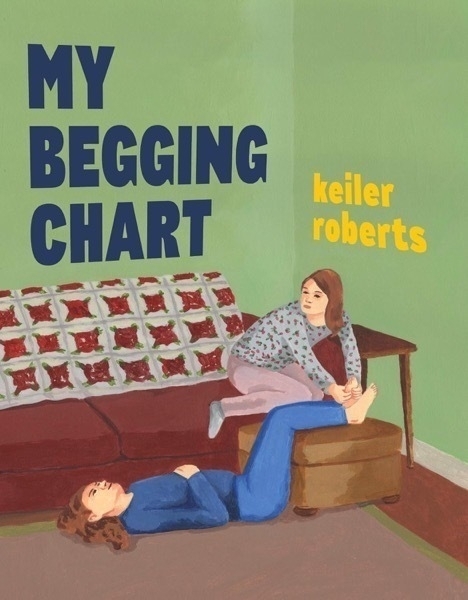
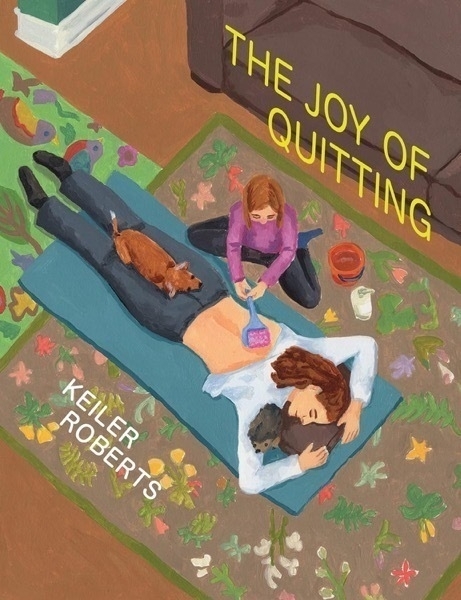
As a devotee of autobiographical comics, I’m ashamed to say I’d never heard of Keilor Roberts before this trip. But we’ve liked Julia Wertz’s comics, and I thought Liz might also enjoy Roberts’ deadpan and Sahara-dry wit.
And we did. These were fun books to drop into and encouraged me to seek out interviews with Roberts and pursue copies of her other work. Highly recommended, especially for her interactions and dialogues with her daughter Xia, who looks at the world as brightly and eccentrically as her oftentimes less-happy mom.
📚 Purchased from a gift/souvenir shop in Chester, N.S. Sadly, I cannot recall the name and cannot find it in Apple Maps.
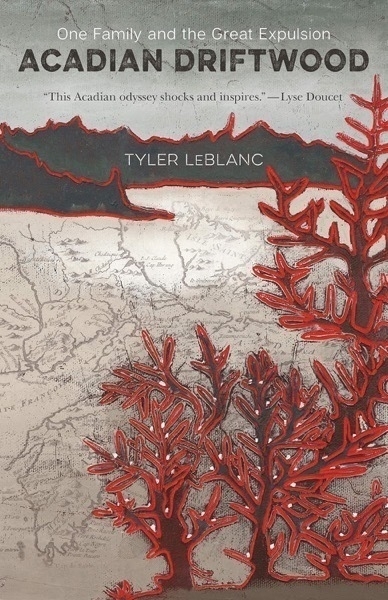
Of all the books I got in Nova Scotia, this was the most powerful. The Expulsion of the Acadians – also called the Great Deportation – which occurred from 1755-64, is one of the great scars of history on this beautiful place, perpetrated by the brutal British colonial government on a peaceful agrarian population whose crime was that they spoke French. The Expulsion echoes still in this region and its local culture.
There are a great number and variety of books on the topic of the Great Deportation; the Grand Pré Visitors Center had books covering all aspects of the event, ranging from academic histories to fictional retellings. Longfellow’s poem “Evangeline” exists in many different formats.
But this book felt different. Acadian Driftwood, despite its slim profile, is packed with thorough research and scholarship, imaginative storytelling using the known facts, and a deeply personal exploration by its author, Tyler Leblanc.
Leblanc did not even know his ancestors were Acadian until he traced his genealogy back to Joseph LeBlanc (his great-great-great-great-great-great-grandfather). The book tells the separate histories of Joseph and his 10 siblings who were expelled from their homes and lands and quite literally scattered to the four winds. Each chapter follows the trail of an individual sibling, where they ended up, and how they possibly fared. Some of them died at sea, others who made their way to France, England, Philadelphia, and yes, Louisiana, and even some who hid out and escaped the clutches of the British soldiers. The book describes the type of life and living conditions Leblanc’s ancestors would have found in these unsafe and openly hostile environments, so different from the green and peaceful Acadia they had known.
A short, powerful book that tells you what you need to know factually about the Great Deportation and what you should know emotionally, personally, about how that event played out in these individual lives. And then ponder how the world treats refugees today and ask yourself: is it any better? Is it any different?
📚 Purchased from the Grand-Pré National Historic Site Visitors Center. The Center has lots of CDs of Acadian and traditional music, and many books on Acadian history and culture, with a focus on the British government’s deportation from 1755-62 of the Acadians from Grand-Pré. The Center also has lots and lots of versions and retellings of Longfellow’s “Evangeline,” which I really must get to one day.
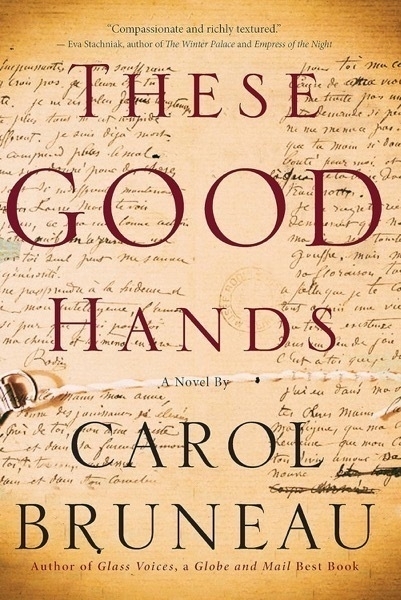
From the bookflap: “Set in the early autumn of 1943, These Good Hands interweaves the biography of French sculptor Camille Claudel and the story of the nurse who cares for her during the final days of her thirty-year incarceration in France’s Montdevergues Asylum.”
Still on my to-read shelf. I bought this early in our trip thinking I’d get back into reading a real book (by which I mean, a good novel). Even though the novel does not have anything to do with Nova Scotian or Acadian culture, I loved the description of the book from its flap and that’s why I bought it.
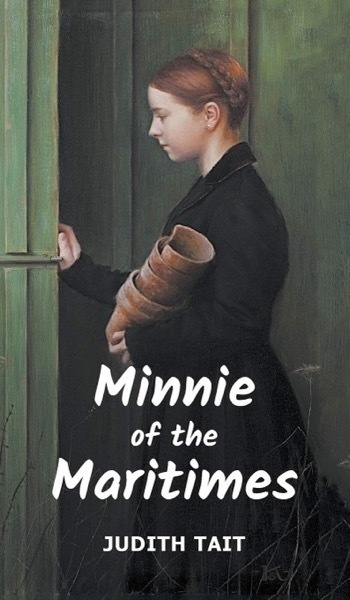
Also not a book with Acadian themes, but it sweeps from one end of Nova Scotia to another, and is a fine first novel. The author’s bio on the last page says this:
Investigating her ancestors led to the fictional life of a real person, Minnie Healy, born in 1864 outside the village of Port Williams in Kings Co., Nova Scotia. No other details of her life were recorded.
Set in the late 19th and early 20th century, the book follows young Minnie as she is cast out from her family’s home. Her pregnancy has cast shame on her family in the community and so she is sent to Montreal, where she delivers the child in a Catholic-run facility for unwed mothers – who are not allowed to keep their children. From there, she lives on Prince Edward Island with her aunt’s family, marries and moves to Halifax, and then ends her days in Wolfville.
It packs a lot of incident for a short book, and there are tinges of melodrama here and there. But the descriptions of those times – along with vintage photographs of the era that help inform the book’s atmosphere – are bracingly physical with great details. Minnie’s train ride to Montreal, the cold stoniness of the Catholic facility, the summers and winters of PEI as she grows to young womanhood – there are so many lovely episodes that the book is a joy to read.
But it’s not just nostalgia for a lost time. I’d heard about the Halifax Explosion but Tait’s description of its aftermath, as Minnie wanders through a neighborhood scorched and scraped bare, was unsettling. The book may appear to be a cozy, but its report has claws.
A small book, maybe a minor book, but a perfect little gift of a book for anyone who loves Nova Scotia and wants to know what life 100+ years ago felt like.
The bedtime book I read to Liz before lights out. We knew nothing of Emily Carr; this was a used book I picked up in Annapolis Royal and it proved to be wonderful. Carr’s descriptions of her early life and her times in San Francisco and London as an art student are brisk and readable. She exhibited such strong character, and withstood such vicious and determined opposition from her family and neighbors, that her occasional lapses of collapsing self-doubt are really heart-breaking. That she powered through so much opposition to make her work and suffered several bouts of what she calls nervous exhaustion (but were likely heart attacks) make it easy to understand why she stopped believing in herself. Until the pictures she’d made brought the world to her door. A remarkable life and this – her last memoir, finished just before her death – covers the sweep of it with unsparing anecdotes.
Finished reading: The Cursed Hermit by Kris Bertin (Writer), Alexander Forbes (Artist) 📚
A sequel to the duo’s previous The Case of the Missing Men though that isn’t strictly needed to appreciate this adventure. The story is not as bonkers as Missing Men but is still deranged and unhinged, with a deeper look at Pauline’s character. She showed hints in the previous book of second-sight, and she goes on a deep personal journey in Hermit.
Found myself going back to the beginning, going back to specific pages and sequences (that paint smudge over Pauline’s eye in the early pages! the kaleidoscope patterns!).
The art by Alexander Forbes is jaw-droppingly detailed and brilliant. I spent several minutes just studying the cross-hatching, shading, brushwork on the trees and cliff faces and rocky outcroppings. His landscapes and nature drawings have a solidly real look, while the fantasy images use that realism to unsettling effect. His character-acting is also great, especially during Pauline’s visions; the inhabitants of Hobtown all look dulled, dumpy, uncaring – and Bertin’s story explains why that is.
I don’t know how many hours and years it took them to create this book, but I will happily wait however long it takes for them to create another. This one really hit my sweet spot for comics, spookiness, character development (Pauline and Dana’s relationship felt real and caring).
Finished reading: Old Christmas by Washington Irving 📚
A classic set of stories that invigorated the Christmas spirit in 1820s America, which saw the holiday as too-English (the war of 1812 was still fresh) and which banned celebrations in some locales. Irving synthesized his research into older English Christmas customs, games, and rituals into a fictional story of a grumpy outsider whose heart is warmed by the lightness and gaiety. He even includes a ghost story. Dickens was an Irving fan and drew from this book for his own “Christmas Carol”.
It took a while for me to get into the style and pace of the writing, though judicious skimming helped and I did love the rich details.
What leapt out at me were the rather lechy old Master Simon who enjoys the company and attention of the pretty younger girls, and the clear and rigid caste system of gentry and peasants, which the narrator endorses (no one has a word of thanks for the busy kitchen staff who cooked all the extravagant foodstuffs), though he is aware of the class divide: his narrator looks sternly at some of the “peasants” knowingly playing up to the guvner.
📚 Purchased from Block Shop Books on a day-trip to Lunenberg, whose picture-postcard downtown area boasts a large number of restaurants, gift shops, and book stores.
I remember entering at the end of our day there, with the store about to close in 10 minutes. With no time to linger, I scanned for the graphic novels section and plucked out these three beauties.
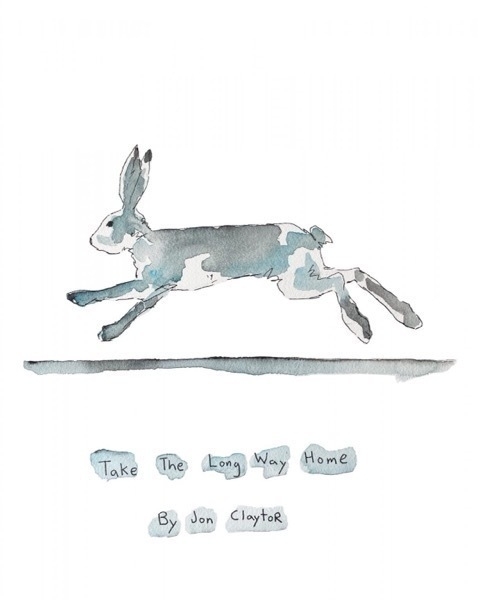
I love diary comics and comics memoirs but this book bounced right off me. I remember reading this book but cannot tell you much more about it. The author takes a cross-country road trip after the collapse of a relationship while also struggling to stay sober. Along the way, he meets up with friends, children, family, talks to the animals, makes new friends, and along the way tries making friends with himself too. The drawings and some watercolors (the book is B&W and grayscale, no color) are mostly all photo-referenced with, more often than not, one big drawing to each page.
The episodic, meandering nature of his journey (both external and internal), and the visually uninteresting pictures and layouts, made this big slab of a book feel rather thin. I will give it another try later; maybe I was having an off week.
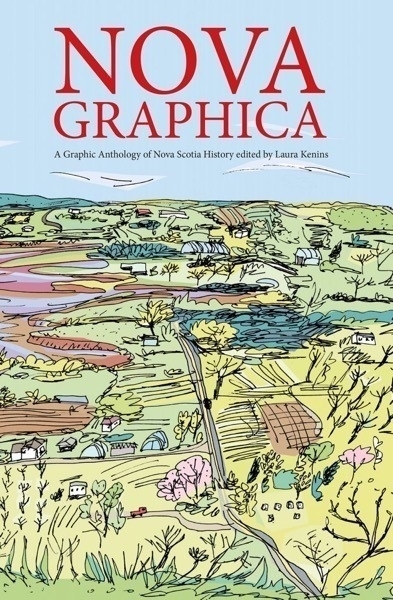
A fantastic collection of short pieces on Nova Scotian history and culture, with a rich blend of personal Nova Scotian history and culture, as well. I loved seeing the variety of drawing styles, the different types of storytelling, and the panorama of topics: Black history, Indigenous history, LGBTQ, ghost stories, family stories, folklore – the gamut. For some reason, I remember the last story called “Five Sided House” by Colleen MacIsaac. It’s a fiction piece about two high school girls who take on as a school project an archeological study of the hundreds of years old foundation of what appears to be a five-sided house located in the hills above Halifax. A little Googling reveals that it’s a real historical conundrum with no clear explanation of the structure’s origin or purpose. What could have been a dry retelling of the scant facts instead becomes a lovely meditation of the past and the present, with imagination as the necessary bridge between the two.
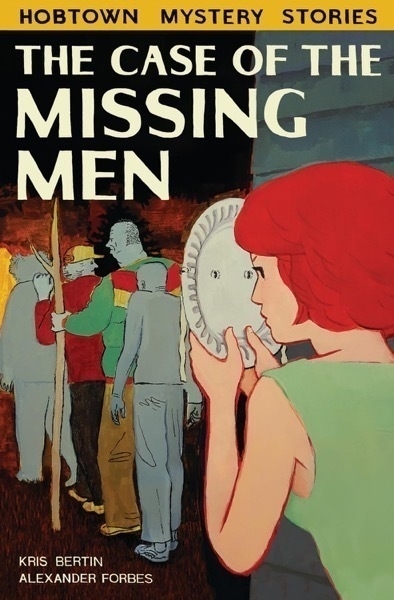
Bertin and Forbes contributed a spooky folk tale to Nova Graphica. In The Case of the Missing Men, they give themselves 300 pages to cut loose with their own brand of local legend, noir storytelling, dark mystery, and unsettling imagery. The first of the “Hobstown Mystery Stories” series, the book follows the investigation of a high school student’s missing father by the Teen Detective Club (a registered afterschool program!). Publishers Weekly nicely summed up the book as a cross between Scooby-Doo and David Lynch, though there are few shenanigans and high-jinks; instead, there are threatening law officers, a secret society, grotesque monster-men, deaths, bodies, chases, and just what is going on behind those kennel fences? The story is odd, compelling, weird, and the exquisitely etched line drawing, detailed cross-hatching, and frankly creepy images make the whole package delightful and re-readable.
The book appears to be out of print, sadly, hence my using the Amazon link. I plan on getting myself their second novel, The Cursed Hermit, as a Christmas present to myself.
By a wonderful coincidence, all of these books were published by Conundrum Press, an independent Canadian publisher of literary graphic novels. They have an extensive catalog of works that are locally, culturally, and artistically daring. I love the range of titles and styles they offer and look forward to reading more of their books.
Purchased from The Odd Book, a really terrific used bookstore two streets back off the main drag of Wolfville, NS. I spent a delightful couple of hours browsing the small but packed alleys of shelves. Fantastic collection of Nova Scotian history and literature. 📚
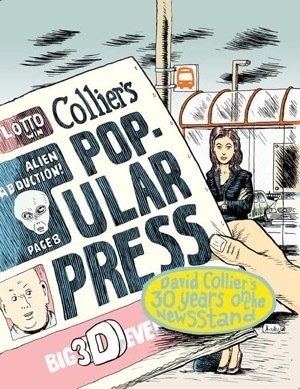
Collier’s Popular Press: David Collier’s 30 Years on the Newsstand by David Collier (2011)
A generously sized collection of the Canadian alternative cartoonist’s fugitive journalism, comics, single-panel cartoons, and sketches for all manner of Canadian newspapers. The comics journalist Jeet Heer’s introduction praises Collier’s craft and his love of homey detail, which are evident in his wonderful landscape drawings that lead off the book, his comics-based diaries, and his own written reminiscences, including a pilgrimage with Pat Moriarty to the house George Herriman lived in.
Collier’s self-portraits, line detail and cross-hatching, and stories where he casts himself as an overly self-conscious overthinking nebbish struck me as very Robert Crumb-y, but without that artist’s graphic skill, emotional intensity, and attention-grabbing sense of danger. I mean, Collier is Canadian, after all. So the collection as a whole is gentle, low-wattage, takes its time. I found his comics documentation of the passing scene, and his personal essays, to be particularly affecting.
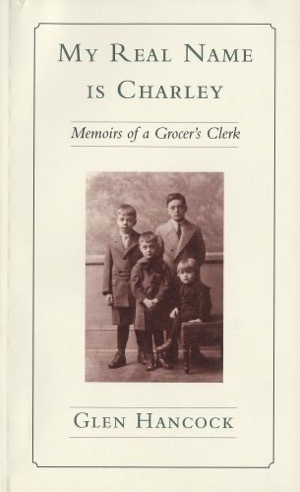
My Real Name is Charley: Memoirs of a Grocer’s Clerk by Glen Hancock
Hancock’s book is a gentle, readable memoir of growing up in Wolfville, NS, and of his life and the town’s life in the years between the world wars. He remembers the town as an enchanting place:
Wolfville is both commonplace and exclusive. It was, in common with other small Canadian municipalities, a heritage of empire, of small beginnings, of ups and downs. But as it is with people, towns have a personality of their own, a heritage that dwells in the heart, and in that way each is different.
The book follows the ups and downs also of his family, with parents who separated (he never discovers why) yet never divorced, the failure of his father’s fortunes during the Depression, and the eventual build-up to WWII. I loved reading his reminiscences of the life of Wolfville when that area of Nova Scotia was a vacation spot with twice-a-day trains, the smallest registered harbor in the world, and yet – like most of NS that time – still a largely rural, farming lifestyle.
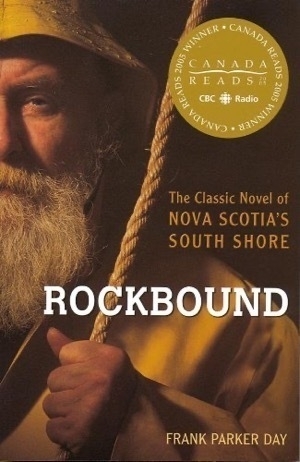
Rockbound by Frank Parker Day
I’ve used the word “gentle” for the first two books of this post, but that adjective definitely does not apply to Day’s novel, first published in 1928 and not reissued till 1973.
Blurbed as “The Classic Novel of NOVA SCOTIA’S SOUTH SHORE”, the novel follows the struggles of young, orphaned David Jung as he returns to the island of Rockbound to build a life for himself. To do that, though, he needs to work for his great-uncle, the tyrannical “king of Rockbound” Uriah Jung. The novel’s picture of the hard, primitive life of a small fishing community in the early 1900s is rich in detail; I could feel the cold, the greed, the back-breaking, skin-cracking toil needed to scratch out a bare existence from both the island and the sea.
The at times melodramatic story provides spaces where Day folds in absorbing scenes, such as a Saturday night fish-cleaning, a hurricane at sea that destroys large fishing schooners, and the protagonists’ race to get a dark lighthouse up and running to prevent disaster. It also has a day-to-day texture that, while no doubt heightened, feels plausible. According to the book’s afterward by scholar Gwendolyn Davies, Day was vilified by the inhabitants of an island called Ironbound who said he had befriended them only to gather scurrilous details for his novel that painted an untrue picture of their communities.
Rockbound’s canvas is large enough to take on one character’s possible madness and a deal with the Devil that breaks open the story to take it places it could not go by staying solely with the more naive and sensible David. The novel loses its balance occasionally; while I appreciate the maritime detail about fisherman gear and boats, I honestly understood very little of it. And in the book’s latter third, David’s friend Gershom Born pretty much takes over the narrative. The book’s voice is somewhat antique today, and others may be put off by the island dialect, though I found that to not be a problem.
In the reviews I read of the novel, no one mentioned a foreshadowing technique Day deploys a few times in the book that got my attention.
But it’s not quite foreshadowing. Three or four times in the book, Day focuses a paragraph or two on a specific minor character, and then jumps ahead a year or 30 years to show that character’s fate. Then the story steps back into the flow of the main narrative and this short interlude is never referred to again. It’s an odd device that poked my imagination somehow and extended the story in a direction that Day could not have done otherwise. (Come to think of it, the movie Y Tu Mama Tambien uses that device also.)
For example: the female characters are generally two-dimensional (as are many of the men in the large cast of characters) and Day rarely gets inside their heads. But there’s a passage in Chapter 3 that really shifted me.
The scene is the Saturday-night fish cleaning, where the day’s catchings are gutted, cleaned, and salted in preparation to sell on the mainland. It’s hard, painful, mechanical work, and all hands are expected to be in the barn to help out. Here’s where Day spends some time on Fanny:
Fanny was certainly a fine creature, but her morals were those of the birds. She came from Big Outpost to hoe Uriah's cabbages and potatoes, since the men had no time to work about gardens. Moreover, gardening was distinctly woman's work. All day long she hoed and weeded and gave a hand at night in the fish house, as did all the island women when a run of fish came. She trudged home from the fields in the late afternoon, hoe over her shoulder, whistling blithely. Before supper she always went to the beach, stripped and washed herself--little cared she if the men peeked--and put on a clean shirt and a fresh dress of blue and white in tiny checks. Her dresses, scrupulously washed and ironed, were kept in her father's sea chest in the loft by her bed. In the midst of all the dirt, stench, and disorder, she had an instinct, well-nigh a passion, for tidiness. In another setting she might have borne herself with the greatest lady in the land. She was great-hearted and could never refuse a strong fisherman half-crazed with lonely passion. When the women talked to her and said: "A little of dat's all right maybe when you'se young, but if you keeps on you'se'll never git a man," she used to reply, "We was made for de good of mens, an' mens is going to have me." If Uriah and his wife, she thought, cared so much for morals, why had they put her and Leah Levy to sleep in the loft with the sharesmen?
Sure enough, she never got a man, but she bore three daughters that grew into stout lasses, knowing no more than Fanny who were their fathers. In after years Gershom used to say, “I t’ink de pretty one wid de yaller hair mus’ be mine, but de dark ugly one favours Noble Morash.” Fanny saved her pennies and looked after herself, and when she was too old to work bought a little white cottage in Liscomb. When she was very old and felt herself at the point of death, she sent for her three daughters, but they refused to come. They had all married and were ashamed of their mother. One morning the neighbours found her dead on her clean-valanced couch, even in death smiling bravely upon a world that had taken her all and paid nothing in return.
But that is going far ahead of this story, for the Fanny who bickered with Gershom Born that night in the fish house was only a wild, gay girl of eighteen. She wore, like the others, oilskins spattered with herring blood, and a sou’wester to protect her yellow hair.
The juxtaposition of those images – of Fanny dying alone, abandoned by her daughters, against the fresh and energetic spitfire of 18 with her two little girls in tow – and that heartbreaking “a world that had taken her all and paid nothing in return” – really got to me. In some ways it got to me more than David’s story did. Whenever Fanny appeared afterward in the book, I could not shake that picture of her dying alone on her couch.
Finished reading: Al Jaffee’s Mad Life by Mary-Lou Weisman 📚 One of the first Kindle books I got when I bought my iPad years ago, mainly so I could enjoy the color illustrations provided by Al throughout the book.
Knowing him only as a cartoonist and humorist (in addition to being the author of The Mad Book of Magic and Other Dirty Tricks, a copy of which I bought in my youthdom and display with pride), reading about his childhood is sobering. The actions of his unstable mother basically condemned her family – Al’s father, Al, and his three younger brothers – to lifelong physical, emotional, and financial traumas.
What shines through the sad stories is Al’s spark of playfulness and humor that enabled him to win over and make friends wherever he happened to land, and to make a game or playground of his sometimes terrible circumstances.
I was reminded a bit of the documentary on Robert Crumb, how he and his brothers grew up in unstable and violent circumstances to become unstable and fragile adults. Yet for Al, as for R. Crumb, art and success – no matter how small – saw him through and enabled him to survive.
In what has unexpectedly turned into a quest, I’m watching the David Suchet Poirot series via Britbox on Amazon Prime Video.
Because the short stories are too short, or the novels too long, they are often significantly reworked to fit into the Procrustean bed of 51-minute episodes. Particularly in the early years, there’s also a desire to establish a family of established characters: Poirot, Miss Lemon, Hastings, and Japp.
So the supporting cast often feature in their own B or C storylines to pad out an episode to 54 minutes.
Example: An early series episode, “The Chocolate Box,” where Japp and Poirot travel to Belgium for Japp to receive an award, and Poirot relates an early case from when he was a policeman. In the original story, Poirot simply retells the case to Hastings. In the TV episode, the expanded world created by the producers offers scope for great scenery, and enlarges both Japp and Poirot’s inner and outer lives, and their respect and affection for each other. Christie never imagined such character-defining moments because such moments were never really her concern.
The TV shows often significantly change the stories, and not only by adding B and C storylines that don’t exist. Again, in “Chocolate Box,” the short story features the murderer correcting Poirot’s deductions by confessing, and the young woman Virginie leaves to join a convent. But in the TV episode, Poirot correctly deduces the murderer, he secretly loved Virginie, and she marries his best friend.
Events planted in the early years – Hastings’ marriage and his move to the Argentine to be a rancher, Poirot’s first retirement – return and are played up or played down as needed in later years. While these threads don’t always work, they provide a sense of a continuing story despite several years’ gaps between series.
So, the three periods of TV-Poirot.
“The Cozies”
The early seasons of single-episode “cozies” that established the theme music and style aesthetics. The production qualities are at a comfortable and uniform level: Art Deco-inspired sets, impeccable costuming and set designs, and a generally high to medium-high quality of acting. It’s also great fun to see young actors starting out, like Christopher Eccleston and Jeremy Northam.
The stories look as if they take place on a grand stage, with Poirot the most dandified character on set, and very much belonging to this world. The direction is four-square and conventional, though the opening scenes sometimes show a dark playfulness and imagination (i.e., the opening of “One Two, Buckle My Shoe”).
I’m assured of a dependable and cozy, if unexciting, standard of viewing pleasure. For that reason, I only rewatched episodes I remembered favorably, or hunted for particularly interesting stories from the first 5-6 years.
“Why Are We Here?”
The middle period, beginning roughly with “The Murder of Roger Ackroyd” is deeply uneven. Only the opening bars of the Poirot theme, and a few seconds of the original credits are used; so a rethink of the stories’ presentation is taking place, but the choices don’t go deep.
The TV family appears now and then, the sets and costuming don’t look as good, the direction is even more boring, and the acting ranges from OK to embarrassing. The drop in overall quality from the early years is rather shocking.
“Roger Ackroyd” seems to mark the beginning of something new, with Poirot’s silhouette in the framing credits promising a more interesting visual style. Given the source novel, a little more imagination is needed to tell the story and they pull it off, even if Japp is brought in by the scruff of the neck. The framing is clever, but the story is told unremarkably.
However unfair the comparison between this period’s “Evil Under the Sun” to the Ustinov movie, the comparison highlights this period’s deficiencies in setting, acting, and direction from its previous dependable standard. (“Murder in Mesopotamia”? “Lord Edgeware”? Tres crap, especially the acting, which is usually one of the most dependable aspects of British TV.)
“Ah, This is Why We’re Here”
I’ve now entered what I think of as the last period, as exemplified by “Murder on the Orient Express,” which I saw out of order before my rewatch. This period, overseen by new producers, is a breathtaking and daring revision of the Poirot world from Period 1, and not only visually. Especially so as compared to Period 2, which left no clue that such a vast boost in quality, atmosphere, and storytelling – an older, darker, richer vision – was possible for the series.
Seeing Poirot in what is recognizably a more naturalistic world, he now stands out as less a stage dandy, and more a weird creature, a deep eccentric clothed in the fashions and morals of a different time and place. This tension provides a meatier subtext for Suchet. His Poirot, ever the outsider, is assaulted more by the modern world, its noise, its ill manners, its neverending brutal violence and stupidity, and its inability to take responsibility for the consequences of its actions.
Example: “Five Little Pigs” (gah, a terrible title; the original title “Murder in Retrospect” is a little better but not much). Time is taken to establish the characters, the direction and script are breathtakingly modern despite having to hew to the genre tropes, and best of all is the acting: total commitment from all the players, which makes the interviews – potentially the dullest part of the story – absolutely riveting.
The next story, “Sad Cypress,” is also long on mood, with again excellent acting and an involving denoument; I watched this twice just to make sure I saw everything I missed on the first watch. What turned my head here was a dream in which Poirot sees the victim’s face bulge, reshape, and transform itself into another face before peeling back to show a skull. I jumped in my chair almost as violently as Poirot did in his bed. It was a bold and wonderful way of giving Poirot a clue (i rewatched that bit three times because I couldn’t quite believe it, but even so, I could see the face horrifically reshape itself into that of the victim’s mother).
And “Death on the Nile,” while not as luxurious as the Ustinov version, is also remarkably good and atmospheric.