Our summer trip to Toronto included a stop at the wonderful McMichael Canadian Art Collection, which featured a great exhibition of First Nations, Inuit, and immigrant art plus a large permanent Group of Seven collection.
Of the landscapes that were on display, the colors and design of Tom Thomson’s landscapes grabbed me. But what has grabbed the public imagination even more than his paintings and sketches are the circumstances surrounding his death and burial(s) (yes, burials). There’s even a whole Wikipedia page on his death and the curious details around it.
Thomson died before the formation of the Group of Seven. Of all the artists from that time, Thomson seems the most singular, remote and unknowable. He preferred the outdoors over the city. He died young with his life and thoughts on art barely documented. All we have left are his paintings and the reminiscences of those who knew him.
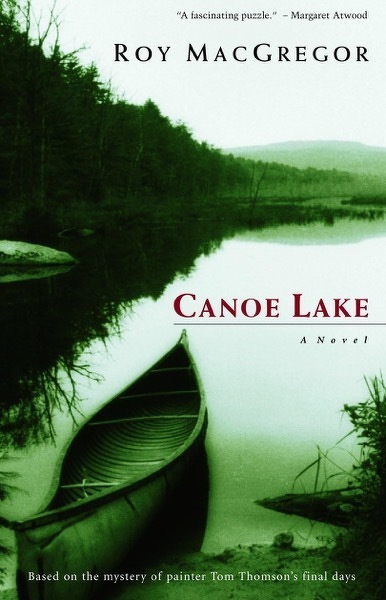
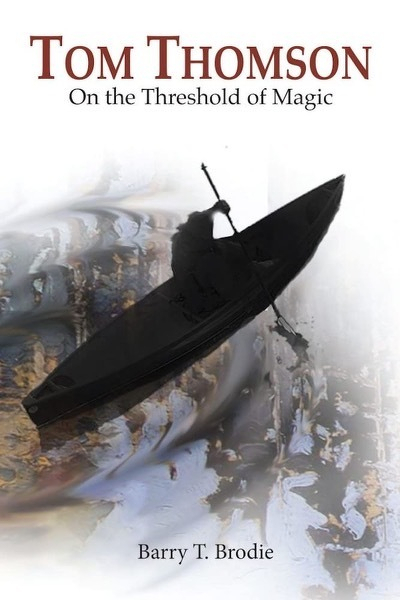
So, interested in Thomson’s story, I picked up two books at the McMichael gift shop (art museum gift shops are the best): a novel, Canoe Lake by Roy MacGregor, and a play, Tom Thompson: On the Threshold of Magic by Barry Brodie.
In Canoe Lake, Eleanor, a young woman from Philadelphia, searches in rural Ontario for her birth mother. Her questions kick off memories in Russell, an old-timer in the village living in a residential hotel, and his friend and unrequited love Jenny, now a spinster recluse but who at one time was going to marry a visiting artist named Tom Thomson. Eleanor’s detective work digging up secrets some people want kept jostles against Russell’s memories of Jenny and Tom, and of course, those worlds will collide in Canoe Lake, the site of Thomson’s death.
It’s a terrific novel, very well done, with depth and great textures, and a sensitivity for its characters, especially the hapless Russell. Definitely worth a re-read.
In his Author’s Note, MacGregor reveals his long fascination with the facts and mysteries surrounding Thomson’s death and MacGregor’s own distant family connection to it. The novel drapes a fiction over the bones of his research, though you can feel MacGregor really savoring the conversations of Thomson’s friends as they examine his body recovered after six or seven days in Canoe Lake, and speculate on the unusual gash on his temple and the fishing line tangled – or wrapped? – around his ankle.
Tom Thomson: On the Threshold of Magic by Barry Brodie is a poetic play with Thomson narrating his inner journey from young man to artist to his afterlife, with all the characters in trembling awe of his artistic vision. Over half of this slim book is in fact devoted to the play’s writing and initial staging, and the back-stage stuff is honestly the most interesting part.
NB: Thomson’s studio now sits on the McMichael grounds.
Life on Great Blasket island, three miles off the west coast of Ireland, was hard and cold, with a meager living scratched out from the ground and the sea. Life in the 20th Century was as primitive as it had been in the 18th and 19th. Among other effects of this isolation was the community’s continued reliance on Gaelic to pass along its rich oral tradition of history and folktales. The island never had more than 150 or so inhabitants and was eventually abandoned in 1953.
Oxford University Press published a series of seven books of Great Blasket memoirs and reminiscences. Peig Sayers was hailed as one of the island’s great storytellers. Her book is a collection of transcriptions of stories written down for her by her son, stories she remembered from others’ telling and stories of what happened to herself.
It took a while for me to get into the rhythm of the book; these stories were meant to be told, of course, not written. When she quotes poetry, the words are transcribed into English as lines of unrhymed prose, so there is a natural loss of emotion and power. And I’m sure the music and rhythms of her speech, the way she would tell the story, would make these reminiscences come alive in a way that they don’t on the quiet page.
Still, as descriptions of a time and place long gone, I was fascinated by the details of the lives they led and the characters she knew. Since we can’t recapture the experience of Peig’s storytelling on the page, here’s a description of the effect they had on a neighbor who had actually sat around her fireplace and heard her stories:
Often her thoughts would turn to sad topics; she might tell, for instance, of the bitter day when the body of her son Tom was brought home, his head so battered by the cruel rocks he had fallen on from the cliff that his corpse was not presentable to the public. So Peig, with breaking heart, had gathered her courage together and with motherly hands had stroked and coaxed the damaged skull into shape. ‘It was difficult,’ she would say; and then, with a flick of the shawl she wore, she would invoke the name of the Blessed Virgin, saying ‘Let everyone carry his cross.’ ‘I never heard anything so moving in my life,’ a Kerryman confessed to me, ‘as Peig Sayers reciting a lament of the Virgin Mary for her Son, her face and voice getting more and more sorrowful. I came out of the house and I didn’t know where I was.’
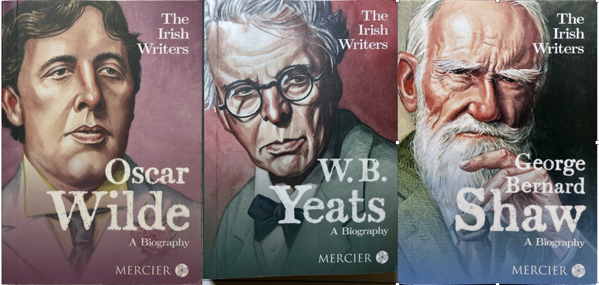
The Irish Writers: Oscar Wilde by David Pritchard 📚
The Irish Writers: W.B. Yeats by David Ross 📚
The Irish Writers: George Bernard Shaw by David Ross 📚
A neat little set of literally mini-biographies – each about 200 pages and about 4"x6" – very easy to hold in the hand. Bought from a newsagent’s across the street from Trinity College in June 2025. Apart from their major works, I knew very little of these authors so these little biographies suited me just fine. Stray observations:
Ross is the better writer of the two. His command of context and content, and his style, simply made his two books more enthralling and readable. The first chapter of his Shaw book, “Two Cities,” summarizes in 11 pages the economic, historic, religious, and cultural conditions of London and Dublin. It is a confident, breathtaking summary that provides a context for the emergence of Shaw – and Wilde and Yeats – onto the cultural and literary scene.
The Wilde book compresses an awful lot into a small space. What it illuminated for me was how long it took Wilde to “become” Wilde. I did not know how relatively late in life his success came, with his discovery of plays and their witty, aphoristic dialog being perhaps his ideal literary form. I also did not know that his father also indulged in sexual misadventures, which brought stress, shame, and hard times to his mother and family. The sins of the father…
While Yeats and Shaw did not engage in sexual adventures in the same way, they had their own hangups and issues with women that distracted their wives and caregivers. Yeats sponged off of them, Shaw adored the adoration of his younger female correspondents while stringing them along and keeping his paper conversations a secret from his wife.
An irony that linked all three of these Irishmen: their desire to be active players on the larger literary stage of London. From Ross’s book on Shaw:
Of the three, Yeats was most involved with their home country. Part of his vision was to establish a modern Irish literature, written in English, and Ireland continued to be a prime source of his inspiration, even though he spent as much time in England as he did there. Wilde was not concerned with Ireland. Shaw never forgot that he was an Irishman, and like Yeats was a Unionist who believed in Home Rule. But, though much in his thought and writing is Irish, he did not feel the rootedness in Irish history and culture that Yeats felt and nourished. He wanted to reform not Ireland or England, but the world.
One of the blurbs says “ice cool, self aware, and very funny.” Definitely icy and detached. A witty novel of a young lower-class Irish woman in Hong Kong and her romantic and sexual adventures among higher-class striving junior professionals. The characters are so high-verbal and articulate that you could cut yourself on their casual, lacerating banter. Ava, the narrator, is so detached from her own life and needs that I felt equally distanced; as funny and sparky as she could be, I also wanted to shake her and tell her to grow up. Though that last page is really good: her body finally chooses what her busy mind has denied her. The last of the books I bought in Ireland.
Note: Found this draft in my Marsedit folder – yipes! Must be over a year old by the time it sees print. Which makes it at least 2 years older than the previous Nova Scotia books posts. ACK. Lightly edited though it could be much better.
Final post! Almost a year after our trip was done and just before we start the next trip!
The only book 📚 I bought at the tourist shop at Hall’s Harbor, a great restaurant and mainstream gift shop, set in a picturesque postcard. Here’s a live webcam of the harbor.
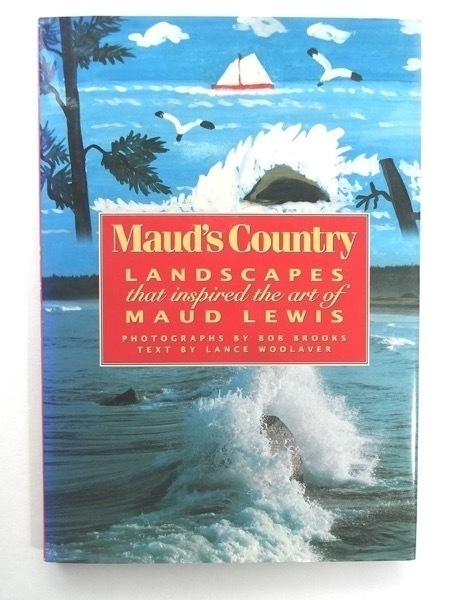
I bought this book at the gift shop, which did not make me less conflicted about contributing to Nova Scotia’s Maud Lewis Art & Industrial Complex.
By any measure, her life was a hard one. Born with birth defects and rheumatoid arthritis, living in a harsh climate, with a husband who people suspected did not treat her well, in a ridiculously tiny house not built to stand that strong weather. We saw the actual house many years ago, transplanted to a permanent Maud Lewis exhibit in Halifax NS. It seemed an incredibly, ridiculously small dwelling for two people. But considering that they lived on the edge of – if not in – poverty, they lived as thinly as did their neighbors.
The poverty was made somewhat bearable by her discovery of painting and its ability to earn small amounts of money that contributed to keep her and husband Everett in the basics.
Her story was ill-served by the cliched and horribly dishonest movie “Maudie”. While Sally Hawkins’ intelligence and energy ennoble any movie, its portrayal of Everett was highly speculative and that’s not including Ethan Hawke’s awful performance. Look at some of the contemporary accounts of his interactions with reporters and Maud’s customers: he was a talker, a glib salesman, the high-energy front man. He may have been dour and sour behind the scenes, but wouldn’t that have that been more interesting to play?
Not to mention the total dishonesty about Maud’s daughter. Read Maud’s Wikipedia entry and you’ll see a more fascinating and complex story than the fable presented in the movie.
But by all means: buy the “Maudie” soundtrack. A more wonderful and melancholy set of songs I’ve never heard, and we have never tired of hearing it.
Back to the book: it’s a thin one that takes scenes from her art and juxtaposes them with actual pictures of those scenes and landscapes, representing perhaps what Lewis would have seen in childhood or out her tiny home’s window. Quotes dot the book from people who knew her. It’s not a lasting contribution to Maud Lewis’s story, but provides an interesting way to look at how she transformed pictures from life into pictures in paint.
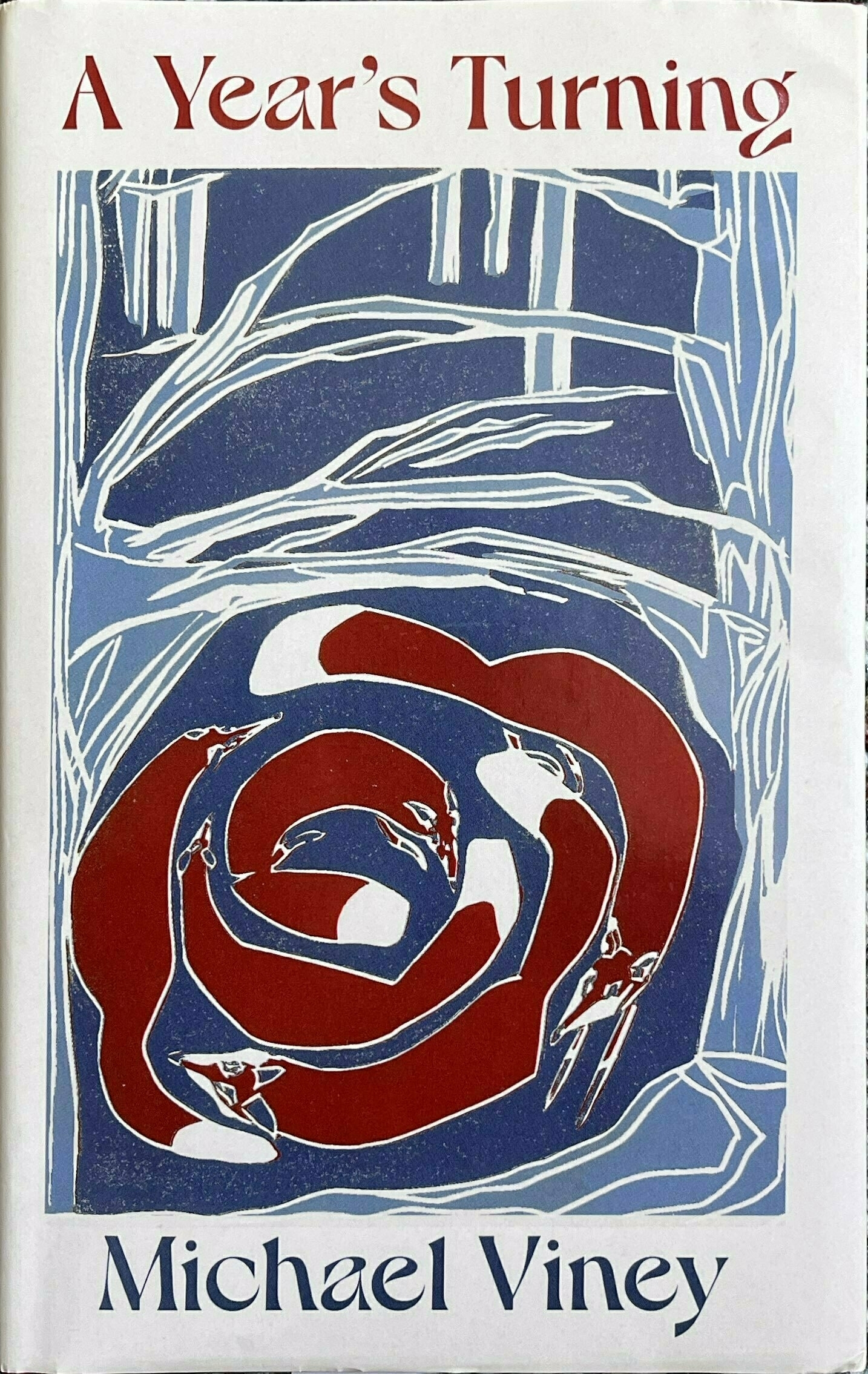
Purchased in a bookshop in Galway because I had not yet purchased any books while in Ireland and I felt I really needed to. And lord, that gorgeous cover illustration by Sheelyn Browne. Viney’s book of natural history, fact, lore, memoir, prose poetry, and his own drawings originated from columns he wrote in the mid-70s when he, his wife and daughter moved “back to the land” in a rural area of County Mayo on the West Coast of Ireland. The book was originally published in 1996 and reissued in 2022.
The essays – one for each month of the year – serve as a naturalist’s notebook of poetry, observations, history, science, and life in a remote and empty area of country. I had quite a bit of trouble following the thread of his essays until it occurred to me to mentally insert a few lines of white space between topics here and there; seeing these passages as entries in a scrapbook (with no need for transitions) made the chapters as a whole make more sense.
The book is studded with wonderful bits of lore and fact: phenology is the study of nature’s calendar; “botanists have calculated that spring moves north across flat ground at roughly two miles an hour” while trees begin to redden from north to south at about 40 miles an hour; primroses bloom early (prima rose, the first rose) to capture light and moisture before woodland trees start to leaf. “Woodland suits primroses because moisture evaporates more slowly in the shade.”
Viney’s prose can be intensely poetic and evocative:
There are at least seventy sorts of blackberry along the hedges of Ireland now, some hauling themselves about with briars the thickness of my thumb and armed with hooked prickles of a medieval ferocity.
But the writer’s attempt to put his love into words sometimes makes the prose giddy on its own perfume:
How lush, by comparison, our ‘bleak’ Mayo hillside, how sprawling and coarsely tangled and seething with flies and bees! But down on the duach, at the margin of the lake, there was an echo of the spare and precious flora of seventy-seven degrees north. For eleven months of the year, the closebitten sward is a sodden green carpet mostly innocent of blossom. And then, in August, its wettest parts put up a flush of chaste and beautiful white flowers.
What impressed me was, even in the mid-90s, Viney’s chronicling of environmental change. The hillsides that had been unchanged since the years of the Famine were seeing more plastic as litter in the landscape and in the ocean, more roads, the disappearance of species, the fading away of older generations who knew and appreciated the old ways of living in harmony with a sometimes harsh but often beautiful nature.
Think of what it means to doubt the ’naturalness’ of weather. We have never been sure what it would do, but we could be fairly sure of what it would not do, on average and over a period. Given a windy winter like this one, we could count on ‘fickle’ nature not to do it too often or too catastrophically. But supposing we lost that assurance: supposing, after sixteen storms since Christmas, we had good reason for trusting that there would not be sixty more? …
It cannot help that the people who might make decisions about global warming are themselves so totally insulated from natural things and especially from weather. One sees them on television, being ushered beneath umbrellas from one heated capsule to the next. What can they possibly know of life amid wind and rain?
Growing up in the South, Lewis and Clark were names in a history book. Important enough to study for a test answer, but with no local associations to their exploits they did not live long in the memory. (In North Carolina, it’s all about the Lost Colony, a few Revolutionary War sites, lots of Civil War battlegrounds, and a few civil rights landmarks.)
When we visited the Fort Clatsop Bookstore near Astoria OR in 2024, I bought several Lewis and Clark related books because I knew nothing about them. I opted for essay collections because I thought they would provide both a sweeping view of the mounds of historical data compiled about the Corps of Discovery and spotlights on specific moments that defined the expedition.
For my money, this is the best introduction to Lewis and Clark, why their exploits were so important, and why they have a hold on not just historians but the public imagination. Duncan’s essays are grounded in a love for and personal scholarship of the Lewis and Clark lore, a plain and straightforward writing style that clearly conveys information and detail, enough personal details and opinion without the essays centering on the writer, and an approach to the material that is respectful, imaginative, and clear-eyed.
What do I mean by that latter claim? Duncan is a Lewis & Clark enthusiast and until reading these books, I did not know there were so many devotees who re-read the journals of the expedition and trekked to retrace the Corps’ path. It’s his imaginative evocation of the Corps’ historical melieu that helps lift his storytelling – or retellings of these well-known episodes – to a more expansive dimension.
Duncan is always careful to remind the reader that, while we know the expedition’s outcome was successful, that was never something the two captains assumed. Duncan reminds the reader, at all times, that boldness, prudence, resourcefulness, grit, hard work, physical endurance, and sheer luck worked together to bring all the expedition’s members – save one who died of a burst appendix – back home safely. As Duncan points out, this is one of the few such excursions in history that actually ended successfully.
I never knew, for example, that the Spanish Army had set out with hundreds of soldiers and Indians to either capture or kill the Corps’ members. But information traveled so slowly and through such torturous routes in those days, that Lewis and Clark never encountered their pursuers. It’s likely they never even knew they were being pursued.
Duncan takes the data – Lewis and Clark and several of the soldiers under their command kept journals, and the wealth of firsthand information is what makes L&C scholarship such a rich field – and serves it up in really appealing ways. One essay is all about what the homefront newspapers were reporting during the two-year trip and how Jefferson was sweating waiting to hear about whether his bet on Meriwether Lewis and the expedition would pay off or whether they would simply vanish without a trace.
Duncan’s essay on 10 leadership lessons from Lewis and Clark starts as a take-off on those faux-business leadership books. But he indeed draws 10 good lessons from the journals by retelling and reframing the stories, mining the journals for details that evoke that time and place.
As for clear-eyed: as this quote makes clear, the aftermath of Lewis and Clark’s discoveries was not a success for the native tribes or the natural world. Comparatively little of what the Corps saw on their travels can be seen today due to dams, development, and American capitalism’s inability to let a good thing be. The native populations that were so numerous and culturally vibrant were reduced by smallpox, broken treaties and promises, and depleted natural resources.
Some of the most affecting passages for me were descriptions of what happened to the captains and crew after their triumphant return. There are few records of what happened to all the Corps soldiers. And Ambrose is clear-eyed about the individual failings of Lewis and Clark; while the trail and its outsized adventures and exertions brought out the heroic best of their characters, their return to civilization almost inevitably shrunk them back to society’s size.
Lewis suppressed the publication of a book by one of his soldiers so it would not compete with his own account – which he never wrote. Lewis’s depression swiftly returned after he re-entered civilian life and he was dead 3 years later. (Murdered or a suicide? Again, lots of lively debate on that .) Clark’s slave, York, accompanied him on the trail. As Duncan speculates, York’s voice was considered during crucial votes taken along the trip and the hardships of the journey equalized all the men (and woman). But back home, Clark refused to free York and was irritated by York’s insistence on joining his enslaved wife.
That’s what I love about Duncan’s essays: they show the high and the low, the best and the worst, the heroic and the craven, the beautiful and the ugly. The Lewis and Clark story is too vast to be one thing. It’s many things encompassing many stories, and these essays can start a new explorer of that landscape on the right path.
From Joann’s Chocolate Shop & Cafe: A charming little cafe where the owner makes her own chocolates and candies. And as if that weren’t enough, she has a goodly number of both used and new books.
Growing Pains by Emily Carr: this was our bedtime reading and a terrific description of long-ago places and times.
This is still on my to-read shelf. I like self-help books, and was interested in this one as the author is an Iranian immigrant who practiced psychotherapy in Newfoundland for 40 years – interested in finding out how or if his Iranian culture influenced his work with Canadian patients and vice versa.
From Bainton’s Tannery Outlet/Mad Hatter Bookstore: Props to Google Maps for finding this store for me; Bing and Apple Maps found the Mad Hatter Wineshop next door, but did not identify these establishments – which are an odd couple on the face of it. The tannery and leather goods occupy one side of this rather snug store, with new books on the other side. What struck me about their book selection was its strong focus on local culture, specifically Annapolis Royal history and culture; many of the books were attractively designed objects ideal for holding in the hand.
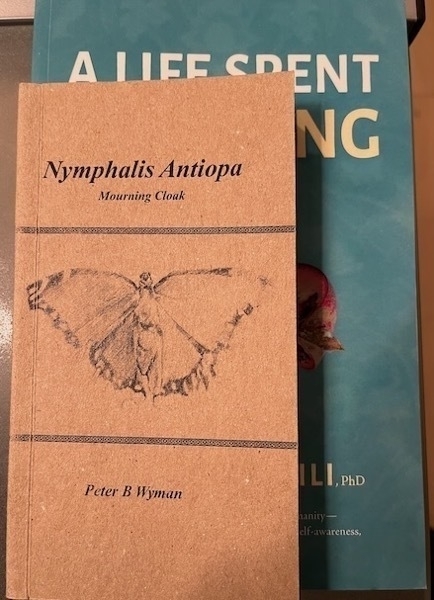
A small book of seven literary short stories. By “literary,” I mean the stories contain elegant writing and description, not much plot, some modest narrative experimentation, and their temperature never rises high enough to lift them off the page. Still, a couple of stories stuck with me. “Broken Angel” follows the police chief as he patrols the blocks of town devastated by the “Great Fire” of 1921; as I read, I remembered street names and landmarks that are key reference points in the story. The last story, “Radio Silence,” follows the narrator as he takes a winter hike along a particularly treacherous stretch of woods lining the shore along the Bay of Fundy and discovers a World War II legacy gifted to him by the strait. It’s a story of time passing, of rhythms, and of resting places.
Note: I was unable to find where this book could be ordered online; searching on the book title yields page after page of butterfly pictures, surprise, surprise. It was likely privately printed. If you’re interested, the author includes his email address on the book as wymanpe@gmail.com
Really enjoyed this story focused on a week in the life of a once-celebrated and now-degenerated, mostly forgotten standup comic slogging his guts out at two-bit one-night stands. Tallent excels at describing the experience of being on stage as Billy Ray Schafer smokes, cokes, drinks, connives, and somehow lurches himself into the only activity that makes him feel alive, while his paranoia and guilt make him self-destruct on his way to the next venue. He’s feeling the light about to go (the book never explains what “running the light” stands for; it’s when the on-stage comic ignores the blinking light signaling the end of his set yet refuses to leave the stage) (though the book’s ending lends another meaning) and it’s time to take care of loose ends.
I thought the story was gripping, with great set-pieces and some startling violence – Billy Ray’s anger at himself and God is always ready to explode at the least provocation.
But the telling … oy. The audiobook may gain a frisson of interest as individual chapters are narrated by various stand-up comics, but their readings are wildly different, some of them are not good at all, I could never tell who was who in a dialogue, and the indifferent, variable sound recording for each narrator made me yearn for a good studio-produced recording with an actor/comic who could have lent consistency to the story’s telling so that I didn’t keep falling out of the dream whenever a new narrator appeared.
Currently listening via Audible to Running the Light by Sam Tallent 📚 I like the way we’re in the character’s head from the get-go, and I’m loving the descriptions of a stand-up comic’s brutal road-life. But having different stand-up comics read aloud each chapter is disconcerting. A few are really good readers, but a few have lousy diction and no sense of rhythm or emotion. It jolts me out of the dream, and the recording quality varies for each one. Disappointing.