Warning - Mild spoiler alert. I don’t reveal plot points, but if you read this post, you’ll be able to put it together.
We’ve had an astonishingly good run of movies this summer, apart from the abysmal – dare I say Pepto-Bysmal – “Blue Jasmine.”
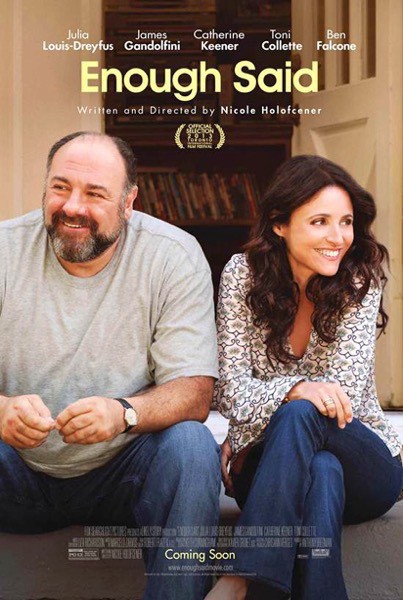
Our latest was “Enough Said,” a small, sweet romantic comedy from writer-director Nicole Holofcener that is a terrific star vehicle for Julia Louis-Dreyfus, whose acting and energy I’ve always liked. It’s also one of James Gandofini’s last movies and what a nice note to go out on.
How rare is it to see a romantic comedy between two middle-aged adults (we’ll skip over “Before Midnight,” which is a different beast altogether and which I didn’t love as much as “Before Sunset”)? Although Gandolfini clearly breaks the typical leading-man mold, Louis-Dreyfus as the masseuse Eva is Hollywood-thin and Hollywood-pretty; when Eva complains about being flabby, my eyes rolled out of their sockets and fell into the popcorn. Still, she and Holofcener are not afraid to show the lines and wrinkles. I also thought it was great seeing a middle-class character living in a smallish home and wearing jeans and flip-flops the way most people I see in life do.
Why do I call it a “small” movie? The story’s concerns stay within a rather tight orbit of family and friends, and the stakes at first seem small – no one is going to lose their house because they can’t land the deal, the Empire will not fall if the Nose-ring of Aggraddorr is not destroyed. But in the end, I was so swept up in the everyday concerns of love, friendship, family, and broken hearts that these characters’ attempts to find happiness left an oh so pleasing aftereffect. The movie’s pace is casual, the music understated, the costumes and settings unextravagant. It’s a recognizable and comfortable world.
I’d even hedge my description of it as a “romantic comedy” as Holofcener strenuously steers the movie away from the standard genre tropes. They don’t meet cute; Gandolfini’s Albert actually asks for Eva’s phone number – like a grown-up would do! Their dialogue in the movie line and at a restaurant is not the sparkling cut-glass banter of Cary Grant and Irene Dunne. Instead, their badinage is playful, gentle, funny, tentative – clever, but in the way that intelligent people can be clever, not Hollywood-clever. And there are no stupid misunderstandings where one starts out not liking the other and then must be swayed to fall in love. These start out liking each other, but then doubts creep in; they’re both divorced and the memory of old mistakes starts affecting the new relationship.
It’s a movie about relationships – wrecked ones, strong ones, parent/child, man/woman, older/younger, boss/employee, lovers, ex-lovers, friends. The movie is full of people needing a connection, or losing a connection, or needing to renegotiate a connection; it’s a theme that is masterfully played out and subtly done.
But the movie can’t escape its genre handcuffs in the way that Eva holds on to information she should clearly divulge yet clings to while stringing along both her boyfriend and her new friend and client, Marianne (Catherine Keener), a poet who lives a kind of beautiful life Eva envies.
The movie pretty much demands that Eva’s deceptions be revealed in the most humiliating way possible and they are. Eva weasels and squirms and tries to evade her responsibility for the situation, but the script doesn’t let her off the hook. And while the deception plot seems just like the kind of slapstick setup for Elaine on the old “Seinfeld” show, Louis-Dreyfus doesn’t go for laughs. Eva deserves to be put on the spot; she knows she’s hurt people she’s come to care about and who care about her. It’s a devastating moment because life will not be the same afterward for anyone.
I liked how Holofcener did not give Eva an easy out. When she goes to Albert’s house to apologize, there’s no shouting, no banging on tables, no big scenes – just honesty and sadness played out in an ordinary kitchen. When Albert’s daughter, who has been an obnoxious snob for most of her scenes, gives Eva a gift of unearned and undeserved kindness, there should not be a dry eye in the house. It’s one of the most real, and also one of the most touching, moments I’ve seen in a movie in a long while. (Always be skeptical of a reviewer who really loves something, kids; it means his love for the material is overlooking flaws. But in this case, I care not.)
One of my few complaints about the story is that Keener’s character is left high and dry by Eva’s betrayal. As I think back on it, it’s pretty clear that Eva was awed by the poet and is flattered to be considered her only friend (really? her only friend?) but the liking is only one way, from the poet to Eva. Keener does a good job of conveying her liking for Eva, and she looks devastated at the revelation of Eva’s betrayal. But we don’t see Eva attempt to apologize or try to set the matter straight with her. It’s as if Holofcener is saying that a loving relationship with a man is more important than an affectionate friendship with a woman. That may be an artifact of the genre or it would have unbalanced the story of Albert and Eva, with whom we’re more invested by the movie’s end. It’s one part of Eva’s story that really bothered me afterward.
In compensation, though, there are many other lovely moments, one of which is Eva and her ex-husband saying goodbye to their daughter at the airport, with tears flowing from the women as they check her through security and then see the escalator take her away. Holofcener holds for a time on Eva and her ex-husband as they walk away, clinging to each other tight and reassuring each other – such a beautifully done moment. Again, a real moment, with respect paid to the emotions these characters are feeling and not chopped short by a wisecrack or witty quip.
The ending is tentative, reassuring, and the right words are said. No big emotions, no big music, no big Hollywood-anything – just two people sitting on a porch, trying to get back to each other. So yes, a small movie, and I loved it.
Although Gandolfini doesn’t get the set pieces that Louis-Dreyfus does, his presence throughout is solid and grounded and it would be a lesser movie without him. He’s a big teddy bear , with a rumbling voice and gentle manner, and enough steel to let Eva know that she’s crossed the line. But even then, he treats her with respect.
Update: The reviews that I’ve scanned also like the movie, and use “bittersweet” to describe its tone, which is a word I wished I’d thought to use. This brief New Yorker review by David Denby says a lot more in a lot less space (I really should learn to write sometime). He also uses a word I should have used to describe Gandolfini’s performance: “dignity.”
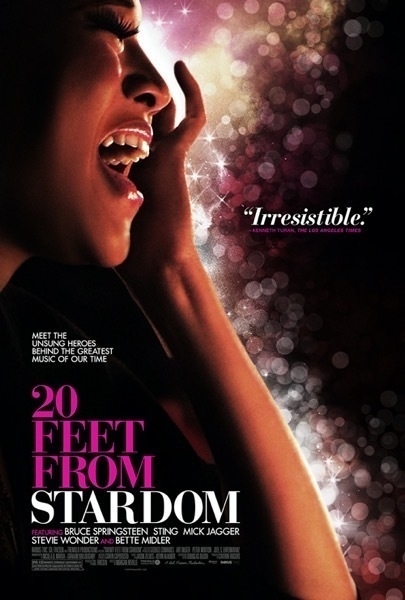
When Tom Waits was inducted into the Rock and Roll Hall of Fame, he said, "We all love music and we want music to love us, too." It's a thought that haunted me after watching the glorious documentary 20 Feet From Stardom.
The movie starts on a sunny note as a trio of backup singers reunite after not having seen each other for decades. The tracks of songs they sang are played underneath, and you notice the names of different girl groups appear for each song. Their voices were everywhere, it seems, but they remained anonymous.
"20 Feet" tracks the fortunes of several singers from the first generation of girl backup singers. The first half of the film is fun, vibrant, and star-studded: the girls sing backup for the big names of rock and roll, with occasional solo duties on the records or duets with the stars. Mick Jagger, Bruce Springsteen, Stevie Wonder, and Sting contribute both raves for the singers who work with them and grounded, thoughtful perspectives on the life of a backup singer and why stardom sometimes eludes them.
Because, make no mistake, these singers gave everything they had to music and -- not without reason -- they'd like something back. As the girls grow into women, and the '60s become the '70s and the '80s, their attempts to crack the mainstream become more and more futile and their feelings about music turn bitter. The movie becomes heartbreaking by slow degrees. There's a particularly disquieting moment when the camera pans down a stack of solo albums by backup singers who saw these records as their ticket to mainstream success -- none of which were successful.
Did they not work hard enough? If you love something enough that you give up your life and youth for it, isn't it supposed to pay off? Where's the line between persistence and banging your head against a wall? Or is it also, as Sting and Springsteen say, a matter of luck, circumstance, and a thousand other variables that no one can control? The up-and-coming singer Judith Hill, who was all set to break out into superstardom, suffers with a tragic setback that she could not have planned for or even imagined. The movie follows her as she continues trying to execute her solo career, while also accepting backup jobs when she has to or wants to.
One of the profiled singers, Lisa Fischer, is at peace with her life as a backup singer. She knows the price big stars pay for their stardom, and she's happy that she never paid it. The occasional moments of her singing solo showcase a deep, jazzy voice; the respect that the other artists in the movie have for her and her voice are strong and stirring. She may not be out front, but she's never taken for granted.
The movie, however, belongs to two women: Merry Clayton, a powerhouse singer with a "kill spirit" who worked single-mindedly to become a star and who still feels the frustration that her dream eluded her, and Darlene Love, whose voice was used in dozens of hits produced by Phil Spector, who cruelly exploited her talent. Darlene's story has a happy ending, of sorts, but I could not shake the story of her years away from music and how narrowly she missed the chance to be welcomed back into its arms.
I picked up this book in Kenosha on my vacation, and it jibes well with Michael Neill's TheInside Out Revolution. This is not surprising as both describe the 3 Principles, which was conceived of and taught by Sydney Banks. But Slowing, written by Richard Carlson and Joseph Bailey, was originally published in 1997, long before the Web and podcasts made it easier to disseminate Banks' spiritual and psychological teaching. Carlson and Bailey focus on a rather narrow piece of the 3 Principles philosophy, without ever mentioning the principles by name, and citing Banks only once. Neill's book, by contrast, was published in 2013; he discusses all the principles and frequently cites Banks' words and teaching stories.
That sounds like I'm sniffing at the book, and I don't mean to. Slowing Down to the Speed of Life is quite good at emphasizing a few key points and then reiterating them, ringing changes on them, showing how they can apply in many different areas of life. The section on Work and Office is terribly skimpy, though the chapter on Family Relationships is terrific. It's quite readable and I sped through it on the train to Chicago and in my spare moments.
Instead of writing an exhaustive and exhausting review, here are the key things that got my attention.
Key Takeaways
It's not what you think, it's that you think. A lot of self-help books, methods, and training -- such as cognitive behavior therapy -- teach you to dispute the contents of your thinking and disprove them. However, what's most relevant is that your mind is kicking up a thoughtstorm of beliefs, feelings, expectations, etc. When an event happens, the feeling you experience is not about the event; rather, what you're experiencing is your feeling about the event. It's as true for internal moods as it is for any external event. When the water in a pond is agitated, you can't see to the bottom -- it's doesn't matter why it's agitated. When the water in the pond is still, it's easier to see to the bottom.
We have two primary thinking modes: analytic and free-flowing. The analytic mode is our typical Western habit of thinking it through, figuring it out, and so on. It works great when the problem is well-defined and logistical. But it's a tool we use to solve most every problem we see (if we think that what we see is a problem -- it's all thought, remember). The free-flowing mode is the slower, deeper, not-much-on-your-mind thinking that is where you should stay as much as possible. This is where all of your good ideas come from when you're in the shower, while driving, etc. When you put things on the back burner, the free-flowing mode is where they're processed until you pull them out to examine them again in analytic mode. Know which mode you're in; you'll feel better in free-flowing mode. Trust it.
Thinking=feelings. As Neill says often, we don't live in the feeling of the world, we live in the feeling of our thinking. If we're feeling anxious, we're thinking anxious thoughts. If we're feeling stressed, we're feeling stressed thoughts. Using analytical thinking to figure out why you're feeling crappy will only make you feel more crappy. You're stirring up an already agitated system. Realize that your feelings are like the weather -- wait a while, let your mind and thoughts calm down, and your feelings will also settle down. With those distracting feelings settled, your free-flowing thinking has a better chance of offering you a solution to your problem.
Key Action Steps
There are no action steps except to stay in the moment, notice your thinking, and calm down. Isn't it frustrating to read a book only to find that there's really not much you can do? Neill's book avoids any prescriptive advice. Slowing provides a few bits of simple advice, but the message is consistent in both books: the key is in recognizing when you're caught up in a thoughtstorm. When you recognize that you're thinking, Carlson and Bailey repeatedly say, you'll almost instantly feel better; the storm will subside and your internal system will reset. I've not found that to be consistently true in my case. I can recognize that I'm in a low mood, I can know my thinking is causing it, but it will still take a week for the cloud to pass before I feel better.
Practice gratitude. They don't mention this one, but it's one I use to interrupt my low moods. I used to write a daily gratitudes list and tried avoiding the easy ones like "my loving wife" and "I have a job." The lower the mood I'm in, sometimes the deeper I have to dig. It turns my attention outward and interrupts the thought spiral.
Set aside time to just sit, with no input. Feel your breathing. Listen to what you can hear in your house, in your backyard, in the world. Feel where the weight of your body is pressing against the chair and the ground. This is like meditation, but maybe a little more natural. When I feel my thoughts about the past or the future, I know I'm not present in the moment. Calming down and being present in the moment can mean simply focusing on doing one thing at a time rather than multitasking. I'm trying to get out to the back porch more to just sit and look at the yard, the birds, the garden. I leave the iPod and Kindle inside and let my brain and mind relax from all the input I stream into it.I find this can extend time for me, and life slows down, in addition to my thinking.
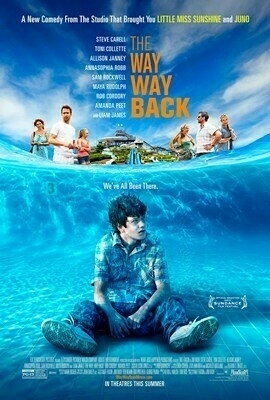
Jim Rash, Charlotte NC-native and UNC-CH alum -- best known to the world as Dean Pelton on Community -- has been exercising other talents the last few years. He and his co-writer Nat Faxon won an Oscar for their screenplay of The Descendants (with Alexander Payne) and the pair have created a great, light, summertime coming-of-age comedy, The Way, Way Back.
An interesting nugget from this article about the film is that the opening scene was drawn from a conversation the 14-year-old Rash had with his own step-father. Which is pretty appalling all on its own. Another appalling fact is that this pleasant, funny, innocuous screenplay sat on a desk for years because, though it was admired, no one wanted to invest the money to film it.
The movie follows the adventures of the sullen Duncan as his mother, her boyfriend, and his daughter occupy a summer cottage near a Massachusetts beach area, in an attempt to foster a "family holiday" vibe. The boy's awakening to his own potential is charmingly done, and I liked that the almost-romance with the girl next door was part of the story but not the whole story.
The all-star cast members -- Toni Collette, Steve Carell, Amanda Peet, Maya Rudolph -- show relatively little of what they're capable of (except for Jim Rash, who gives himself a colorful cameo). The movie is largely driven by the other characters' reactions to Liam James' brooding Duncan or they're behaving in those baffling ways lost adults do when they want to torture their sensitive offspring. James walks around like a slumping caveman; his knuckles would drag the ground if his arms were long enough. So when he starts to look around and participate in the world around him, his delight and excitement is warming to watch.
That said, two performances really got my attention: Allison Janney's brash and boozy next-door neighbor and Sam Rockwell as the fast-talking, mouthy owner of the Water Wizz amusement park where Duncan finds a haven. Rockwell's character is a lazy slacker, but he's accepting of all the misfits who drift through the water park. His needling, cajoling, and ribbing of Duncan bring the boy out of his shell; his loyalty and support of Duncan are quietly done and deliver exactly what I want in a feel-good summertime movie.
I have thoroughly enjoyed showrunner/head writer Steven Moffat’s fresh take on Doctor Who, and I’ve equally enjoyed Matt Smith’s take on the character and the deepening relationship between the Doctor and his new companions, Amy (Karen Gillan) and Rory (Arthur Darvill). Part of the excitement may have been being in on Seasons 5 and 6 as they’ve been broadcast; I came to the 2005 reboot late and gorged on Netflix streaming of the episodes as my school and work schedule allowed.
The problem with coming to the show late was that the conversations around the episodes had already happened, so it was like coming to a party late only to find the leftovers – paper plates, cups, empty bottles and cans, and handfuls of snack foods strewn all over the counters and tables – after all the people have left the house and moved on to the next party. So part of my excitement about seeing the episodes as they’ve aired is also waiting to see what the reviews are like, whether I agree with them, leaving comments, and joining in the conversation myself.
I do have to often remind myself – this is just a TV show and there are reasons beyond reasons why stories and seasons work out as they do. Reading The Writers Tale by previous showrunner and the man responsible for the series reboot Russell T Davies showed just how haphazard and crazy-making is the production that goes on behind the scenes. I’m sure Moffat’s reign has been no different. That so many good episodes get made that delight so many people is something to be thankful for, and I usually find something to enjoy even in the so-so episodes.
Anyway – the final episode of this mini-season aired over the weekend, so here are my (I hope) capsule comments. And keep in mind I’ve only seen these episodes once, so, caveat emptor. Also – Spoilers!
Asylum of the Daleks
Well, I babbled on all about this episode in a previous post. I’ll reiterate that, despite the story’s longing to impress with its epic scale, it still felt like a small episode. Small emotionally, that is. I could never believe that Amy and Rory would have separated, so that seemed like fabricated conflict and it was never referred to again (much like Amy’s inability to have children; she adjusted to that pretty well, didn’t she?). But the Doctor’s discovery of Oswin’s true nature – and the show’s toying with the audience all the way through till the twist – is classic Moffat and was absolutely brilliant. He has a weakness for being too clever by half and loves high-concept structures (such as Donna Noble’s life in the library, which used the standard TV technique of jumpcuts as part of the storytelling method).
Still, a throat-grabbing season opener, written with his typical quickness and smash-panache. It’s probably unfair to ask other writers to create Moffat-type blockbuster stories; he’s really the only one who can do that kind of story justice. And he’s one of the few to actually play with timey-wimey stories, though I fear he over-relies on certain types of time-travel stories to the exclusion of others.
Dinosaurs on a Spaceship
A romp, which is what was called for, but not a story I’ll come back to often. The villain was the kind of unrelieved evil bastard that we rarely see in the series and I was frankly glad for the Doctor to send the guy to his reward, morals be damned.
What I liked most, though, was the interplay with Rory’s Dad, Brian, and the changes that occur to him due to his adventuring in the TARDIS.
Amy, particularly, finds herself still to be the girl who’s waiting for the whine of the TARDIS. Why is the Doctor’s gaps between visits getting longer and longer? Also, that chilling moment of dialogue that Steven Cooper captured so well in his review:
When Amy tells of her fear that one day he’ll simply stop showing up and she’ll be left waiting forever, he promises her, “Come on, Pond. You’ll be there till the end of me.” Amy cheerfully replies, “Or vice versa,” and then there’s an odd, rather horrible pause until the Doctor finally says softly, “Done…” He immediately pretends that he just meant he had finished what he was working on, but it’s obvious that something important has been set in motion. An ominous portent for the future, and a signal that the time for carefree adventuring is over.
Also, the way he looks longingly at Amy and Rory as they gaze down at Earth. The look of immense sadness on the Doctor’s face is a signal to me that he already knows their future. And this is one of his last chances to let that sadness show.
A Town Called Mercy
Not much of Amy and Rory in this episode, but a great setting and a moral quandary reminiscent of Star Trek: The Next Generation. The Doctor is better used here, and the acting and speeches are all done to a faretheewell. For such a talky episode, I found it absorbing. Definitely one I’ll see on a threepeat.
The big honking bash-us-over-the-head-with-it clue is that the Doctor was taking the Ponds to a Day of the Dead festival. Oh come on! Isn’t that a little too on the nose?
The Power of Three
Most reviewers commented that this felt like a classic RTD episode: invasion of Earth, big emotions, UNIT. Good stuff and props to the writer Chris Chibnall for delivering an episode that delivered on the emotions but not so much on the story.
I agree with most of the reviews that say the ending did not live up to its promise, but when does that ever happen in most stories? The premise is always the best part, with Acts 1 and 2 exploring the implications of the premise. Act 3 usually comes up short. It’s even worse in genre stuff like science fiction or Doctor Who (I like The Moff’s description of the show as fantasy and fairy tale). As Harlan Ellison has said of writing science fiction, the emotional and intellectual content has to always sink below the level of the rococo furniture of plot, pacing, logic, etc. How many really great Doctor Who endings have there been? RTD hit the reset button multiple times, as did The Moff in “The Big Bang,” so let’s just be glad the ending didn’t take up more time.
The A story for me was the Ponds finding that they enjoyed real life, non-Doctor life. I couldn’t quite believe that Rory missed the running around and adventuring; he always struck me as the one most likely to want to settle down and live a normal life. And Brian’s pointed question to the Doctor of what has happened to his previous companions was gloriously and gravely delivered by Matt Smith.
“Some left me, some got left behind, and some—not many, but… some died. Not them, Brian. Never them.”
Does the Doctor know at this point what will happen next? If he does, how dare he look at Brian in the face, and smile, and salute? Even so, that final moment is gracious and wonderful.
The highlight, the sheer emotional pinnacle of the season thus far is the conversation between the Doctor and Amy, where he confesses his love for both Rory and Amy – “you’re imprinted on my hearts” – and that he’s never running away from things, but running to them before they fade – as Rory and Amy will fade. It’s a heart-choking moment as they simply sit and enjoy each other’s company. Amy is the companion whose life has been the most affected – even abused – by her time with the Doctor. It’s astonishing how Gillan lets Amy absorb those experiences and still find peace and happiness with both Rory and the Doctor.
Again – is this the Doctor stealing one last moment of closeness with the Ponds after the New York adventure? Just because we see these stories in a particular order doesn’t mean Moffat isn’t playing timey-wimey games with us.
The Angels Take Manhattan
Oh. My. God. I had to watch the last 20 minutes standing up as I was too anxious and scared to sit without squirming. Typical Steven Moffat story! Timey-wimey, breakneck speed, fabulous images, chilling plot twists, and darker, more jagged emotional edges for the Doctor. I was aghast at how he left River to get herself free of the Angel and then not noticing the price she paid to get free – and her determination to keep him from knowing the price all of his companions pay. Although River didn’t play a big part in the story’s big moments, her presence made this a family episode and she lent considerable weight to the emotional moments.
Amy and Rory are getting older, as is River – but not the Doctor. The Doctor loves Amy and Rory but we know he also likes the company of the young and can’t bear to see these short-lived humans he loves wither and die. How to resolve this? And – the actors playing Amy and Rory have stated they don’t want to do any cameo appearances on later episodes. The Ponds’ farewell has to be final, and Moffat must craft that type of story. (Unless he’s lying. Rule One: Moffat Lies.)
Yes yes yes, there are plotholes. (How come Amy and Rory aren’t scooped up the big Angel when they’re not looking at her? Why aren’t the Doctor and River taken by the graveyard angel? Where do Amy and Rory wind up when they’re sent back?) But as Moffat has said, the scene on the roof with Amy and Rory is where they grow up, where they come into their own and are free of the Doctor. The Doctor offers little help to anyone in this episode and suffers the most loss. The cleverness that enabled a reboot of the universe and escaping death on the beach is not present here. Amy’s final scene, as she has to say good-bye to the Doctor and give instructions to River without turning to look at them, was powerful and wrenching. I’m sad that Rory didn’t have a similar farewell scene, but his moments on the rooftop made up for that.
Notice how the headstone didn’t include their years? Probably not significant. The point was to show that they had lived long, full lives – without the Doctor. And continued to help him with the writing of the novel that provided the clues he needed to get him out of the dilemma with the Angels. That device is so reminiscent of what Sally Sparrow does in “Blink”; Moffat really loves to pieces and overuses the Bootstrap paradox of time travel, and I dearly wish he could think himself out of that device and play a little more.
I so, so want a few lines in a future episode where he looks them up in old newspapers or books – why did they stay in New York? How did they survive their first days in New York with no ID, no money, no friends, no comforts of home? How could two people used to the comforts of the modern era adapt to mid-20th century life? But then, hadn’t they survived much worse? Maybe it’s enough to know that they lived happily ever after and – though they didn’t decide it on their own – had stopped waiting and started living.
Final stray thoughts
I’ve enjoyed Moffat’s series-long arcs, with all their clues and secrets that only made sense after the season was up and I saw the episodes again. Despite Moffat’s contention that this mini-season would be made up of standalone blockbuster episodes, I still think he has laid clues and elements that tie the stories together into a whole. I can’t wait to watch these episodes again, now that the Ponds – I should say, the Williams – have well and truly left the scene.
One of the visual motifs many commenters noticed was that each episode had blinking, buzzing light bulbs on the verge of going out. I don’t think that has any deeper significance than being a visual/sonic element to tie these stories into more of a thematic whole. I will note that Moffat likes buzzing light bulbs; just watch “Jekyll.” Also, I remember Francis Ford Coppolla talking about a scene in “Godfather II,” where Vito Corleone’s first victim pauses in a hallway to screw in a lightbulb that’s blinking and buzzing. Coppolla’s contention, as I remember it, was that something odd has to happen just before a major explosive event, something out of the ordinary that signals the extraordinary that is about to come. Think about those eerie moments before Sonny is killed in “The Godfather”; he knows something is wrong but doesn’t know what. Similarly, I think Moffat told the writers or production team to throw in some buzzy light bulbs to signal to the audience that something was about to happen, so keep watching.
One of the thematic motifs for this season has been endings, growing older, and growing up. Amy and Rory are aging faster than their friends, she needs reading glasses, River needs to keep up a bravura front (wasn’t she supposed to be growing younger?). But the Doctor hates endings and the Doctor never ages. As one reviewer has remarked, series 5-7 have been about the companions – these stories have been about Amy and Rory’s journey.
I think the blockbusters idea sounded great on paper and made for great-looking episodes – better than anything seen in the RTD era – but their size and scale failed to deliver what a good bottle show like “Amy’s Choice” could. The stories were so big and so swift, yet had to compressed to less than 45 minutes. that there was no time to let the emotional moments breathe. I missed those moments.
Various reviewers made much of Amy’s repeated warnings to the Doctor not to travel alone, that traveling solo unmoored him from his moral bearings. No one ever mentioned that Donna Noble said this to the Doctor way back in “The Runaway Bride.” So I couldn’t help but think this was simply reiterating a point that had been made very effectively years ago. And I couldn’t see right off what Amy’s observation added to it.
Also, let’s remember – it’s early days yet. After I’ve lived with these stories for a while, and seen the episodes again, I may feel very differently. Moffat’s stories have always rewarded repeat viewings.
Can we have a round of applause please for Karen Gillan and Arthur Darvill? I was not impressed by Gillan in “The 11th Hour” but by the time of “Amy’s Choice,” I thought she was great and she only got better, with “The Girl Who Waited” being her masterwork. And Darvill, stuck with a potentially thankless part, made the most of it and became a great source of decency, strength, humor and humanity in the stories.
I may yet have another Doctor Who related post up my sleeve at some timey-wimey in the future. Until then – waiting impatiently for the Christmas episode!
I can’t remember how I ran across Markson’s novel This Is Not A Novel, but I found it so fascinating an experiment that I scooped up and read his other novels that followed the same disconnected yet mosaic-like form.
Colin Marshall has written an appreciation of Markson, who recently died, that takes in all of his novels, and the comments led me to this post on the author’s death, written in the late-Markson style.
It’s a potent style that’s quite seductive to adopt. And of course I adopted it in 2009 when writing about Markson’s last books for UNC-CH’s School of Information and Library Science’s in-house zine, The Galley, and which I’ve included below. (I had a stringent word-count to meet, hence its painful brevity.)
Suggested headline: This Is Not A Book Review
Commuting from the Park & Ride lot, I read these books, one by one. You can read 10 pages in a very short time.
Unusual they are, with sometimes awkward syntax. With about 14 one- or two-sentence blurbs to a page. Sometimes only fragments.
Every page filled by remembered passages of verse or prose, quotations, anecdotes, the detritus and gossip of artists’ sad lives. The “residue of a lifetime’s reading,” says the back-cover blurb.
A melancholy book. With one or two jokes thrown in.
You’re left to intuit what’s really happening at its center. Rather like contemplating the negative space in a painting. It’s weirdly fascinating and absorbing.
Markson claims that not one fact is repeated among all the books.
Reader’s Block and This Is Not A Novel are the first two books, and are the best. Markson has found a new, challenging, avant-garde form, and plays with this odd new toy.
But the third book, The Last Novel, feels too deliberate and planned.
Give them a try. They’re at Davis Library. I bet you’ll read more than 10 pages at a time.
Thanks to the glory of Netflix, Liz and I saw this documentary that I can assure you never visited the Carolina Theatre. It's a bio-doc on the writer Harlan Ellison, 72 years old at the time of the movie's release in 2007, and covers an impressive sweep of his life, with samples of him reading from his stories, talking heads quotes from friends and other writers about his influence and the impression he's made on their lives, and various NSFW-language interviews that evoke the man's history, philosophy, irritations, annoyances, and, now and then, joys. (The YouTube video here is from the movie; it's HE in his most typical mode of full-flow righteous anger--well-deserved, in this case.)
I was introduced to HE as a sophomore in high school and didn't look back for nearly 15 years; his personality and writing were vivid, electrifying, throat-grabbing--uncompromising, is the word that leaps to mind. Uncompromising to the point of lunacy, sometimes, but all in the name of dignity, self-respect, and justice, which for HE are paramount virtues.
"Dreams with Sharp Teeth" was a real test, as Liz had never experienced Harlan and was put off by his abrasive and, it must be said, obnoxiously show-offy personality. But she said she grew to like him better as the movie went on; you see the grit, energy, anger and just plain orneriness (an old-fashioned word that Harlan would love) that took a bullied little kid from Painesville, OH (a metaphorical town name, if ever there was one) to Los Angeles and success, of a sort. The movie confronts the fact that, although his writing has always been admired by his peers and lauded by fans, his career never really took off. His labor in the vineyards of genre fiction, teleplays, and short stories won him many writers' awards, but not mainstream success.
The documentary recognizes the respect that is paid to his longevity and his highest writing achievements--especially some of his most important short stories from the 1960's, such as "Repent Harlequin, Said the Ticktockman" and "I Have No Mouth and I Must Scream." But he still remains a marginal literary figure, it seems to me, a miniaturist in a culture that likes The Big Novel, the province of a dedicated few. His legacy, in addition to his thousands of stories and awards, may be more in the writers he has inspired who've gone on to produce Babylon5, the revamped Battlestar Galactica, and other TV series, or had more commercially successful writing careers themselves (such as Dan Simmons and Neil Gaiman, who pay tribute to HE).
As Gaiman says in the interviews, HE's greatest creative act has been this character called "Harlan Ellison." Partly sincere, partly schtick, with a freakish a memory for cultural and historical details, a fast-talking patter, and in-your-face energy--an electrical storm front on legs--driven by a hair-trigger temper and a determination to prove he's better and smarter than the bullies around him.
He says, in a poignant reflection, that being beaten up every day by bullies makes you an outsider. I think that, in many ways, large pieces of him are still hurting and still wants a happy childhood.
Another legacy of his childhood is that he sees the world as a big bully that shouldn't be let off the hook. In fact, the bully should be shamed, kicked where it hurts, and his nose should be rubbed in it. ("Revenge is a good thing," he says in a 1981 TV interview.) It powered his writing and his political and civil rights activism, his numerous lawsuits against studios and networks, and made him a fiercely loyal friend and ally. But it also meant he couldn't pick and choose his battles because everything--from a Writers Guild contract to the wrong brand of yogurt at the grocery store--demands a shouting confrontation, and if you cross him, then get ready for screaming phone calls.
While he never got to be one of the writers of great movies, as I think he dearly wished to be, it's hard to imagine him being happy on a movie set. To have the sort of control he wants, he'd have to do what his acolytes have done: become the producer and helm the entire enterprise. But that would mean he'd have to be the boss, and I'm guessing he'd not enjoy that role. He considers writing his holy chore, not producing or directing. Although I think he'd love meeting and kibitzing with the actors (his life's wealth could be said to be the devoted friendships he's gained of rich and famous people), he'd be driven to mania and a rusty chain saw by the thousand compromises and trade-offs that are a major movie production.
And also, he's always been an outsider; to be a producer/director would mean having to work inside the system, and he couldn't flatter and cajole the suits whose primary concerns are the budget and the schedule, not the story. HE knows his confrontations and lawsuits have poisoned the studios and investors against him and made him virtually unemployable except by a few younger-generation writer/producers who see him as a mentor who inspired them when they were teenagers. He says he has accepted that condition--though it's hard to be sure. Regret and disappointment are other major themes in his work.
The movie is a wonderful hagiography of Ellison (much better than the similar "The Mindscape of Alan Moore" in 2005) though it does assume that he's loved by his fellow writers, which isn't always the case. "The Last Dangerous Visions" issue is lightly touched on and then set aside. There has been some criticism of the movie because none of his enemies are interviewed--HE reportedly told the director, Erik Nelson, that he's known by his impressive enemies list and they should have a hearing in the documentary--but Nelson replied that HE was his own worst enemy.
I've grown up seeing HE's image in photos and television interviews, and it's poignant to see how he has aged. The geeky kid in his teens becomes the slim, handsome, dynamic ladies' man in the 1970s and 1980s, and now is a round matzoh ball who looks like Larry "Bud" Melman. The fire is still there, but the heart attacks, surgeries, chronic fatigue syndrome, and other maladies (none of which are described in the documentary) are catching up with him.
I came to HE's writing first via The Glass Teat, which a high school friend introduced me to. For the next 15 or so years, I became an Ellison fanatic, read all the stories, interviews, columns, etc. His last great book of stories, to my mind, is Strange Wine. He's written some remarkable stories afterward--"The Man Who Rowed Christopher Columbus Ashore" was selected for Best American Short Stories 1993--but I've not enjoyed them as much as I did his early work. His art has evolved from pulp genre fiction, to his own brand of fantasy, to, in the last 20 years, a Borgesian lyricism and vision, with non-linear stories that are collages, impressions, prose poems, descriptions of mood and interior states rather than character. That I can't connect to this vision--which eschews the traditional short story and plot props I'm accustomed to--I will take the blame for. As an artist, HE continues to evolve and follow his muse where it leads him; not all of his old fans can do the same.
I was often struck by the fact that HE wrote two or three novels during his years as a pulp writer, but none afterward. I think this was a shame and a missed opportunity. It could be that his inclination was more for the pointed message, the singular effect, the impatient prophet--maybe he had too many things to say--a sprinter, rather than a marathoner. Of course, the screenplays he wrote (such as his famous unproduced screenplay for "I, Robot") also took as much time and measured energy to write as a novel. But I think movies called to him as an artist in a way novels couldn't.
The documentary features television interviews from his heyday in the 1970s and 1980s, and a small tour of his remarkable pop-culture museum of a house, which is stuffed to bursting with books, ephemera, and toys. It struck me as the magical treehouse his 8-year-old self would have wanted to live in, a very safe and cozy Xanadu (complete with secret passageways and pizza) that's retreat and recharging station and probably everything HE would have ever wanted.
It will be odd the day I wake up and hear that Harlan is not part of the landscape. I wonder whether he will see death as a bully or a friend.
Where to start. For the fiction, The Essential Ellison is a good but large and baggy collection; Deathbird Stories is an earlier and more compact volume that contains many of his classics. Dangerous Visions is his groundbreaking SF anthology; I've not read it in decades but still remember some of its stories. His Dream Corridor comics are interesting curios, but not essential.
I daresay that his reputation, like Gore Vidals, may rest on his essays, which are remarkably supple yet all of a piece. It's in these essays (and the introductions to his stories) that the Harlan Ellison voice and "character" were forged, and I can recall more happy moments reading them than I do his fiction. Sleepless Nights in the Procrusteam Bed is the best nice-sized volume that shows his range. The Harlan Ellison Hornbook reprints his 1960s essays and they're all immediate and throat-grabbing. Harlan Ellison's Watching contains his fugitive movie criticism; The Glass Teat and The Other Glass Teat contain his classic dissections of network teevee in the 1960s--truly a snapshot of another era and full of opinions that are still scarily relevant.
In the 1980s, he started a fan club thing called The Harlan Ellison Record Collection, which made available recordings of him reading his work. (This was pre-Internet days, kids -- it was all done by mail and Pony Express.) Listening to him performing (not reading, performing) "Prince Myshkin, or Pass the Relish" and "Waiting for Kadak" are more fun than reading them. I also hugely enjoyed the 60-min interview of his "Loving Reminiscences of the Dying Gasp of the Pulp Era"; he clearly has a great nostalgia for that period of his young manhood, and there are times he can sure sound today like a cranky old man lamenting the good ol' days.
But it's the recordings of his public lectures that are the most entertaining. Of the On The Road series, my friend Scott says that the preferred order would be vol. 2, then 1, then 3.
This blog’s subtitle, “Oddments of High Unimportance,” comes from Arnold Bennett’s journal entry for 23-July-1907:
In the afternoon I seemed to do nothing but oddments of high unimportance.
I went on a Bennett binge last year. I suppose I first became aware of him through posts on the Zhurnalwiki site (now Zhurnaly.com), whose proprietor has several admiring pages devoted to Bennett’s writings on stoicism and what Bennett called (in one of his essay collections) “Mental Efficiency.” And in fact it’s in his essays of self-help (which ran originally as a series of newspaper articles) that I first made my acquaintance with him.
You can find more on Bennett and his work with just a little research or reading some of his works online, but here’s the potted history:
Born 1867 in the Potteries district of England; primarily industrial, working-class, a family of genteel poverty and not always pleasant relations with his immediate family.
Eventually becomes a journalist and through sheer hard work, remakes himself as a literary man who lived by his pen.
Writes novels, short stories, plays, book reviews, literary journalism, “self-help” articles, and even headed England’s war propaganda dept in WWI, for a time.
His most famous novel, and the one that made his name, was The Old Wives Tale.
He wrote too much, really. The “peanut butter” school of energy management says that when you spread the peanut butter too thin, it loses its flavor. Likewise, the more he wrote, particularly fiction, the more thin and less interesting his material became. His style of novel-writing slowly antiqued under his fingers.
As he grew more successful and rich (and despised by the younger literary elite for his success, money, and “old-fashioned” writing style) he grew more distanced from the material that really fed his fiction. Still, late in his life, he wrote Riceyman Steps, a study of a miserly bookstore owner, which surprised the literary world and rejuvenated him for a bit. The old dog still had a few tricks left in him. (I read “Riceyman” last year; some quite unbelievable moments, but good details here and there and a few mind-popping scenes, as when the miser has to decide whether to give a charity a few dollars in his hand, and look beneficent in front of his new wife, or hold on to those few dollars for dear life.)
He was a director of the Savoy Hotel, whose chef named an omelette for him.
Along the way, Bennett republished as books collections of articles on what he called his “pocket philosophies”: self-help, mainly, on staying calm in the storm, not working so hard against yourself, keeping an even keel, and so on. He was a Stoic and extolled Epictetus and Aurielius. These were mainly collections of articles he’d written and were read by many lower- and middle-class people who didn’t read or know about his fiction. (These articles were published as series in newspapers but under anonymous byline, I think.) Selections include How to Live on 24 Hours a Day and The Human Machine.
If you riffle through Margaret Drabble’s biography of Bennett, you’ll soon see that his philosophies were harder to live by than to package and sell. He made a disastrous first marriage (she never granted him a divorce), and in his second relationship, left his companion and their daughter almost paupers.
He was of that generation which the new literary lions, i.e., The Bloomsbury Group, despised. He and Virginia Woolf crossed swords in a series of book reviews, and Woolf dealt Bennett’s reputation a death blow in her essay “Mr. Bennett and Mrs. Brown.” Though they met later at parties and seemed to get on well (her thoughts of Bennett in her diary are touching), her essay lived on and stamped his literary reputation for decades.
When he was dying of typhoid in 1931, Scotland Yard put straw on the streets outside his residence to dampen the sound of carts and vehicles. He was the last “great man” for whom this was done.
There is no recording of Bennett, despite many other authors of his time giving recorded interviews. His severe, lifelong stutter no doubt inhibited him from making any recordings.
Not long after his death, the Depression and changing literary fashion made Bennett forgotten within a matter of only a few years.
His books (the major ones anyway) were still read for decades after, but he’s regarded nowadays as one of those bestselling authors of yesteryear whose books are unreadable today.
Some of his nonfiction essays on travel, theater, art, politics, etc., were collected in privately circulated books that he gave to friends at Christmas, and are by and large quite readable, I think. He tends to lead the reader by the hand quite a lot, but his prose is clear and he links his ideas so that anyone can understand them. This is probably why he sold so many of the pocket philosophies. I found his travel writings a little boring after a while and the essays on the current state of politics or theatrical management less than interesting. But when he got on to writing about literature or art, my interest revived and he was a most congenial companion.
In addition to all the other writing he did, he also kept a journal off and on (mostly on) from 1896 to his death. Local used bookshops in our area have several copies of this, and I’ve been dipping into it as my breakfast-table reading. I imagine it would make nice bedtime reading also, as it’s settlement pick-uppable and put-downnable. He also seems, from the writing, a genuinely nice and sensible man, with a generous nature, a tart sense of humor, disdainful of stupid and unthinking behavior, solid opinions but with the ability to change his mind, and it’s quite nice to spend a few minutes with him.
Here’s a quote from one of his most famous novels to go out with:
In front, on a little hill in the vast valley, was spread out the Indian-red architecture of Bursley - tall chimneys and rounded ovens, schools, the new scarlet market, the high spire of the evangelical church……the crimson chapels, and rows of little red houses with amber chimney pots, and the gold angel of the Town Hall topping the whole. The sedate reddish browns and reds of the composition all netted in flowing scarves of smoke, harmonised exquisitely with the chill blues of the chequered sky. Beauty was achieved, and none saw it.
Clayhanger (1910)
Addendum:
A shortish bio of Bennett by his friend Frank Swinnerton is here, but with Bennett’s name misspelled (sigh).