Books: Canoe Lake, Tom Thomson: On the Threshold of Magic 📚

Our summer trip to Toronto included a stop at the wonderful McMichael Canadian Art Collection, which featured a great exhibition of First Nations, Inuit, and immigrant art plus a large permanent Group of Seven collection.

Of the landscapes that were on display, the colors and design of Tom Thomson’s landscapes grabbed me. But what has grabbed the public imagination even more than his paintings and sketches are the circumstances surrounding his death and burial(s) (yes, burials). There’s even a whole Wikipedia page on his death and the curious details around it.

Thomson died before the formation of the Group of Seven. Of all the artists from that time, Thomson seems the most singular, remote and unknowable. He preferred the outdoors over the city. He died young with his life and thoughts on art barely documented. All we have left are his paintings and the reminiscences of those who knew him.

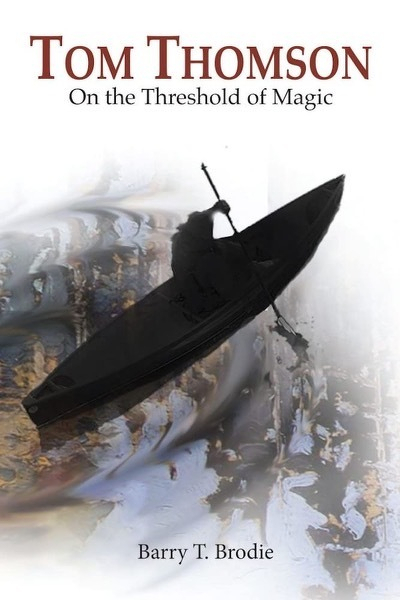
So, interested in Thomson’s story, I picked up two books at the McMichael gift shop (art museum gift shops are the best): a novel, Canoe Lake by Roy MacGregor, and a play, Tom Thompson: On the Threshold of Magic by Barry Brodie.
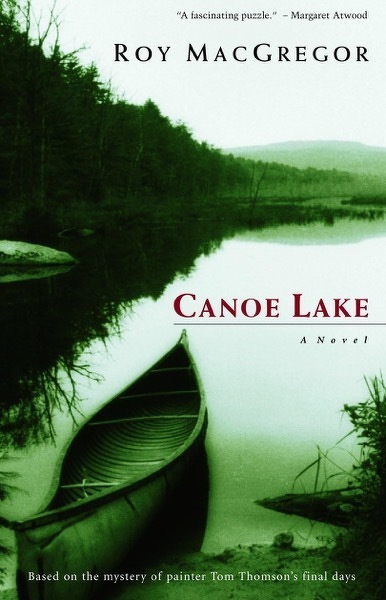
In Canoe Lake, Eleanor, a young woman from Philadelphia, searches in rural Ontario for her birth mother. Her questions kick off memories in Russell, an old-timer in the village living in a residential hotel, and his friend and unrequited love Jenny, now a spinster recluse but who at one time was going to marry a visiting artist named Tom Thomson. Eleanor’s detective work digging up secrets some people want kept jostles against Russell’s memories of Jenny and Tom, and of course, those worlds will collide in Canoe Lake, the site of Thomson’s death.

It’s a terrific novel, very well done, with depth and great textures, and a sensitivity for its characters, especially the hapless Russell. Definitely worth a re-read.

In his Author’s Note, MacGregor reveals his long fascination with the facts and mysteries surrounding Thomson’s death and MacGregor’s own distant family connection to it. The novel drapes a fiction over the bones of his research, though you can feel MacGregor really savoring the conversations of Thomson’s friends as they examine his body recovered after six or seven days in Canoe Lake, and speculate on the unusual gash on his temple and the fishing line tangled – or wrapped? – around his ankle.

MacGregor returned to the subject later with a non-fiction account of the incident and the times, Northern Light: The Enduring Mystery of Tom Thomson and the Woman Who Loved Him. The Author’s Note is a précis, I think, for this fuller treatment.
Thomson threshold.

Tom Thomson: On the Threshold of Magic by Barry Brodie is a poetic play with Thomson narrating his inner journey from young man to artist to his afterlife, with all the characters in trembling awe of his artistic vision. Over half of this slim book is in fact devoted to the play’s writing and initial staging, and the back-stage stuff is honestly the most interesting part.

NB: Thomson’s studio now sits on the McMichael grounds.

Closing the niceness loop

Note: I found this draft in a folder of old documents I’m clearing out. I have no idea when I wrote it, but between 2018 and 2022 is my best guess. I saw it was not on the blog, so am finally posting it here.

Saying “thank you” is one of the great civilized acts we do in daily life. It makes our social interactions with clerks, vendors, waitstaff, co-workers, friends, family – nearly anyone we come into contact with during our day – a little more pleasant.

“Thank you” marks the end of a transaction. We have concluded our business and I want to express my gratitude for your part in it. “Amen” is not too dissimilar in action and meaning.

But when it comes to saying “thank you” in email … aye, there’s the rub. Is it courteous to send a one-liner “thank you” email or are we burdening the recipient with yet another task and decision we have forced them to make?

My friend Bob calls these one-liners “closing the niceness loop.” We’re so obsessed with appearing “nice” that we waste our time and our recipient’s time with a one-liner email that did not need to be sent.

And if there are multiple recipients of the email on the CC line: heaven help them. Their inboxes are now filling up with one-line “thank you” emails followed by the obligatory replies of “you’re welcome” or “sure.”

Delete, delete, delete.

Fast Company, in an article on bad email habits, also condemns the puny one-liner:

Replying to an email with “Thanks” or “OK” does not advance the conversation in any way. “You don’t have to answer every email,” says Duncan, who takes a moment to analyze our email conversation. When I asked Duncan if she was free at 3 p.m. to chat, she replies yes and sent me her phone number.

“A lot of people would have replied ‘Okay, great, talk to you then’” says Duncan – an unnecessary email that simply clogs up someone’s inbox and doesn’t contribute anything to the conversation. To avoid being the victim of one-liner emails, feel free to add “no reply necessary” at the top of an email if you don’t anticipate a response.

Nick Bilton, in the NY Times Bit Blog:

Don’t these people realize that they’re wasting your time?

Of course, some people might think me the rude one for not appreciating life’s little courtesies. But many social norms just don’t make sense to people drowning in digital communication.

Take the “thank you” message. Daniel Post Senning, a great-great-grandson of Emily Post and a co-author of the 18th edition of Emily Post’s Etiquette, asked: “At what point does appreciation and showing appreciation outweigh the cost?”

That said, he added, “it gives the impression that digital natives can’t be bothered to nurture relationships, and there’s balance to be found.”

I find the one-liner thank-you a hard habit to break on our cohousing community mailing lists. We’re all volunteers in the effort so saying thank-you seems like a (cringe) nice thing to do to show appreciation. But when I look at a 15-message-long thread that contains 10-12 “thank-yous,” I cringe there too.

I favor not sending the one-liner. Those replies don’t advance the conversation, and I think they annoy all the other recipients who are eavesdropping on the thread and don’t care anyway. (In other words: it annoys me when I’m on the CC line of those threads. At some point, I mute the thread.)

Also, it’s likely I’ll see the person in real time or email with them on another topic; if a thank-you is indicated, there are plenty of opportunities to fold it in with another message.

However, there is a type of one-liner email I always send. When I’ve been assigned a task via email, I will reply with a single word – “Done” – to signal that the task has been completed. Since we’re all keeping records of our work in our email, I want everyone else’s inbox to have a record of what I did and when.

Thank you for reading.

Our State magazine, December 2025

Every Christmas, my mother gives me a subscription to Our State magazine, which, as the subtitle says, is dedicated to “celebrating North Carolina.” I like browsing each issue to find some new or unusual places to visit for a day trip or long weekend. Although I’m a native North Carolinian, there’s lots I don’t know about the state.

This year’s Christmas-themed issue delighted me more than usual. In addition to the recipes and events – Peanut Butter Cup Cookies! Christmas Flotillas! – are some really well-reported (if occasionally overwritten) articles on bits of hyperlocal history, culture, and the passing scene.

Ourstate DEC25 Cover Thumbnail 262x337.

Brief excerpts from some of my favorite articles:

Christmas on Portsmouth Island - More than 50 years after the last residents of Portsmouth Island moved away, a descendant of the once-busy shipping village decks the halls in their honor.

His father — a carpenter and commercial fisherman who worshiped during homecomings in this same church — passed away about six months prior. In this moment, the loss deepens Gilgo’s connection to this place and the meaning of the Christmas season. Satisfied with the job, he turns to leave, his work now done. He may be one of only a few handfuls of people who ever see these decorations, and that is enough.

Resilience in the Ebersole Holly Garden - Once left to the weeds, a world-class holly collection in Pinehurst is thriving again, thanks to the determination of those who believe in a second season.

Most people think they can identify a holly. “You imagine that evergreen, Christmas-tree shaped bush at the corner of your house,” Bunch says.

To expand that notion, he takes visitors over to one of his favorite spots in the Ebersole Holly Garden, a section filled with massive trees, some boasting 40-foot-tall canopies. Bunch encourages them to look up. “These huge, beautiful hollies have white-and-gray bark, different from any other trees — a stark contrast to our native pines,” he says. “To get underneath them is a different experience than from looking straight on to the holly bush in your yard.”

Old Christmas in Rodanthe - For more than 200 years, villagers in the Outer Banks community have celebrated Christmas on their own terms.

As the story goes, during the [[Battle of Culloden]], a nonfatal arrow struck the 12-year-old Scottish drummer, Donald McDonald, in the left shoulder. After his recovery, he set sail to the New World, drum in tow. During the voyage, McDonald fell overboard during a storm and swam to shore using the drum as a life preserver. He arrived at the place where he’d spend the rest of his life: Rodanthe.

… The drum is folklore made material. A symbol of persistence and resistance, it bridges past and present. According to legend, decades had passed when news reached Hatteras Island that England had, in 1752, adopted the Gregorian calendar that changed Christmas from January 6 or 7 to December 25. Committed to their ways, the village of Rodanthe refused to go along with the change and continued celebrating Jesus’s birth when and how they always had.

North Carolina’s Santa School - Before the beard and belly laugh, becoming the Man in Red requires a little magic — and plenty of training — in Charlotte, where Santas go to earn their ho-ho-ho. A wonderful piece by Daniel Wallace.

On offer this weekend is a rare opportunity for Santas from all over the state and beyond to watch other Santas at work, to study their routines, and, not unlike a child at the mall getting their picture taken with the Man in Red, to ply the old pros with questions of their own, such as, well, “What do you say when they ask you where your reindeer are?” No two Santas have the exact same answer to this question, or to any question for that matter. But you need at least one.

No Kings Rally

We attended the No Kings rally yesterday at Durham’s Central Park, along with 5,000 to 7,000 other folks. A beautiful sunny, warm day with lots to see. So loud and crowded we could barely hear the speakers, but the vibe was everywhere.

A quote from the Indy Week story linked above:

“Then [[at the time of the previous No Kings rally]], it seemed like it was on the edge. Now, we’ve fallen off the edge. We are falling, free falling. So it’s that imperative, like today, to come together even stronger,” Monpetit said. “Hopefully, coming together like this, we can figure out who we are and what we’re doing together. The more we talk, the better.”

A friend told me of the “Drunk Trump Game”, which is to find on YouTube a speech by the current occupant and then play it at a speed of .5 or .75. To my ear, he doesn’t sound so much drunk as sleepy.

(“Current occupant” is the appellation used by Orange Crate Art, which we have adopted.)

Review: An Old Woman's Reflections by Peig Sayers 📚

Finished reading: An Old Woman’s Reflections by Peig Sayers 📚

Life on Great Blasket island, three miles off the west coast of Ireland, was hard and cold, with a meager living scratched out from the ground and the sea. Life in the 20th Century was as primitive as it had been in the 18th and 19th. Among other effects of this isolation was the community’s continued reliance on Gaelic to pass along its rich oral tradition of history and folktales. The island never had more than 150 or so inhabitants and was eventually abandoned in 1953.

Oxford University Press published a series of seven books of Great Blasket memoirs and reminiscences. Peig Sayers was hailed as one of the island’s great storytellers. Her book is a collection of transcriptions of stories written down for her by her son, stories she remembered from others’ telling and stories of what happened to herself.

It took a while for me to get into the rhythm of the book; these stories were meant to be told, of course, not written. When she quotes poetry, the words are transcribed into English as lines of unrhymed prose, so there is a natural loss of emotion and power. And I’m sure the music and rhythms of her speech, the way she would tell the story, would make these reminiscences come alive in a way that they don’t on the quiet page.

Still, as descriptions of a time and place long gone, I was fascinated by the details of the lives they led and the characters she knew. Since we can’t recapture the experience of Peig’s storytelling on the page, here’s a description of the effect they had on a neighbor who had actually sat around her fireplace and heard her stories:

Often her thoughts would turn to sad topics; she might tell, for instance, of the bitter day when the body of her son Tom was brought home, his head so battered by the cruel rocks he had fallen on from the cliff that his corpse was not presentable to the public. So Peig, with breaking heart, had gathered her courage together and with motherly hands had stroked and coaxed the damaged skull into shape. ‘It was difficult,’ she would say; and then, with a flick of the shawl she wore, she would invoke the name of the Blessed Virgin, saying ‘Let everyone carry his cross.’ ‘I never heard anything so moving in my life,’ a Kerryman confessed to me, ‘as Peig Sayers reciting a lament of the Virgin Mary for her Son, her face and voice getting more and more sorrowful. I came out of the house and I didn’t know where I was.’

The Irish Writers: Wilde, Yeats, Shaw 📚

Finished:

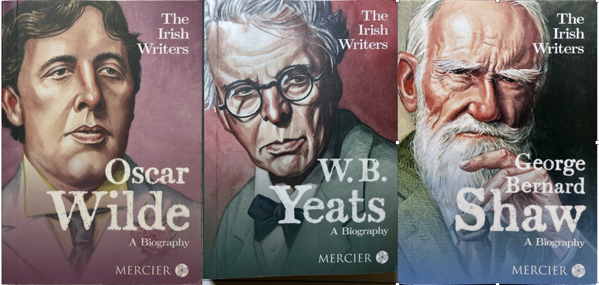
  • The Irish Writers: Oscar Wilde by David Pritchard 📚
  • The Irish Writers: W.B. Yeats by David Ross 📚
  • The Irish Writers: George Bernard Shaw by David Ross 📚

A neat little set of literally mini-biographies – each about 200 pages and about 4"x6" – very easy to hold in the hand. Bought from a newsagent’s across the street from Trinity College in June 2025. Apart from their major works, I knew very little of these authors so these little biographies suited me just fine. Stray observations:

  • Ross is the better writer of the two. His command of context and content, and his style, simply made his two books more enthralling and readable. The first chapter of his Shaw book, “Two Cities,” summarizes in 11 pages the economic, historic, religious, and cultural conditions of London and Dublin. It is a confident, breathtaking summary that provides a context for the emergence of Shaw – and Wilde and Yeats – onto the cultural and literary scene.
  • The Wilde book compresses an awful lot into a small space. What it illuminated for me was how long it took Wilde to “become” Wilde. I did not know how relatively late in life his success came, with his discovery of plays and their witty, aphoristic dialog being perhaps his ideal literary form. I also did not know that his father also indulged in sexual misadventures, which brought stress, shame, and hard times to his mother and family. The sins of the father…
  • While Yeats and Shaw did not engage in sexual adventures in the same way, they had their own hangups and issues with women that distracted their wives and caregivers. Yeats sponged off of them, Shaw adored the adoration of his younger female correspondents while stringing them along and keeping his paper conversations a secret from his wife.
  • An irony that linked all three of these Irishmen: their desire to be active players on the larger literary stage of London. From Ross’s book on Shaw:

Of the three, Yeats was most involved with their home country. Part of his vision was to establish a modern Irish literature, written in English, and Ireland continued to be a prime source of his inspiration, even though he spent as much time in England as he did there. Wilde was not concerned with Ireland. Shaw never forgot that he was an Irishman, and like Yeats was a Unionist who believed in Home Rule. But, though much in his thought and writing is Irish, he did not feel the rootedness in Irish history and culture that Yeats felt and nourished. He wanted to reform not Ireland or England, but the world.

Finished reading: Exciting Times by Naoise Dolan 📚

One of the blurbs says “ice cool, self aware, and very funny.” Definitely icy and detached. A witty novel of a young lower-class Irish woman in Hong Kong and her romantic and sexual adventures among higher-class striving junior professionals. The characters are so high-verbal and articulate that you could cut yourself on their casual, lacerating banter. Ava, the narrator, is so detached from her own life and needs that I felt equally distanced; as funny and sparky as she could be, I also wanted to shake her and tell her to grow up. Though that last page is really good: her body finally chooses what her busy mind has denied her. The last of the books I bought in Ireland.