Posts in "Review"

"Presto!" by Penn Jillette

Presto! is Penn Jillette’s memoir of losing 100 pounds in 3 months – how he did it, why he did it the unusual way he did, and the physical, mental, and emotional changes it brought. Having been swayed by Critical Mas’s post on the potato hack and read the (e)book on the subject, I wanted to see if I could strain Penn’s book for ideas, tips, or just some new thinking.

Penn’s disclaimer in the book, interviews, and Q&As promoting the book, is if you take health advice from a magician, you’re an asshole and deserve to die. Or put more delicately: his path was his path and it worked for him. So, take the book for what it is, sift it, and behave responsibly.

That said, it’s still quite a story. Having lived a large life – he weighed 320 pounds and was on high dosages of eight different blood pressure medications – his doctor recommended a stomach sleeve following a health crisis that put him in the hospital.

Jillette reports taking the news calmly and then pondering his next moves. The doctor said they needed to wait 3 months before doing the surgery; Jillette saw this as his opportunity for an extreme challenge of the sort that has defined his life. If he could lower his weight by 100 pounds in 90 days, he could be taken off many of his medications and could avoid surgery for the stomach sleeve. I have to say, were I faced with that prospect, I’d have probably gone for the extreme choice myself.

Penn is an interesting guy, who does think differently from the herd and enjoys the company of others who think differently, so the book is full of his opinions on lots of things. That said, I skimmed many passages because his humor, such as it is, tends to the verbal smackdown and fast patter of his act. If he reads the audiobook version of this, it may be more enjoyable. But I doubt it. I don’t think he’s as funny as he thinks he is. But this is his personality, so I got used to filtering out the noise for the interesting detail underneath.

What, if anything, am I taking away from his book?

  • It’s winter now, so feel the cold more often. Penn’s advisor, an odd and provocative fellow named Ray Cronise, prescribed contrasting showers of hot (10 seconds) and cold (20 seconds) for 5 minutes or so, ending with cold water for as long as he could stand it. Cronise maintains that the body will burn more calories trying to keep its trunk and brain warm than it will burn with exercise.
  • According to Penn, Cronise said the modern world has eliminated three things that all wild animals must deal with: darkness, cold, and hunger. Our bodies, he says, are built to survive a winter that never comes. Cronise’s program for Penn introduced more cold and more hunger to encourage his body to burn its stored calories.
  • For the 90-day crash diet, Cronise prohibited any form of exercise because “You can’t outrun your mouth.” He focused on Penn eating only vegetables, no processed foods, no salt or sugar, and later on, only minimal seasoning. (Penn favored Tabasco.)
  • After the body has lost the fat, then Cronise permitted him to start exercising to restore the muscle; don’t confuse the body by promoting two different processes at the same time, according to Cronise. Penn said that when he started lifting weights again, he was very weak. But the leaner muscle he gained felt “stronger” than the marbled fat-and-muscle he had before.
  • For his maintenance diet, Penn uses Dr. Joel Fuhrman’s books and dietary program as a guide. He likes Fuhrman’s uncompromising attitude to the subject: losing weight and eating right is hard. To paraphrase Fuhrman: I’m not here to make it easy, I’m here to tell you what you need to do.
  • Penn now eats only whole plants, with no animals or animal products. He will allow himself a “Rare and Appropriate” meal(s) once or twice a month, but only if someone else is paying or it’s a special occasion, like a birthday or anniversary.
  • He was monitored by his doctor throughout the 3 months and taken off blood pressure medications as appropriate, but this was a delicate process. The remaining medicines had to be balanced and tweaked to ensure he wouldn’t have another health crisis. On Episode 233 of his podcast, Penn reported that he is still on some BP meds because his heart is still enlarged. After a few years, when his body has adjusted to the change, then the heart may reduce in size and he can go off more meds.
  • Penn wondered about the social awkwardness of not eating with others at a restaurant. What he found was that it was awkward for about 20 seconds, and then everyone else settled down to their eating while he drank decaf coffee and carbonated water (my favored dinner drinks for years now). A lot of the food we shovel into our mouths has to do with imagined social harmony rather than real hunger.
  • And fasting is also an option. I will fast 16-22 hours once or twice a week, or at least skip breakfast several times a week. Fasting is one of the few techniques that makes sense to me. It’s binary – you’re either eating or you’re not – so it’s hard for me to cheat; it’s easy for me; and it always teaches me about the difference between cravings and real hunger.
  • At the end of the first two weeks, where he ate only potatoes, Penn broke his cravings to the salty/fatty/sugared food that had been a staple of his eating life for 60 years. He wondered if he would miss his favorite foods, and he didn’t – because he had lost his craving for them.
  • As an aside, Penn relates going on a celebrity cooking show and being quickly trained by a popular Las Vegas chef. The keys to winning are to pick 5 dishes and have a good story to go with each one; we’re wired for stories and emotion, and telling the story as the dish is prepared lands with the judges more effectively than the food alone. (Training and association, folks.) Also, the way to make any food taste good? Fat, then salt to cover the fat, then sugar to cut the saltiness, then more salt to cut the sweetness, then more oil over everything, ad infinitum.
  • Losing weight made him lighter – physically and emotionally. Losing the fat helped him also level his moods. I’ve found this to be the case for myself, also.

Update, 2017-01-19

Penn made it clear he was not writing a how-to book and that his advisor, Ray Cronise, was writing his own book (yet to be published), so Penn was deliberately vague on details. The CalorieLab site extracted from Penn’s book all the details it could and subjected the book to the kind of skeptical (and somewhat sarcastic) appraisal that the ol’ Penn Jillette of Bullshit! fame would admire. The comments to the CalorieLab post offer good discussion; some of the commenters support CalorieLab’s view, some are skeptical of Penn, some support Penn. But as Penn said from the start: don’t look to him for diet or medical advice. You have to look out for yourself.

Updated on 2026-01-10
"More Fool Me" by Stephen Fry (audiobook)

<img src=“https://cdn.uploads.micro.blog/10307/2019/298848f4bd.jpg" alt=“Cover of “More Fool Me”” title=“morefoolme.jpg” border=“0” width=“475” height=“475” style=“float:right;” />

More Fool Me is Fry’s third book of memoirs, and covers roughly the years 1986-2001, when he was professionally and personally flying high, not least due to incredible quantities of cocaine and vodka that fueled his addictive, rather needy personality. I listened to the audiobook version, as read by Fry, and it’s a far better experience than reading it would have been, I’m sad to say.

The recording starts with an hour of him recapping the events of his first two memoirs (and mock-apologizing for it frequently) and ends with almost three hours of him reading his daily diary entries from three typically busy months in 1993. Had I read this on paper, I’d have been furious about reading a book that seemed assembled from parts rather than written. But hearing it performed took a bit of the sting out of it. When he tells his stories, he acts out the characters, takes on the voices (his impersonation of John Cleese, if impersonation it was, was spot on), and it feels as if one is sitting across from him as he expertly paces and tells his stories.

That said, three months of daily diary entries is asking a bit much of the casual reader.1 Fry includes the passages as an example of how fast and frenetic his life had become and how, looking back, he could see that a breakdown was inevitable. But it does not avoid becoming a long recitation of name-dropping, self-indulgence, and snobbery. Trey Graham’s NPR.org review sums it up this way:

In barely three months of diary entries, from August to November of 1993, Bad Stephen writes a novel; sits for a portrait; attends the London premiere of The Fugitive and is embarrassed to be seated with the B-list celebs; attempts [writing] the book for an Elton John jukebox musical; races about England benevolently signing books and meeting blushingly with personal bankers; does a speechy thing or two for Prince Charles; tries out a new bespoke tailor; dines with Dennis (aka Mr. Margaret) Thatcher at the Garrick Club and pronounces him, with a blithe arrogance worthy of any Cambridge grad, “better read than I had ever imagined.” Eventually he purchases at auction two letters in Oscar Wilde’s hand — but not without both citing and complaining of the price, and not before dropping roughly as many names, familiar and obscure, as he does pounds sterling. Fear not, he footnotes the obscure ones so as to evoke suitable awe.

Graham concludes: “A misguided, misspent early midlife is one thing to recount and repent. The blithe snobbery, the casual cruelty, the condescension to those less gifted that’s on such vulgar display in this all-too-dense diary of excess — they all demand more examination, more reflection, more humanity than Fry provides.”

During the period described in this book, Fry was enjoying immense visibility from appearing in “Blackadder,” “Jeeves and Wooster,” “A Bit of Fry and Laurie,” and the movie Peter’s Friends. It was entirely unforeseen for the schoolboy described in his first memoir, Moab is My Washpot. There, Fry felt like an outsider due to his increasing awareness of his homosexuality, being Jewish, and whatever other unknowable demons drove him to skip school, steal from fellow students to feed his cravings for sweets and cigarettes, take advantage of everyone around him, attempt suicide, and otherwise transgress shamelessly.

His second memoir, The Fry Chronicles, sees him begin to explore relationships, act, write and perform, and become addicted to applause and attention. Though clearly an intelligent and self-aware man, that knowledge doesn’t stop him getting addicted to cocaine as chronicled in More Fool Me and indulging himself by snorting the stuff not just in the private clubs that became his second home but also in the House of Commons, the House of Lords, and Buckingham Palace. Though he never snorted at Hugh Laurie’s house, knowing Laurie and his wife disapproved; even Fry’s inner demons respected Laurie and his friendship too much to transgress there.

Fry makes no bones about it: he enjoyed himself tremendously and did not see himself as an addict. He details the little kit he assembled to carry and snort 3-5 grams of coke with him whenever he went and is pleased to describe in detail its compact stylishness. (When I smoked a pipe in my 20s, I also happily indulged in all the paraphernalia that goes with that pastime. There is pleasure in the fetish of the ritual.)

Fry throughout feels himself to be the outsider still, even when the evidence of being a tremendous insider explodes all around him – the private clubs, the celebrities, the parties, Lady Di telling him a secret: he loves every drop of it. Cocaine is the thick icing atop a very yummy cake, the soundtrack to the exclusive A-list parties.

Moab is My Washpot remains his best book-length narrative to date because he was able to see young Stephen in toto, forgive him, see him from his childhood into young adulthood and a new beginning, and thus shape the story into a satisfying whole. It’s a touching and affectionate book.

A key reason for the weakness of More Fool Me is that Fry’s larger story has yet to come to an ending. The book is reportorial, brimming with surface details, bright anecdotes, and, as said, an entertaining vocal performance. But not enough time has passed for Fry to really understand who he was and what happened so that he could shape the material into a story that could stand on its own. Fry begins the story bewildered and beleaguered, and ends the same way; there is no change or transformation, just incident after incident.

Much waits in Fry’s future after this book ends: a diagnosis of bipolar disorder, a continued and apparently unquenchable thirst for vodka, and several suicide attempts, including a very close call from 2012. Fry’s demons are still in there. Maybe one day, Fry (if he is still in there as well) will be able to tell the whole story.

To his credit, he doesn’t ask for forgiveness or understanding, just a chance to tell his side of the story. I don’t demand an answer to the mystery of his behavior but I do need more than a raconteur’s dinner stories.

Stray observations

  • Fry lists his early literary heroes as Wilde, Wodehouse, Waugh, and Doyle. You see their influence in his sometimes baroque, ornamental style. I wouldn’t say he loves the sound of his own voice so much as he loves the music he can make from his words.
  • Fry is stung by Alice Faye Cleese’s remark that she and John prefer his shorter pieces, such as the Telegraph and Listener columns and essays he wrote that were collected in Paperweight, over his comic novels. Fry thinks they’re wrong, that Cleese believes comic novels cannot treat serious topics. But Cleese is right: the shorter length tamps down Fry’s natural discursive style and forces him to focus. In that smaller container, he says a lot more. I stopped reading his fiction after his third novel; they were OK but not memorable.

(originally posted 2016-10-29, updated for micro.blog)


  1. If this book had been billed as Fry’s journal entries for these years, I would react differently. I love reading collections of diaries, letters, and journals. I object when verbatim diary entries take up room in what should be a shaped narrative, as this memoir purports to be. ↩︎

Playmakers Rep's "Three Sisters"

In their ads read during the local morning NPR news, Playmakers Rep touted its “new take” on Chekhov’s Three Sisters. What on earth does that meaningless phrase mean? This is my third production of Three Sisters and it didn’t look anything like some of the wilder Shakespeare productions I’ve seen. Chekhov plays are so rooted to their time and place that they resist overmuch tampering.

Is it a “new take” because it was a new idiomatic translation? Or color-blind casting (two of the principal actors are African-American)?

The new translation by Libby Appel seemed fine, though with too many Americanized phrases for my ear. Appel translates “I don’t understand you” as “I don’t get it.” Yes, it’s shorter, more colloquial – but it jars my ear. Some phrases also struck me as clichés that would have been stripped from any other play. (Had I gone with the intention of writing a review, I’d have taken notes!)

Vivienne Benesch’s direction orchestrated some fine moments, though I think the size and spread of PRC’s thrust stage, with audiences on three sides, worked against the production and the play.

Chekhov charts the sisters’ descent from their height in Act 1, where they are clearly the center of attention and in charge of the household, until they are slowly squeezed into a small bedroom under the eaves, and then finally ejected by the domineering sister-in-law whose vulgarity they had earlier sneered at.

The creeping claustrophobia of the home is echoed by the smothering provinciality of their small town. The sisters early on deride the town’s small-minded pettiness and lack of culture. “To Moscow, to Moscow” is their prayer, their plaint, their lament.

Yet the stage, though cleverly redressed for the major scene changes, never emphasized their increasingly crowded and shrinking horizons. Olga and Irina’s bedroom should be a tiny thing, and though small enough on the PRC stage, there seems to be a whole other space alongside it where they and their uninvited guests can wander freely, talk, lie down, and scream. The sheer size of the stage undercut the play’s intimacy.

The performances were good, but not uniformly so. Daniel Pearce’s Kulygin always commanded my attention when he walked onstage, and Carey Cox’s Natalya was quite strong.

For me, the standout performances were Allison Altman’s Irina –- particularly her sad and shocking breakdown as she realizes she will not escape to Moscow – and Arielle Yoder’s Masha, whose cool demeanor hides a seething anger and yearning. Marinda Anderson’s Olga was firm and supportive – the tone-setter in the opening minutes and the solid emotional anchor in the final minutes – but isn’t given the opportunity to tear into her own longings and desires. One moment of Anderson’s I loved: her shock and uneasiness at Natasha’s barking mad frustration with the old nurse.

In the last scene, as the sisters stand in the back yard of their former home, Olga hears the marching music of the soldiers leaving the town. She hopes that the sisters will soon learn “why we are alive and why we suffer.” As she said this, I think all three sisters turned outward to look at the audience, as if to say –- We’re suffering so you can learn and remember. I’m not sure if I’m remembering or interpreting that moment correctly; it simply struck me as odd for the sisters to turn their backs to each other at a moment when they should be reaching toward each other and thereby finding their purpose.

Three Sisters was a fine but not a great production, with moments of exquisitely etched agony and loss, but it did not strike me as a new take.

Updated on 2026-01-10

Current reading

The Relationship Handbook -- George Pransky.  The focus is primarily spousal relationships, though there are a few chapters dealing with parents and children. The core message is that our insecure thinking lowers our moods, which causes us to act defensively against our partner and they against us. The chief remedies include simply calming down until our thoughts look less real and choosing to talk about sensitive issues only when both partners are in their best state, when each partner's statements are understood and not simply reacted to. More important than "solving problems" is enjoying your partner's company and basking in a warm relationship. Simple language, readable, and applicable to fostering a better relationship with oneself as well. Pransky is of the first generation of Three Principles practitioners who worked with Sydney Banks. As with other popularizations of the Principles, it focuses more on revved-up thinking than with the other principles.

In These Times the Home is a Tired Place  -- Jessica Hollander. Before I started my grad school adventure in 2006, I was in a writing group that counted as its members two people who would go on to publish their fiction. One was David Halperin, who published Journal of a UFO Investigator in 2011. The other is Jessica, who went on to an MFA at the University of Alabama and last year published this book of short stories, which won the Katherine Anne Porter Prize in Short Fiction (publisher description). They're odd, off-kilter, ethereal stories (or maybe prose poems) that take place in the characters' mundane world of cheap duplexes, loud neighbors, families under pressure, and someone who keeps moving the Welcome mat to other apartments in the building. You know the saying that every line of a poem creates a universe? Every sentence in a Jessica Hollander story does the same thing. The stories all have a voice that is uniquely Jessica's -- a quality her stories had even back in the day. I would kill to write dialogue that oblique and funny, with such a light touch.

How to Live: Or A Life of Montaigne in One Question and Twenty Attempts at an Answer -- Sarah Bakewell. Bakewell attacks the life of Montaigne and the life of his Essays by taking the writer's chief question -- How should one live? -- and then drawing from the essays 20 different, sometimes contradictory, answers. Along the way, she paints pictures of the historical, intellectual, and cultural currents of his time (I did not know the horrific conditions in France caused by the Catholic-Protestant conflicts) and how Montaigne's message of Stoicism, skepticism, and delighted self-discovery has been viewed by other thinkers, writers, and readers through the centuries.

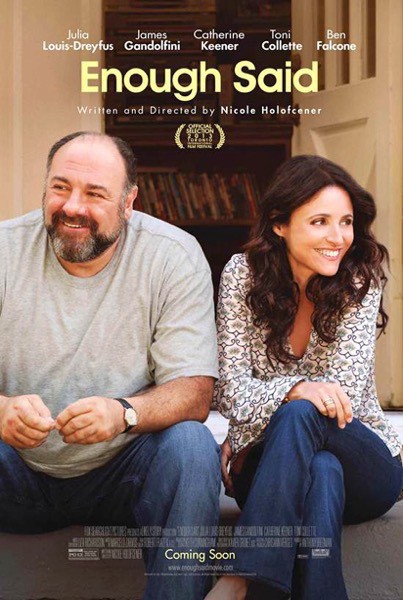
Movie: "Enough Said"

Warning - Mild spoiler alert. I don’t reveal plot points, but if you read this post, you’ll be able to put it together.

We’ve had an astonishingly good run of movies this summer, apart from the abysmal – dare I say Pepto-Bysmal – “Blue Jasmine.”

Our latest was “Enough Said,” a small, sweet romantic comedy from writer-director Nicole Holofcener that is a terrific star vehicle for Julia Louis-Dreyfus, whose acting and energy I’ve always liked. It’s also one of James Gandofini’s last movies and what a nice note to go out on.

How rare is it to see a romantic comedy between two middle-aged adults (we’ll skip over “Before Midnight,” which is a different beast altogether and which I didn’t love as much as “Before Sunset”)? Although Gandolfini clearly breaks the typical leading-man mold, Louis-Dreyfus as the masseuse Eva is Hollywood-thin and Hollywood-pretty; when Eva complains about being flabby, my eyes rolled out of their sockets and fell into the popcorn. Still, she and Holofcener are not afraid to show the lines and wrinkles. I also thought it was great seeing a middle-class character living in a smallish home and wearing jeans and flip-flops the way most people I see in life do.

Enough said poster

Why do I call it a “small” movie? The story’s concerns stay within a rather tight orbit of family and friends, and the stakes at first seem small – no one is going to lose their house because they can’t land the deal, the Empire will not fall if the Nose-ring of Aggraddorr is not destroyed. But in the end, I was so swept up in the everyday concerns of love, friendship, family, and broken hearts that these characters’ attempts to find happiness left an oh so pleasing aftereffect. The movie’s pace is casual, the music understated, the costumes and settings unextravagant. It’s a recognizable and comfortable world.

I’d even hedge my description of it as a “romantic comedy” as Holofcener strenuously steers the movie away from the standard genre tropes. They don’t meet cute; Gandolfini’s Albert actually asks for Eva’s phone number – like a grown-up would do! Their dialogue in the movie line and at a restaurant is not the sparkling cut-glass banter of Cary Grant and Irene Dunne. Instead, their badinage is playful, gentle, funny, tentative – clever, but in the way that intelligent people can be clever, not Hollywood-clever. And there are no stupid misunderstandings where one starts out not liking the other and then must be swayed to fall in love. These start out liking each other, but then doubts creep in; they’re both divorced and the memory of old mistakes starts affecting the new relationship.

It’s a movie about relationships – wrecked ones, strong ones, parent/child, man/woman, older/younger, boss/employee, lovers, ex-lovers, friends. The movie is full of people needing a connection, or losing a connection, or needing to renegotiate a connection; it’s a theme that is masterfully played out and subtly done.

But the movie can’t escape its genre handcuffs in the way that Eva holds on to information she should clearly divulge yet clings to while stringing along both her boyfriend and her new friend and client, Marianne (Catherine Keener), a poet who lives a kind of beautiful life Eva envies.

The movie pretty much demands that Eva’s deceptions be revealed in the most humiliating way possible and they are. Eva weasels and squirms and tries to evade her responsibility for the situation, but the script doesn’t let her off the hook. And while the deception plot seems just like the kind of slapstick setup for Elaine on the old “Seinfeld” show, Louis-Dreyfus doesn’t go for laughs. Eva deserves to be put on the spot; she knows she’s hurt people she’s come to care about and who care about her. It’s a devastating moment because life will not be the same afterward for anyone.

I liked how Holofcener did not give Eva an easy out. When she goes to Albert’s house to apologize, there’s no shouting, no banging on tables, no big scenes – just honesty and sadness played out in an ordinary kitchen. When Albert’s daughter, who has been an obnoxious snob for most of her scenes, gives Eva a gift of unearned and undeserved kindness, there should not be a dry eye in the house. It’s one of the most real, and also one of the most touching, moments I’ve seen in a movie in a long while. (Always be skeptical of a reviewer who really loves something, kids; it means his love for the material is overlooking flaws. But in this case, I care not.)

One of my few complaints about the story is that Keener’s character is left high and dry by Eva’s betrayal. As I think back on it, it’s pretty clear that Eva was awed by the poet and is flattered to be considered her only friend (really? her only friend?) but the liking is only one way, from the poet to Eva. Keener does a good job of conveying her liking for Eva, and she looks devastated at the revelation of Eva’s betrayal. But we don’t see Eva attempt to apologize or try to set the matter straight with her. It’s as if Holofcener is saying that a loving relationship with a man is more important than an affectionate friendship with a woman. That may be an artifact of the genre or it would have unbalanced the story of Albert and Eva, with whom we’re more invested by the movie’s end. It’s one part of Eva’s story that really bothered me afterward.

In compensation, though, there are many other lovely moments, one of which is Eva and her ex-husband saying goodbye to their daughter at the airport, with tears flowing from the women as they check her through security and then see the escalator take her away. Holofcener holds for a time on Eva and her ex-husband as they walk away, clinging to each other tight and reassuring each other – such a beautifully done moment. Again, a real moment, with respect paid to the emotions these characters are feeling and not chopped short by a wisecrack or witty quip.

The ending is tentative, reassuring, and the right words are said. No big emotions, no big music, no big Hollywood-anything – just two people sitting on a porch, trying to get back to each other. So yes, a small movie, and I loved it.

Although Gandolfini doesn’t get the set pieces that Louis-Dreyfus does, his presence throughout is solid and grounded and it would be a lesser movie without him. He’s a big teddy bear , with a rumbling voice and gentle manner, and enough steel to let Eva know that she’s crossed the line. But even then, he treats her with respect.

Update: The reviews that I’ve scanned also like the movie, and use “bittersweet” to describe its tone, which is a word I wished I’d thought to use. This brief New Yorker review by David Denby says a lot more in a lot less space (I really should learn to write sometime). He also uses a word I should have used to describe Gandolfini’s performance: “dignity.”

Book: "Slowing Down to the Speed of Life"

I picked up this book in Kenosha on my vacation, and it jibes well with Michael Neill's The Inside Out Revolution. This is not surprising as both describe the 3 Principles, which was conceived of and taught by Sydney Banks. But Slowing, written by Richard Carlson and Joseph Bailey, was originally published in 1997, long before the Web and podcasts made it easier to disseminate Banks' spiritual and psychological teaching. Carlson and Bailey focus on a rather narrow piece of the 3 Principles philosophy, without ever mentioning the principles by name, and citing Banks only once. Neill's book, by contrast, was published in 2013; he discusses all the principles and frequently cites Banks' words and teaching stories. That sounds like I'm sniffing at the book, and I don't mean to. Slowing Down to the Speed of Life is quite good at emphasizing a few key points and then reiterating them, ringing changes on them, showing how they can apply in many different areas of life. The section on Work and Office is terribly skimpy, though the chapter on Family Relationships is terrific. It's quite readable and I sped through it on the train to Chicago and in my spare moments.

Instead of writing an exhaustive and exhausting review, here are the key things that got my attention.

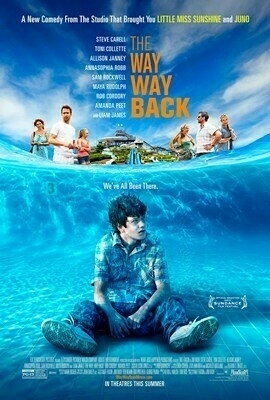
Movie: "The Way Way Back"

Jim Rash, Charlotte NC-native and UNC-CH alum -- best known to the world as Dean Pelton on Community -- has been exercising other talents the last few years. He and his co-writer Nat Faxon won an Oscar for their screenplay of The Descendants (with Alexander Payne) and the pair have created a great, light, summertime coming-of-age comedy, The Way, Way Back.

An interesting nugget from this article about the film is that the opening scene was drawn from a conversation the 14-year-old Rash had with his own step-father. Which is pretty appalling all on its own. Another appalling fact is that this pleasant, funny,  innocuous screenplay sat on a desk for years because, though it was admired, no one wanted to invest the money to film it.

Ad440 the way way back poster

The movie follows the adventures of the sullen Duncan as his mother, her boyfriend, and his daughter occupy a summer cottage near a Massachusetts beach area, in an attempt to foster a "family holiday" vibe. The boy's awakening to his own potential is charmingly done, and I liked that the almost-romance with the girl next door was part of the story but not the whole story.

The all-star cast members -- Toni Collette, Steve Carell, Amanda Peet, Maya Rudolph -- show relatively little of what they're capable of (except for Jim Rash, who gives himself a colorful cameo). The movie is largely driven by the other characters' reactions to Liam James' brooding Duncan or they're behaving in those baffling ways lost adults do when they want to torture their sensitive offspring. James walks around like a slumping caveman; his knuckles would drag the ground if his arms were long enough. So when he starts to look around and participate in the world around him, his delight and excitement is warming to watch.

That said, two performances really got my attention: Allison Janney's brash and boozy next-door neighbor and Sam Rockwell as the fast-talking, mouthy owner of the Water Wizz amusement park where Duncan finds a haven. Rockwell's character is a lazy slacker, but he's accepting of all the misfits who drift through the water park. His needling, cajoling, and ribbing of Duncan bring the boy out of his shell; his loyalty and support of Duncan are quietly done and deliver exactly what I want in a feel-good summertime movie.

Article: Oscar-winning Charlotte native plunges into directing with ‘The Way Way Back’ | Movie News & Reviews | NewsObserver.com.

"Dreams with Sharp Teeth"

[youtube https://www.youtube.com/watch?v=mj5IV23g-fE&hl=en&fs=1&w=300&h=242]

Thanks to the glory of Netflix, Liz and I saw this documentary that I can assure you never visited  the Carolina Theatre. It's a bio-doc on the writer Harlan Ellison, 72 years old at the time of the movie's release in 2007, and covers an impressive sweep of his life, with samples of him reading from his stories, talking heads quotes from friends and other writers about his influence and the impression he's made on their lives, and various NSFW-language interviews that evoke the man's history, philosophy, irritations, annoyances, and, now and then, joys. (The YouTube video here is from the movie; it's HE in his most typical mode of full-flow righteous anger--well-deserved, in this case.)

I was introduced to HE as a sophomore in high school and didn't look back for nearly 15 years; his personality and writing were vivid, electrifying, throat-grabbing--uncompromising, is the word that leaps to mind. Uncompromising to the point of lunacy, sometimes, but all in the name of dignity, self-respect, and justice, which for HE are paramount virtues.

"Dreams with Sharp Teeth" was a real test, as Liz had never experienced Harlan and was put off by his abrasive and, it must be said, obnoxiously show-offy personality. But she said she grew to like him better as the movie went on; you see the grit, energy, anger and just plain orneriness (an old-fashioned word that Harlan would love) that took a bullied little kid from Painesville, OH (a metaphorical town name, if ever there was one) to Los Angeles and success, of a sort. The movie confronts the fact that, although his writing has always been admired by his peers and lauded by fans, his career never really took off. His labor in the vineyards of genre fiction, teleplays, and short stories won him many writers' awards, but not mainstream success.

The documentary recognizes the respect that is paid to his longevity and his highest writing achievements--especially some of his most important short stories from the 1960's, such as "Repent Harlequin, Said the Ticktockman" and "I Have No Mouth and I Must Scream." But he still remains a marginal literary figure, it seems to me, a miniaturist in a culture that likes The Big Novel, the province of a dedicated few. His legacy, in addition to his thousands of stories and awards, may be more in the writers he has inspired who've gone on to produce Babylon5, the revamped Battlestar Galactica, and other TV series, or had more commercially successful writing careers themselves (such as Dan Simmons and Neil Gaiman, who pay tribute to HE).

As Gaiman says in the interviews, HE's greatest creative act has been this character called "Harlan Ellison." Partly sincere, partly schtick, with a freakish a memory for cultural and historical details, a fast-talking patter, and in-your-face energy--an electrical storm front on legs--driven by a hair-trigger temper and a determination to prove he's better and smarter than the bullies around him.

He says, in a poignant reflection, that being beaten up every day by bullies makes you an outsider. I think that, in many ways, large pieces of him are still hurting and still wants a happy childhood.

Another legacy of his childhood is that he sees the world as a big bully that shouldn't be let off the hook. In fact, the bully should be shamed, kicked where it hurts, and his nose should be rubbed in it. ("Revenge is a good thing," he says in a 1981 TV interview.) It powered his writing and his political and civil rights activism, his numerous lawsuits against studios and networks, and made him a fiercely loyal friend and ally. But it also meant he couldn't pick and choose his battles because everything--from a Writers Guild contract to the wrong brand of yogurt at the grocery store--demands a shouting confrontation, and if you cross him, then get ready for screaming phone calls.

While he never got to be one of the writers of great movies, as I think he dearly wished to be, it's hard to imagine him being happy on a movie set. To have the sort of control he wants, he'd have to do what his acolytes have done: become the producer and helm the entire enterprise. But that would mean he'd have to be the boss, and I'm guessing he'd not enjoy that role. He considers writing his holy chore, not producing or directing. Although I think he'd love meeting and kibitzing with the actors (his life's wealth could be said to be the devoted friendships he's gained of rich and famous people), he'd be driven to mania and a rusty chain saw by the thousand compromises and trade-offs that are a major movie production.

And also, he's always been an outsider; to be a producer/director would mean having to work inside the system, and he couldn't flatter and cajole the suits whose primary concerns are the budget and the schedule, not the story. HE knows his confrontations and lawsuits have  poisoned the studios and investors against him and made him virtually unemployable except by a few younger-generation writer/producers who see him as a mentor who inspired them when they were teenagers. He says he has accepted that condition--though it's hard to be sure. Regret and disappointment are other  major themes in his work.

The movie is a wonderful hagiography of Ellison (much better than the similar "The Mindscape of Alan Moore" in 2005) though it does assume that he's loved by his fellow writers, which isn't always the case. "The Last Dangerous Visions" issue is lightly touched on and then set aside. There has been some criticism of the movie because none of his enemies are interviewed--HE reportedly told the director, Erik Nelson, that he's known by his impressive enemies list and they should have a hearing in the documentary--but Nelson replied that HE was his own worst enemy.

I've grown up seeing HE's image in photos and television interviews, and it's poignant to see how he has aged. The geeky kid in his teens becomes the slim, handsome, dynamic ladies' man in the 1970s and 1980s, and now is a round matzoh ball who looks like Larry "Bud" Melman. The fire is still there, but the heart attacks, surgeries, chronic fatigue syndrome, and other maladies (none of which are described in the documentary) are catching up with him.

I came to HE's writing first via The Glass Teat, which a high school friend introduced me to. For the next 15 or so years, I became an Ellison fanatic, read all the stories, interviews, columns, etc. His last great book of stories, to my mind, is Strange Wine. He's written some remarkable stories afterward--"The Man Who Rowed Christopher Columbus Ashore" was selected for Best American Short Stories 1993--but I've not enjoyed them as much as I did his early work. His art has evolved from pulp genre fiction, to his own brand of fantasy, to, in the last 20 years, a Borgesian lyricism and vision, with non-linear stories that are collages, impressions, prose poems, descriptions of mood and interior states rather than character. That I can't connect to this vision--which eschews the traditional short story and plot props I'm accustomed to--I will take the blame for. As an artist, HE  continues to evolve and follow his muse where it leads him; not all of his old fans can do the same.

I was often struck by the fact that HE wrote two or three novels during his years as a pulp writer, but none afterward. I think this was a shame and a missed opportunity. It could be that his inclination was more for the pointed message, the singular effect, the impatient prophet--maybe he had too many things to say--a sprinter, rather than a marathoner. Of course, the screenplays he wrote (such as his famous unproduced screenplay for "I, Robot") also took as much time and measured energy to write as a novel. But I think movies called to him as an artist in a way novels couldn't.

The documentary features television interviews from his heyday in the 1970s and 1980s, and a small tour of his remarkable pop-culture museum of a house, which is stuffed to bursting with books, ephemera, and toys. It struck me as the magical treehouse his 8-year-old self would have wanted to live in, a very safe and cozy Xanadu (complete with secret passageways and pizza) that's retreat and recharging station and probably everything HE would have ever wanted.

It will be odd the day I wake up and hear that Harlan is not part of the landscape. I wonder whether he will see death as a bully or a friend.

Where to start. For the fiction,  The Essential Ellison is a good but large and baggy collection; Deathbird Stories is an earlier and more compact volume that contains many of his classics. Dangerous Visions is his groundbreaking SF anthology; I've not read it in decades but still remember some of its stories. His Dream Corridor comics are interesting curios, but not essential.

I daresay that his reputation, like Gore Vidals, may rest on his essays, which are remarkably supple yet all of a piece. It's in these essays (and the introductions to his stories) that the Harlan Ellison voice and "character" were forged, and I can recall more happy moments reading them than I do his fiction. Sleepless Nights in the Procrusteam Bed is the best nice-sized volume that shows his range. The Harlan Ellison Hornbook reprints his 1960s essays and they're all immediate and throat-grabbing. Harlan Ellison's Watching contains his fugitive movie criticism; The Glass Teat and The Other Glass Teat contain his classic dissections of network teevee in the 1960s--truly a snapshot of another era and full of opinions that are still scarily relevant.

In the 1980s, he started a fan club thing called The Harlan Ellison Record Collection, which made available recordings of him reading his work. (This was pre-Internet days, kids -- it was all done by mail and Pony Express.) Listening to him performing (not reading, performing) "Prince Myshkin, or Pass the Relish" and "Waiting for Kadak" are more fun than reading them. I also hugely enjoyed the 60-min interview of his "Loving Reminiscences of the Dying Gasp of the Pulp Era"; he clearly has a great nostalgia for that period of his young manhood, and there are times he can sure sound today like a cranky old man lamenting the good ol' days.

But it's the recordings of his public lectures that are the most entertaining. Of the On The Road series, my friend Scott says that the preferred order would be vol. 2, then 1, then 3.

On Arnold Bennett

This blog’s subtitle, “Oddments of High Unimportance,” comes from Arnold Bennett’s journal entry for 23-July-1907:

In the afternoon I seemed to do nothing but oddments of high unimportance.

I went on a Bennett binge last year. I suppose I first became aware of him through posts on the Zhurnalwiki site (now Zhurnaly.com), whose proprietor has several admiring pages devoted to Bennett’s writings on stoicism and what Bennett called (in one of his essay collections) “Mental Efficiency.” And in fact it’s in his essays of self-help (which ran originally as a series of newspaper articles) that I first made my acquaintance with him.

You can find more on Bennett and his work with just a little research or reading some of his works online, but here’s the potted history:

  • Born 1867 in the Potteries district of England; primarily industrial, working-class, a family of genteel poverty and not always pleasant relations with his immediate family.
  • Eventually becomes a journalist and through sheer hard work, remakes himself as a literary man who lived by his pen.
  • Writes novels, short stories, plays, book reviews, literary journalism, “self-help” articles, and even headed England’s war propaganda dept in WWI, for a time.
  • His most famous novel, and the one that made his name, was The Old Wives Tale.
  • He wrote too much, really. The “peanut butter” school of energy management says that when you spread the peanut butter too thin, it loses its flavor. Likewise, the more he wrote, particularly fiction, the more thin and less interesting his material became. His style of novel-writing slowly antiqued under his fingers.
  • As he grew more successful and rich (and despised by the younger literary elite for his success, money, and “old-fashioned” writing style) he grew more distanced from the material that really fed his fiction. Still, late in his life, he wrote Riceyman Steps, a study of a miserly bookstore owner, which surprised the literary world and rejuvenated him for a bit. The old dog still had a few tricks left in him. (I read “Riceyman” last year; some quite unbelievable moments, but good details here and there and a few mind-popping scenes, as when the miser has to decide whether to give a charity a few dollars in his hand, and look beneficent in front of his new wife, or hold on to those few dollars for dear life.)
  • He was a director of the Savoy Hotel, whose chef named an omelette for him.
  • Along the way, Bennett republished as books collections of articles on what he called his “pocket philosophies”: self-help, mainly, on staying calm in the storm, not working so hard against yourself, keeping an even keel, and so on. He was a Stoic and extolled Epictetus and Aurielius. These were mainly collections of articles he’d written and were read by many lower- and middle-class people who didn’t read or know about his fiction. (These articles were published as series in newspapers but under anonymous byline, I think.) Selections include How to Live on 24 Hours a Day and The Human Machine.
  • If you riffle through Margaret Drabble’s biography of Bennett, you’ll soon see that his philosophies were harder to live by than to package and sell. He made a disastrous first marriage (she never granted him a divorce), and in his second relationship, left his companion and their daughter almost paupers.
  • He was of that generation which the new literary lions, i.e., The Bloomsbury Group, despised. He and Virginia Woolf crossed swords in a series of book reviews, and Woolf dealt Bennett’s reputation a death blow in her essay “Mr. Bennett and Mrs. Brown.” Though they met later at parties and seemed to get on well (her thoughts of Bennett in her diary are touching), her essay lived on and stamped his literary reputation for decades.
  • When he was dying of typhoid in 1931, Scotland Yard put straw on the streets outside his residence to dampen the sound of carts and vehicles. He was the last “great man” for whom this was done.
  • There is no recording of Bennett, despite many other authors of his time giving recorded interviews. His severe, lifelong stutter no doubt inhibited him from making any recordings.
  • Not long after his death, the Depression and changing literary fashion made Bennett forgotten within a matter of only a few years.
  • His books (the major ones anyway) were still read for decades after, but he’s regarded nowadays as one of those bestselling authors of yesteryear whose books are unreadable today.

Some of his nonfiction essays on travel, theater, art, politics, etc., were collected in privately circulated books that he gave to friends at Christmas, and are by and large quite readable, I think. He tends to lead the reader by the hand quite a lot, but his prose is clear and he links his ideas so that anyone can understand them. This is probably why he sold so many of the pocket philosophies. I found his travel writings a little boring after a while and the essays on the current state of politics or theatrical management less than interesting. But when he got on to writing about literature or art, my interest revived and he was a most congenial companion.

In addition to all the other writing he did, he also kept a journal off and on (mostly on) from 1896 to his death. Local used bookshops in our area have several copies of this, and I’ve been dipping into it as my breakfast-table reading. I imagine it would make nice bedtime reading also, as it’s settlement pick-uppable and put-downnable. He also seems, from the writing, a genuinely nice and sensible man, with a generous nature, a tart sense of humor, disdainful of stupid and unthinking behavior, solid opinions but with the ability to change his mind, and it’s quite nice to spend a few minutes with him.

Here’s a quote from one of his most famous novels to go out with:

In front, on a little hill in the vast valley, was spread out the Indian-red architecture of Bursley - tall chimneys and rounded ovens, schools, the new scarlet market, the high spire of the evangelical church……the crimson chapels, and rows of little red houses with amber chimney pots, and the gold angel of the Town Hall topping the whole. The sedate reddish browns and reds of the composition all netted in flowing scarves of smoke, harmonised exquisitely with the chill blues of the chequered sky. Beauty was achieved, and none saw it. Clayhanger (1910)

Addendum: A shortish bio of Bennett by his friend Frank Swinnerton is here. Patrick Donovan wrote an excellent, up-to-date 2022 biography, Arnold Bennett: Lost Icon.

This post updated on 2026-01-09.