The first issue of Fantastic Four was published in 1961.
The Pulitzer Prize for Fiction in 1961 went to Harper Lee for To Kill a Mockingbird. Even better.
“West Side Story” won the Oscar for Best Film and, winning Grammies, were Percy Faith for “Theme from A Summer Place” (Record of the Year), “The Button-Down Mind of Bob Newhart” (Album of the Year), and “Theme of Exodus” (Song of the Year). All in 1961. Well. At least Bob Newhart’s album is still listenable.
Not a very interesting year, I’ll grant you. But I’m sentimental about it.
I tend to read first thing in the morning in my rocking chair, with my coffee, with the morning light coming in over my shoulder onto the page or Kindle.
A trick I picked up to keep my reading habit from flagging is from Andy Miller’s book The Year of Reading Dangerously. The way he got through his reading project was to read 50 pages in the morning before getting on with the business of the day.
I find that rate very compatible with my current life circumstances, as the morning is the only time I really control before the day’s obligations sink their claws into me. Depending on the book, a reading session can take 60-90 minutes, and I can get through a ~250 page book in about five days, more or less. By reading that much material in a session, I am less likely to lose track of the plot or characters and it keeps my interest in the book alive. If I’m facing time constraints or I miss the morning pages, then I’ll aim to read 25 or so pages later in the day.
It’s too easy to set a book down and say, “I’ll get to it later.” I’ve put off profligate reading for many, many years, and now is the time of my life to sit down with my coffee and enjoy all the pleasures I’ve been waiting to do “someday.” Someday is today.
A recording from my iPhone’s Voice app from an after-supper walk in June. Rosehill Avenue features a large, high canopy of trees and the sound of the cicadas, tree frogs, etc. This was an experience I wanted to remember. (1m 37s)
I was bored one evening and applied the Adbreak mod to my Kindle Oasis (10th generation). I was helped along by Dammit Jeff’s video and step-by-step instructions on the Kindle Modding wiki.
Jailbreaking devices like the Kindle are a popular pastime for folks. Getting past Amazon’s defenses allows intrepid users to customize layouts, fonts, UI, load e-books of different formats, change almost every aspect of the device’s function, etc. and add extra programs like simple games or even disabling ads.
Dammit Jeff pointed out some interesting apps like KindleForge and KOReader that could be installed,
KOReader was more interesting, as it promised the ability to read many more ebook formats, flow PDF text to make those files more readable, adjust the fonts and sizes of almost every aspect of the UI to your liking. and that’s great – if you want to spend a lot of time fiddling instead of reading.
Also, very few of the many apps available for download via KindleForge seemed worth spending my time on. Do I really need a Tetris clone on my Kindle? No. No, I do not.
So I backed out of the jailbreak and reset my Kindle. I felt more comfortable almost immediately.
Lord knows the Kindle is not perfect. It is a deliberately dumbed-down device with few customizations available apart from loading fonts (Hyperlegible is a good one), a so-so attitude to leading and kerning, etc. As Jason Snell often observes in his Kindle reviews, Amazon could do so much better if it cared to.
But for me, for now, my lowly Kindle Oasis (now discontinued) is fine. It’s fine. It meets my low expectations, the battery still holds a charge, and I can carry 100+ books in my hand wherever I go.
Today’s lesson: Kindles come and go. It’s the books that delight.
Every Christmas, my mother gives me a subscription to Our State magazine, which, as the subtitle says, is dedicated to “celebrating North Carolina.” I like browsing each issue to find some new or unusual places to visit for a day trip or long weekend. Although I’m a native North Carolinian, there’s lots I don’t know about the state.
Christmas on Portsmouth Island
- More than 50 years after the last residents of Portsmouth Island moved away, a descendant of the once-busy shipping village decks the halls in their honor.
His father — a carpenter and commercial fisherman who worshiped during homecomings in this same church — passed away about six months prior. In this moment, the loss deepens Gilgo’s connection to this place and the meaning of the Christmas season. Satisfied with the job, he turns to leave, his work now done. He may be one of only a few handfuls of people who ever see these decorations, and that is enough.
Resilience in the Ebersole Holly Garden
- Once left to the weeds, a world-class holly collection in Pinehurst is thriving again, thanks to the determination of those who believe in a second season.
Most people think they can identify a holly. “You imagine that evergreen, Christmas-tree shaped bush at the corner of your house,” Bunch says.
To expand that notion, he takes visitors over to one of his favorite spots in the Ebersole Holly Garden, a section filled with massive trees, some boasting 40-foot-tall canopies. Bunch encourages them to look up. “These huge, beautiful hollies have white-and-gray bark, different from any other trees — a stark contrast to our native pines,” he says. “To get underneath them is a different experience than from looking straight on to the holly bush in your yard.”
Old Christmas in Rodanthe
- For more than 200 years, villagers in the Outer Banks community have celebrated Christmas on their own terms.
As the story goes, during the [[Battle of Culloden]], a nonfatal arrow struck the 12-year-old Scottish drummer, Donald McDonald, in the left shoulder. After his recovery, he set sail to the New World, drum in tow. During the voyage, McDonald fell overboard during a storm and swam to shore using the drum as a life preserver. He arrived at the place where he’d spend the rest of his life: Rodanthe.
… The drum is folklore made material. A symbol of persistence and resistance, it bridges past and present. According to legend, decades had passed when news reached Hatteras Island that England had, in 1752, adopted the Gregorian calendar that changed Christmas from January 6 or 7 to December 25. Committed to their ways, the village of Rodanthe refused to go along with the change and continued celebrating Jesus’s birth when and how they always had.
North Carolina’s Santa School
- Before the beard and belly laugh, becoming the Man in Red requires a little magic — and plenty of training — in Charlotte, where Santas go to earn their ho-ho-ho. A wonderful piece by Daniel Wallace.
On offer this weekend is a rare opportunity for Santas from all over the state and beyond to watch other Santas at work, to study their routines, and, not unlike a child at the mall getting their picture taken with the Man in Red, to ply the old pros with questions of their own, such as, well, “What do you say when they ask you where your reindeer are?” No two Santas have the exact same answer to this question, or to any question for that matter. But you need at least one.
Did my ankle and knee PT this morning, read another story in the latest First Line literary magazine, and started in on my inbox.
Since my semi-retirement in April and now full retirement, I’ve found that my much-vaunted and hard-fought-for productivity habits have totally unraveled. With no one imposing a deadline on me, I tend to get around to things when I want to do them. Which is, in its own way, very relaxing. I get to things, just not when other people want me to get to them.
I’m unsubscribing from some newsletters, or moving them to Readwise Reader app. I usually delete a lot of things that arrive daily, which are reminders from FollowUpThen or ads from local businesses I want to stay aware of.
On a day like today, where I have 50+ emails in the box, I like to sit and just plow through the inbox from top to bottom, put stuff in Google Tasks or Keep or Evernote, and then stop when the inbox is empty or I’m tired of doing it.
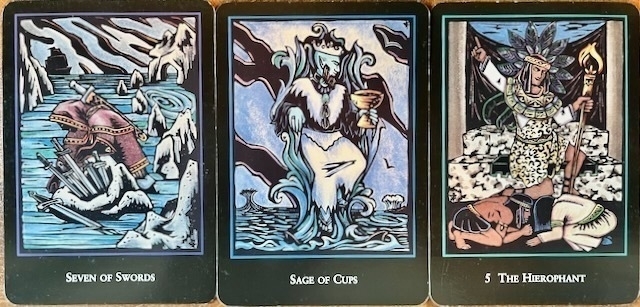
I did a three-card reading using the World Spirit Tarot deck (1st edition). Instead of the usual “Past Present Future” layout, as I shuffled the cards I asked them to tell me something I needed to know about this year and to tell it as a story.
Here are the cards I drew.
The World Spirit Tarot site, maintained by Madame Onca, the deck’s artist, has these handy capsule descriptions of each card:
SEVEN of SWORDS – “Strategy, stealth and wit are required to meet your goals. From tactful communication to outright manipulation, utilize the spectrum of strategy to obtain your objectives. Be honest about your motives and methods, as dishonesty can beget its own problems. Can you accomplish your ends without compromising your integrity? (Craftiness)”
SAGE of CUPS – “Emotional maturity and a progressive nature allow the Sage to adapt to the changing times. Capable of great finesse and calculated communication, they lead well, and gaslight brutally. This empathetic personality struggles to maintain a most challenging balance between the rigors of worldly responsibility and a deeply emotional, artistic nature.”
V THE HIEROPHANT – “Are you ready to expand your knowledge? Bringing together the worlds of inner spirit and outer learning, this card represents the laws and culture of religious and academic tradition. Study the collected wisdom of the ancestors with all its gifts and shortcomings, then find the truly Sacred in your own way.”
The Hierophant, by the way, is my Spirit Card, the Major Arcana card that aligns to certain numerological data associated to my name and birth date. Seeing that card turned over at the end made my eyes pop.
The swords are an air sign, symbolizing intellect, communications, and boundaries. The cups are a water sign, signifying emotions, intuition, love, dreams. The Hierophant, as a Major Arcana symbol, dominates the reading. If these cards tell a story – starting from the intellectual and moving to the emotional – then the Hierophant is a hell of a note to end on.
One of the things I note about the card’s figures: the Swords figure is facing left and down, bending over, picking up the swords in a freezing cold sea, while a ship is heading toward her in the distance. She has to work fast. She is also facing to the left while the Sage is facing right in contemplation. Opposites-ville. But both figures are in cold, blue settings with clouds stabbing diagonally across the sky. They’re telling different sides of the story but they’re swimming in the same sea.
The Swords card pretty accurately summarizes my head at the moment. I want to clear up various health issues this year, and I have a life-changing project simmering in the background that will come to fruition, I hope, later this year. I want to set lots of plates spinning on the tips of many swords, and am wondering how to coordinate it all.
Once those plates are spinning, though, time to be the Sage and contemplate where I am, how I’m feeling, and how I will negotiate the life-change transition that is headed my way. The Swords card is, I think, about planning the physical aspects of my life. The Sage reminds me not to forget the emotional side, which needs equal care and attention. The honest Sword turns away from the calculating, gaslighting, manipulative Sage. But that last sentence of the card description shows the Sage trying his best to bridge the needs of the world with the needs of the soul.
And how will the story end? The Hierophant. The Rules-Maker and Rules-Follower, the Lawgiver, who joins in one role the emotional (religious, yearning, soulful) and the academic (intellect, boundaries, order from chaos). The dark side of the Hierophant is a slavish devotion to the rules rather than balanced and knowing wisdom. The rather haughty pose in the card, and the supplicants, show for me a disposition to avoid, a haughtiness I do not want to emulate. But I do want to honor the Sacred in the card, the light of the torch, and – the mysteries. What lies behind that black curtain? The Hierophant represents a codified religious system, but that system’s purpose is to guide one to the mysteries that lie within.
I took this to be a very hopeful and beneficial reading. I will be working hard at the start of the year (Swords), by mid-year I’ll be assessing where I am and how I’m feeling about where I’m going (Cups), and – I hope – by the end of the year, I’ll be the writer of my own story, the master of my moment, enjoying the pleasures of the emotions and the intellect. And since the Hierophant is my Soul Card, perhaps the reading indicates that I will come into my own, be fully myself.
I had a productivity insight recently. Namely, that if my natural state is peace, and I’m the one whose thinking messes with that peace, then my natural state is focus and the only way I lose focus is when my thoughts distract me from it.
So I don’t need 12 steps to a distraction-free environment or the key understanding to controlling my attention. Instead, I just notice when my thoughts start to insist that I need a break. The insistence feels uncomfortable and that’s the cue to stand, stretch, breathe, make a cup of tea. Clear my head, in other words, rather than continue cluttering it with web-surfing or YouTube.
I’ve noticed my Self over the last few weeks unsubscribing from newsletters and podcasts, being more intentional about how I spend my attention energy, and deliberately opening up spaces in the evening where I don’t do anything, just sit, without consuming this intellectual snack food.
Purchased from The Odd Book, a really terrific used bookstore two streets back off the main drag of Wolfville, NS. I spent a delightful couple of hours browsing the small but packed alleys of shelves. Fantastic collection of Nova Scotian history and literature. 📚
Collier’s Popular Press: David Collier’s 30 Years on the Newsstand by David Collier (2011)
A generously sized collection of the Canadian alternative cartoonist’s fugitive journalism, comics, single-panel cartoons, and sketches for all manner of Canadian newspapers. The comics journalist Jeet Heer’s introduction praises Collier’s craft and his love of homey detail, which are evident in his wonderful landscape drawings that lead off the book, his comics-based diaries, and his own written reminiscences, including a pilgrimage with Pat Moriarty to the house George Herriman lived in.
Collier’s self-portraits, line detail and cross-hatching, and stories where he casts himself as an overly self-conscious overthinking nebbish struck me as very Robert Crumb-y, but without that artist’s graphic skill, emotional intensity, and attention-grabbing sense of danger. I mean, Collier is Canadian, after all. So the collection as a whole is gentle, low-wattage, takes its time. I found his comics documentation of the passing scene, and his personal essays, to be particularly affecting.
My Real Name is Charley: Memoirs of a Grocer’s Clerk by Glen Hancock
Hancock’s book is a gentle, readable memoir of growing up in Wolfville, NS, and of his life and the town’s life in the years between the world wars. He remembers the town as an enchanting place:
Wolfville is both commonplace and exclusive. It was, in common with other small Canadian municipalities, a heritage of empire, of small beginnings, of ups and downs. But as it is with people, towns have a personality of their own, a heritage that dwells in the heart, and in that way each is different.
The book follows the ups and downs also of his family, with parents who separated (he never discovers why) yet never divorced, the failure of his father’s fortunes during the Depression, and the eventual build-up to WWII. I loved reading his reminiscences of the life of Wolfville when that area of Nova Scotia was a vacation spot with twice-a-day trains, the smallest registered harbor in the world, and yet – like most of NS that time – still a largely rural, farming lifestyle.
Rockbound by Frank Parker Day
I’ve used the word “gentle” for the first two books of this post, but that adjective definitely does not apply to Day’s novel, first published in 1928 and not reissued till 1973.
Blurbed as “The Classic Novel of NOVA SCOTIA’S SOUTH SHORE”, the novel follows the struggles of young, orphaned David Jung as he returns to the island of Rockbound to build a life for himself. To do that, though, he needs to work for his great-uncle, the tyrannical “king of Rockbound” Uriah Jung. The novel’s picture of the hard, primitive life of a small fishing community in the early 1900s is rich in detail; I could feel the cold, the greed, the back-breaking, skin-cracking toil needed to scratch out a bare existence from both the island and the sea.
The at times melodramatic story provides spaces where Day folds in absorbing scenes, such as a Saturday night fish-cleaning, a hurricane at sea that destroys large fishing schooners, and the protagonists’ race to get a dark lighthouse up and running to prevent disaster. It also has a day-to-day texture that, while no doubt heightened, feels plausible. According to the book’s afterward by scholar Gwendolyn Davies, Day was vilified by the inhabitants of an island called Ironbound who said he had befriended them only to gather scurrilous details for his novel that painted an untrue picture of their communities.
Rockbound’s canvas is large enough to take on one character’s possible madness and a deal with the Devil that breaks open the story to take it places it could not go by staying solely with the more naive and sensible David. The novel loses its balance occasionally; while I appreciate the maritime detail about fisherman gear and boats, I honestly understood very little of it. And in the book’s latter third, David’s friend Gershom Born pretty much takes over the narrative. The book’s voice is somewhat antique today, and others may be put off by the island dialect, though I found that to not be a problem.
In the reviews I read of the novel, no one mentioned a foreshadowing technique Day deploys a few times in the book that got my attention.
But it’s not quite foreshadowing. Three or four times in the book, Day focuses a paragraph or two on a specific minor character, and then jumps ahead a year or 30 years to show that character’s fate. Then the story steps back into the flow of the main narrative and this short interlude is never referred to again. It’s an odd device that poked my imagination somehow and extended the story in a direction that Day could not have done otherwise. (Come to think of it, the movie Y Tu Mama Tambien uses that device also.)
For example: the female characters are generally two-dimensional (as are many of the men in the large cast of characters) and Day rarely gets inside their heads. But there’s a passage in Chapter 3 that really shifted me.
The scene is the Saturday-night fish cleaning, where the day’s catchings are gutted, cleaned, and salted in preparation to sell on the mainland. It’s hard, painful, mechanical work, and all hands are expected to be in the barn to help out. Here’s where Day spends some time on Fanny:
Fanny was certainly a fine creature, but her morals were those of the birds. She came from Big Outpost to hoe Uriah's cabbages and potatoes, since the men had no time to work about gardens. Moreover, gardening was distinctly woman's work. All day long she hoed and weeded and gave a hand at night in the fish house, as did all the island women when a run of fish came. She trudged home from the fields in the late afternoon, hoe over her shoulder, whistling blithely. Before supper she always went to the beach, stripped and washed herself--little cared she if the men peeked--and put on a clean shirt and a fresh dress of blue and white in tiny checks. Her dresses, scrupulously washed and ironed, were kept in her father's sea chest in the loft by her bed. In the midst of all the dirt, stench, and disorder, she had an instinct, well-nigh a passion, for tidiness. In another setting she might have borne herself with the greatest lady in the land. She was great-hearted and could never refuse a strong fisherman half-crazed with lonely passion. When the women talked to her and said: "A little of dat's all right maybe when you'se young, but if you keeps on you'se'll never git a man," she used to reply, "We was made for de good of mens, an' mens is going to have me." If Uriah and his wife, she thought, cared so much for morals, why had they put her and Leah Levy to sleep in the loft with the sharesmen?
Sure enough, she never got a man, but she bore three daughters that grew into stout lasses, knowing no more than Fanny who were their fathers. In after years Gershom used to say, “I t’ink de pretty one wid de yaller hair mus’ be mine, but de dark ugly one favours Noble Morash.” Fanny saved her pennies and looked after herself, and when she was too old to work bought a little white cottage in Liscomb. When she was very old and felt herself at the point of death, she sent for her three daughters, but they refused to come. They had all married and were ashamed of their mother. One morning the neighbours found her dead on her clean-valanced couch, even in death smiling bravely upon a world that had taken her all and paid nothing in return.
But that is going far ahead of this story, for the Fanny who bickered with Gershom Born that night in the fish house was only a wild, gay girl of eighteen. She wore, like the others, oilskins spattered with herring blood, and a sou’wester to protect her yellow hair.
The juxtaposition of those images – of Fanny dying alone, abandoned by her daughters, against the fresh and energetic spitfire of 18 with her two little girls in tow – and that heartbreaking “a world that had taken her all and paid nothing in return” – really got to me. In some ways it got to me more than David’s story did. Whenever Fanny appeared afterward in the book, I could not shake that picture of her dying alone on her couch.
Finished reading: The Courage to Be Disliked by Ichiro Kishimi 📚 on Derek Sivers recommendation. Good intro to Adlerian psychology, which doubles as a sensible philosophy of life.
Key takeaways:
Your happiness is based on the quality of your interpersonal relationships. We live in a society, and to be of service without expecting recognition is key to finding one’s “place” and therefore purpose.
Be clear about the boundary line between what is your task and what is someone else’s task. If the task I am engaged in makes me disliked by someone, that dislike is their task. It is not my task to make them feel better or to somehow make their dislike go away. My task can be to ask how I can help or to sit with them, but my task is not to make them feel better about me.
There are nuances to this standpoint, of course, but that’s enough to get started on.